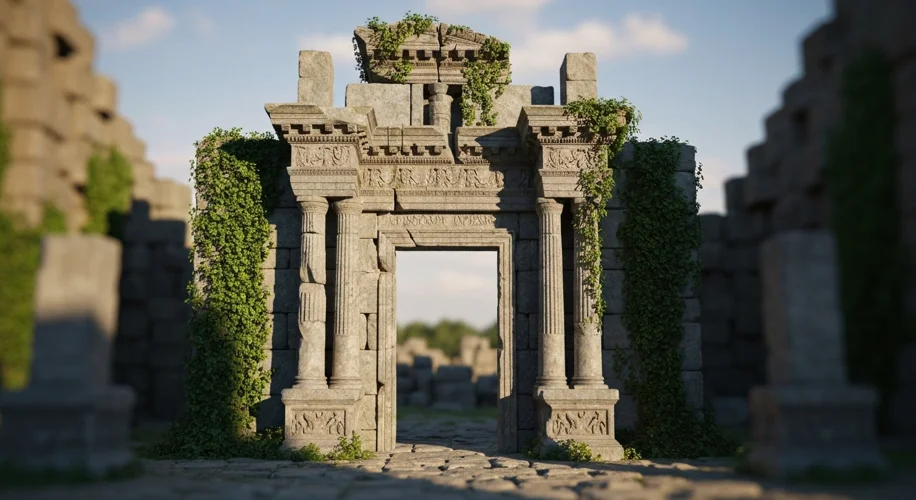
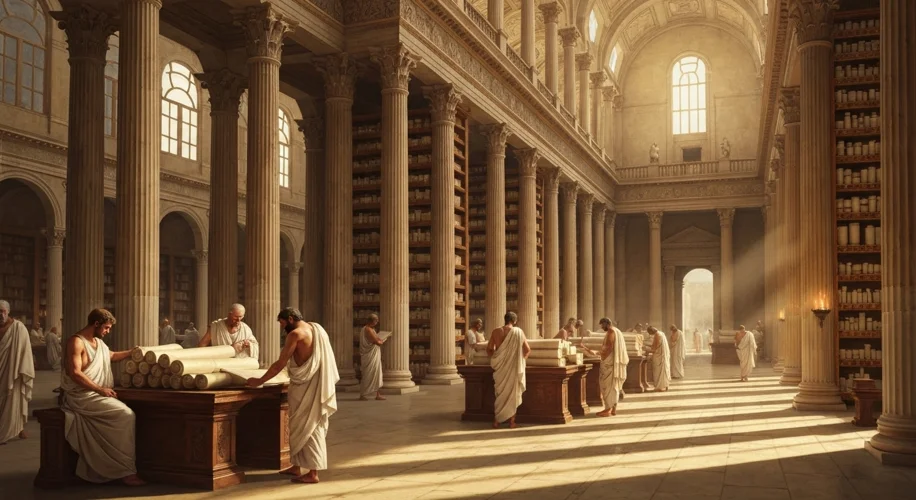
Visualize this: the year is 283 BCE. Alexandria, Egypt, a bustling metropolis under the Ptolemaic dynasty, is about to witness the birth of a legend – the Great Library of Alexandria. More than just a repository of scrolls, it was a vibrant intellectual hub, a testament to humanity’s insatiable thirst for knowledge.
Founded by Ptolemy I Soter, a general under Alexander the Great, and flourishing under his son Ptolemy II Philadelphus, the Library was an audacious project. The vision was grand: to collect all the world’s knowledge. Scholars, mathematicians, astronomers, poets, and philosophers flocked to Alexandria, drawn by the promise of unparalleled resources and a stimulating environment. The city itself was a melting pot of cultures, with Greek, Egyptian, Jewish, and other influences mingling, creating a fertile ground for intellectual exchange.
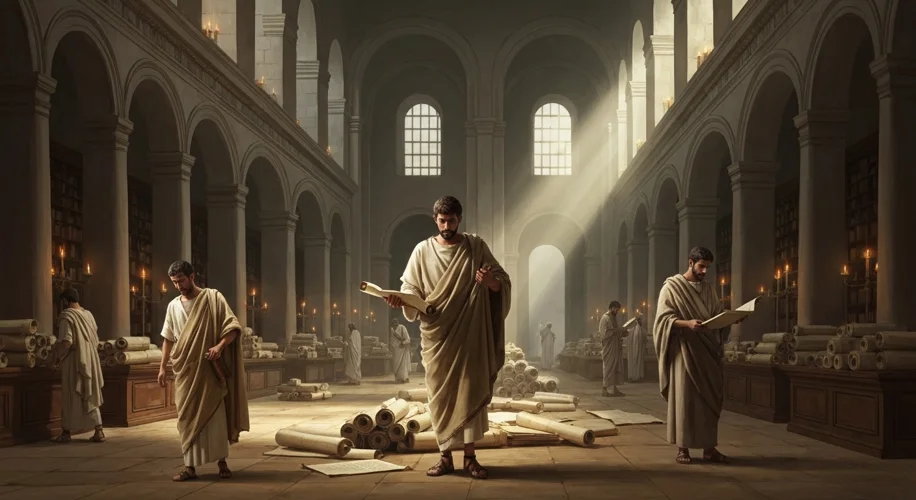
The Library’s collection was staggering. It’s estimated to have housed anywhere from 40,000 to 400,000 scrolls, possibly even more. Imagine the scene: rows upon rows of papyrus, meticulously cataloged, containing the wisdom of ages. The Ptolemies employed a rigorous acquisition policy. Ships docking in Alexandria had their scrolls confiscated, copied by scribes, and the originals kept for the Library, with the copies returned to the owners. Even the famous works of Homer were sought out, with claims that the Library possessed original manuscripts.
Among the luminaries who graced its halls were figures like Euclid, the father of geometry, who taught there; Eratosthenes, who calculated the circumference of the Earth with remarkable accuracy; and Aristarchus of Samos, who proposed a heliocentric model of the solar system centuries before Copernicus. These scholars didn’t just read; they debated, they experimented, they translated, and they created. The Library was also home to the Mouseion, a research institution akin to a modern university, complete with lecture halls, laboratories, and observatories.
The eventual decline and destruction of the Library is a subject of much historical debate, shrouded in a mix of fact and legend. While often blamed on a single catastrophic event, the reality is likely a more gradual process involving multiple incidents.
One prominent theory points to Julius Caesar’s fire in 48 BCE during his involvement in Egyptian civil wars. While Caesar did set fire to ships in the harbor, whether this fire spread and significantly damaged the main Library or its warehouses is uncertain. Some accounts suggest a substantial loss, while others claim the damage was minimal or confined to a portion of the collection.
Later events also contributed to its decline. The decrees of Theodosius I in the late 4th century CE led to the suppression of paganism, and some scholars believe this may have impacted the Library’s pagan traditions and perhaps even led to the destruction of certain texts deemed heretical or pagan.
The final blow is often attributed to the Muslim conquest of Alexandria in 642 CE. A widely circulated story, though considered apocryphal by many modern historians, claims that Caliph Omar ordered the destruction of the books, stating that if they agreed with the Quran, they were unnecessary, and if they disagreed, they were heretical. This narrative, appearing centuries after the event, is generally dismissed as propaganda.
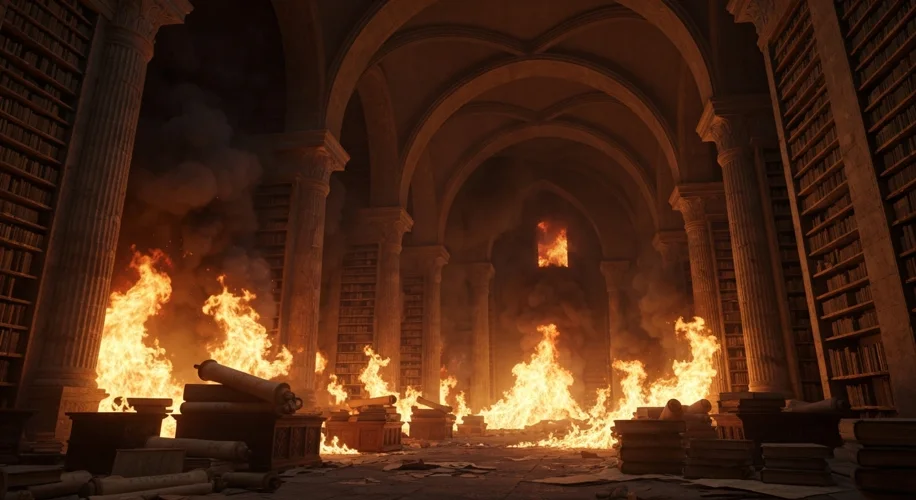
The loss of the Library of Alexandria represents an incalculable tragedy for humanity. Imagine the scientific treatises, the philosophical arguments, the lost plays, and the historical records that vanished forever. It is a stark reminder of the fragility of knowledge and the vulnerability of cultural heritage to conflict, neglect, and ideological extremism. The echoes of its destruction resonate even today, urging us to protect and preserve the intellectual treasures we possess.
Why does the story of the Library of Alexandria continue to captivate us? Perhaps it is the sheer scale of its ambition – to gather all the world’s learning. Perhaps it is the romance of a lost golden age of scholarship. Or perhaps it serves as a cautionary tale, a poignant reminder that even the most magnificent structures of human intellect can be reduced to ashes, leaving us to ponder what profound insights were lost to the silent whispers of time.