
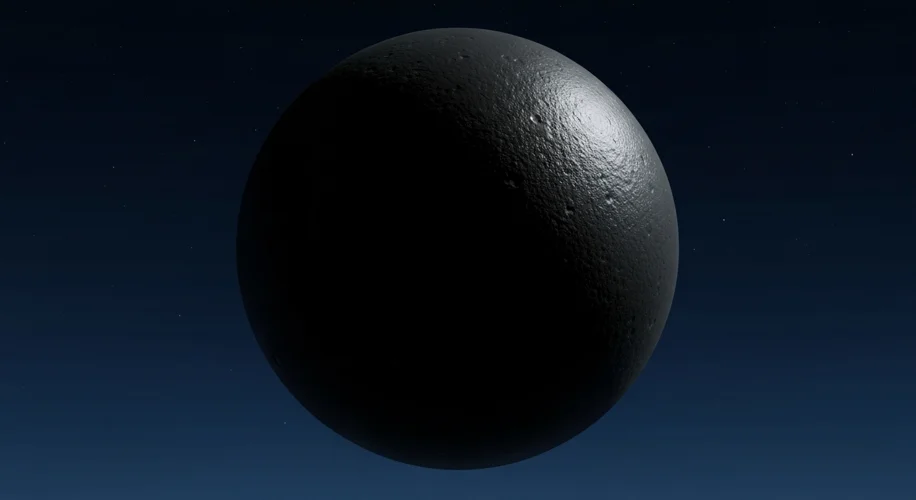
The vast, inscrutable depths of the Pacific Ocean have always held a certain mystique, a frontier teeming with unknown life and echoing with the silence of millennia. On a recent expedition, a team of marine biologists aboard the research vessel Odyssey stumbled upon a discovery that has sent ripples of excitement and speculation through the scientific community. Nearly 20,000 feet below the surface, in a region previously thought to be largely barren, they found them: clusters of enigmatic, perfectly spherical, jet-black orbs, unlike anything cataloged before.
Dubbed ‘obsidian spheres’ by the awestruck crew, these objects initially defied easy categorization. They were roughly the size of a grapefruit, with a texture that seemed to absorb all light, giving them an almost unreal, velvety appearance. “It was like looking into a tiny black hole,” described Dr. Aris Thorne, the lead biologist on the expedition. “There was an immediate sense of profound antiquity about them, as if they had been waiting in the darkness for eons.”
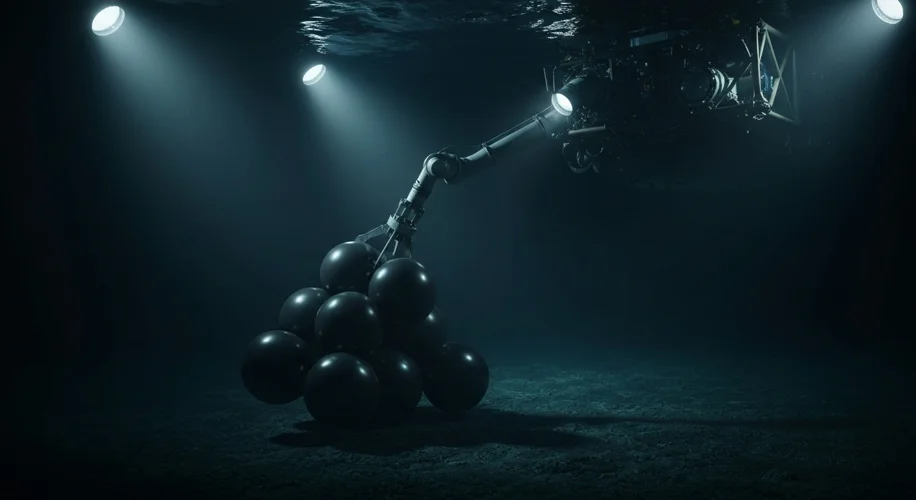
The initial challenge was simply to retrieve them. The immense pressure at such depths would typically crush any delicate sample, but these spheres proved remarkably resilient. Advanced submersible drones, equipped with specialized collection arms, carefully extracted several specimens. Back on the Odyssey, under the sterile glow of the onboard laboratory, the real work began.
Initial analysis of the spheres’ composition yielded perplexing results. They weren’t biological in the conventional sense, nor were they simple geological formations. Instead, they appeared to be a complex, highly organized matrix of organic compounds, interwoven with trace elements that suggested an origin far beyond typical deep-sea extremophiles. “The structure was almost crystalline, but with a biological underpinning,” explained Dr. Lena Hanson, the expedition’s geochemist. “We’ve never seen anything like it. It suggests a form of life, or perhaps a biological process, that operates under conditions we can barely comprehend.”
The true shock, however, came when the team managed to extract a viable sample from within one of the spheres. Using a specially designed micro-drill, they penetrated the impenetrable shell. What they found inside wasn’t genetic material as we understand it, but an astonishingly dense, intricately structured energy field. This field, when analyzed, began to emit a complex series of low-frequency radio waves – a form of communication.
But this wasn’t just random noise. The patterns were deliberate, structured, and astonishingly, they began to resolve into what appeared to be a form of data. Decryption proved to be an immense undertaking, requiring the Odyssey‘s advanced computing resources and drawing on algorithms developed for deciphering deep-space signals. What the data revealed has fundamentally challenged humanity’s understanding of life and intelligence in the universe.
According to the decoded transmissions, these ‘black eggs’ are not eggs at all, but dormant bio-computers, meticulously crafted by an ancient, long-vanished civilization. This civilization, referred to in the data as the ‘Stellarians,’ existed billions of years ago, predating even the formation of our solar system in its current configuration. They were a species that had transcended their physical forms, dedicating themselves to cataloging and preserving the universe’s nascent life and knowledge.
These spheres, scattered across the deep oceans of countless worlds, are repositories of their findings. The specific data recovered from the Pacific spheres contains detailed cosmological observations, the evolutionary pathways of numerous extinct species from galaxies long gone, and perhaps most profoundly, a complex philosophical treatise on the nature of consciousness and the interconnectedness of all matter. The Stellarians foresaw their own inevitable decline but ensured that their legacy – the accumulated wisdom of ages – would endure.
The implications of this discovery are staggering. It suggests that life, and indeed advanced intelligence, is not a unique terrestrial phenomenon, but a cosmic constant. It implies that we are not the first, nor likely the last, intelligent species to ponder the universe’s mysteries. The black eggs are, in essence, a message in a bottle from a civilization that sailed the cosmic seas long before Earth even had an ocean.
Dr. Thorne and his team are now meticulously analyzing the remaining data, a task expected to take years. The discovery has already sparked intense debate about the nature of artificial versus biological intelligence, the possibility of extraterrestrial contact, and the ethical considerations of interacting with such ancient and profound artifacts. The deep Pacific, once thought of as a silent void, has now become a library of cosmic history, and humanity has just turned the first, earth-shattering page.