
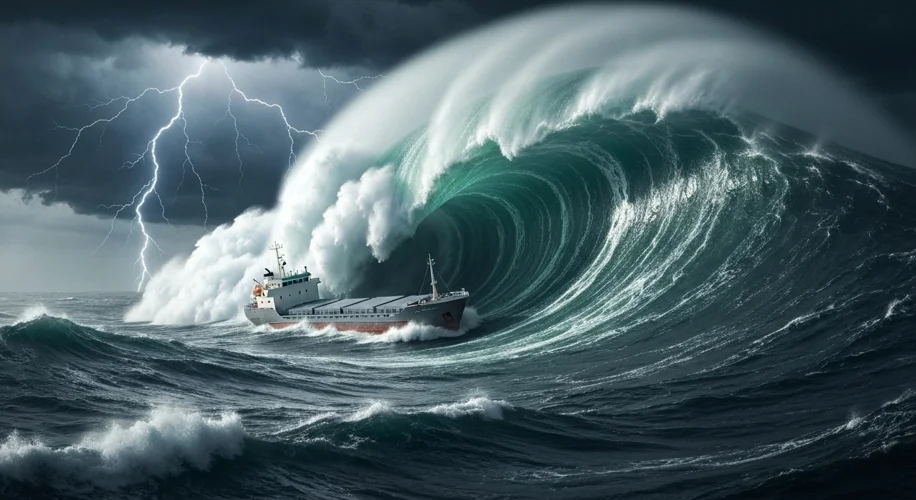
The ocean, a vast expanse of mystery and power, has always held a certain awe for humanity. For centuries, sailors and seafarers have spun tales of monstrous waves, walls of water that rise from the seemingly calm sea, dwarfing even the mightiest ships and disappearing as quickly as they arrived. These are the rogue waves, the maritime boogeymen, the stuff of legend and the harbinger of disaster. For too long, their very existence was met with skepticism, relegated to the realm of folklore and exaggeration.
But the ocean does not lie, and neither do the shattered remnants of ships that have met these watery giants. The evidence was undeniable: the SS Edmund Fitzgerald, lost on Lake Superior in 1975; the MS München, vanishing without a trace in the Atlantic in 1978; and the USS Ramage, a modern warship, reportedly hit by a 60-foot wave in 2010. These incidents, and countless others, painted a grim picture of an ocean capable of unleashing truly terrifying, and seemingly impossible, forces.
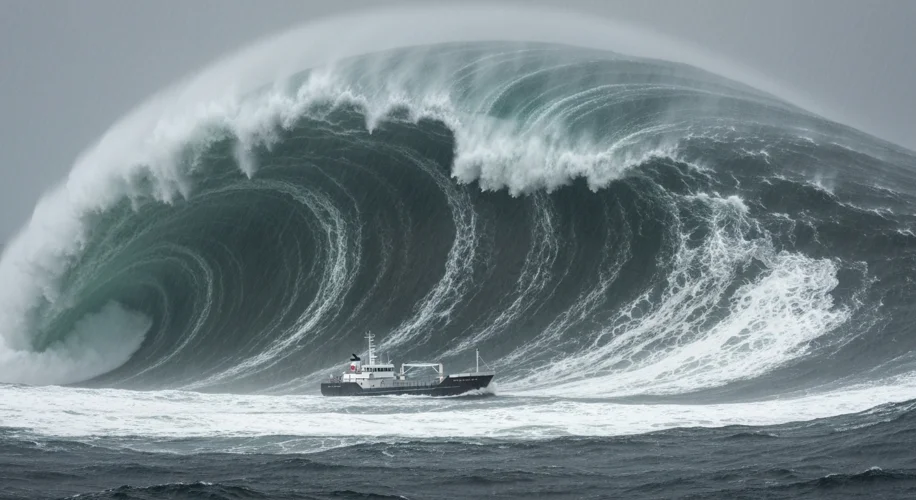
The scientific community, initially hesitant to embrace the idea of waves so far beyond the norm, began to pay attention. Early attempts to explain these phenomena often attributed them to freak combinations of smaller waves, a “wave-in-wave” scenario. However, this explanation, while plausible in some instances, didn’t quite capture the sheer, unadulterated power and unexpected nature of the true rogue waves. They were not just large; they were anomalies, defying the statistical models that predicted wave behavior.
The turning point began to emerge in the late 20th century with the development of more sophisticated oceanographic instruments and a deeper understanding of fluid dynamics. Researchers started to look beyond simple wave interactions and delve into more complex theories. One of the leading explanations that gained traction is known as the “breather theory.” This theory, rooted in advanced mathematical models, suggests that certain conditions in the ocean can lead to the spontaneous formation of these colossal waves. It’s akin to a cascade effect, where energy from smaller waves can, under specific circumstances, converge and amplify into a single, monstrous entity.
Think of it like a crowd at a stadium. If everyone claps at random, it’s just noise. But if people start clapping in unison, the sound amplifies dramatically. In the ocean, the “clapping” is the interaction of wave patterns. When these patterns align in a very specific, albeit rare, way, they can create a phenomenon where wave energy concentrates, leading to the formation of a rogue wave. This process, described by complex non-linear equations, can generate waves that are more than twice the height of the surrounding waves – a truly extraordinary event.
The advent of digital oceanographic sensors and satellite technology in recent decades has provided an unprecedented amount of data. For the first time, scientists could observe and measure these waves directly, not just rely on anecdotal accounts. Projects like the MaxWave study, a European effort launched in the early 2000s, used satellite altimeter data to identify and analyze hundreds of large, individual waves. The findings were stark: rogue waves were not as rare as once thought, occurring far more frequently than statistical models predicted, and posing a significant threat to maritime safety.
This breakthrough has profound implications. For the shipping industry, it means better understanding of risks and potentially the design of more resilient vessels. For offshore engineering, it aids in the construction of more robust platforms and structures. For meteorology, it refines our understanding of ocean dynamics and their impact on global weather patterns.
The quest to understand rogue waves is a testament to humanity’s enduring curiosity and our drive to unravel the mysteries of the natural world. It’s a story that began with the hushed whispers of terrified sailors and has culminated in the rigorous analysis of complex data, revealing a hidden force of nature that, while still awe-inspiring, is no longer entirely a mystery. The ocean still holds its secrets, but today, we understand a little more about its most formidable giants.