
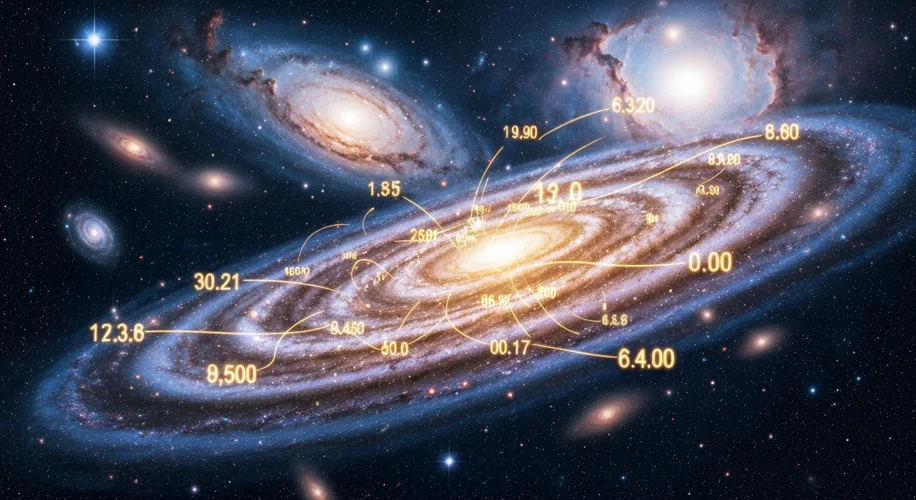
Imagine the universe as a vast, intricate clockwork. Every gear, every spring, every tiny cog must be in precisely the right place for it to function. Now, imagine that the very constants governing the universe – the strength of gravity, the charge of an electron, the mass of a proton – are like those precisely calibrated parts. If even one of them were infinitesimally different, the universe as we know it, and consequently, life itself, could never have arisen. This is the essence of the fine-tuning argument, a concept that has recently been reignited by new studies suggesting that the probability of life emerging through purely random chance is astronomically, almost impossibly, small.
For decades, scientists have grappled with the question of abiogenesis – the process by which life arose from non-living matter. It’s a puzzle that involves a dizzying array of chemical reactions, energy sources, and specific environmental conditions. The sheer complexity of even the simplest single-celled organism, with its intricate DNA, energy-producing mitochondria, and protective cell membrane, seems to defy a purely accidental origin. Think of trying to assemble a fully functional smartphone by randomly shaking a box of components. The odds are so minuscule, they barely register.
This inherent improbability has led some to question established theories. The universe’s apparent predisposition towards life, often referred to as the “fine-tuning” of physical constants, suggests that our existence might be less a product of sheer luck and more a consequence of a deliberate design or a fundamental principle we have yet to fully grasp. Consider the cosmological constant, a force that dictates the expansion of the universe. If it were even slightly larger, the universe would have expanded too quickly for stars and galaxies to form. If it were smaller, the universe would have collapsed back on itself. The value we observe sits in an incredibly narrow window, a cosmic “Goldilocks zone” that allows for the development of complex structures.
Even the emergence of life at a molecular level presents similar statistical hurdles. The spontaneous formation of a self-replicating molecule, like RNA, requires a precise sequence of amino acids and a stable environment. The chances of this happening randomly in a primordial soup are often compared to a hurricane passing through a junkyard and assembling a Boeing 747. While this analogy is illustrative, it captures the staggering improbability involved.
This isn’t a new debate. Philosophers and scientists have pondered the “anthropic principle” for years. The weak anthropic principle suggests that we observe the universe to be the way it is because only in such a universe could observers exist. The strong anthropic principle, however, posits that the universe must have properties that allow life to develop within it at some stage in its history. Recent computational studies, employing advanced probability models, are now providing more robust quantitative evidence to these long-held ideas. These studies, often employing Monte Carlo simulations and complex algorithms, are attempting to map out the vast parameter space of possible universes and calculating the likelihood of life-permitting conditions arising.
The implications of these findings are profound. If the mathematical probability of life arising spontaneously is indeed vanishingly small, it forces us to re-examine our understanding of the cosmos and our place within it. It could suggest that our universe is not a solitary accident, but perhaps one of many within a larger multiverse, where a vast array of possibilities exist, and we simply happen to inhabit one where life is possible. Or, it might lend credence to the idea of an intelligent designer, a creator who fine-tuned the universe specifically for life.
However, it’s crucial to approach these conclusions with scientific rigor. Critics argue that we may not yet possess all the necessary information to make such definitive statements. Perhaps our understanding of abiogenesis is incomplete, or there are undiscovered principles at play that make the emergence of life more probable than we currently calculate. The history of science is replete with examples of phenomena that once seemed miraculous but were later explained by natural laws.
Furthermore, the very act of observing the universe is influenced by our existence within it. We are inherently biased towards universes that can support us. The scientific community continues to explore these questions, pushing the boundaries of our knowledge in cosmology, chemistry, and biology. While the numbers may suggest an almost impossible feat, the undeniable reality of life’s existence is a testament to the universe’s enduring mysteries, pushing us to continue seeking answers, even if the math initially seems to say “no.”