
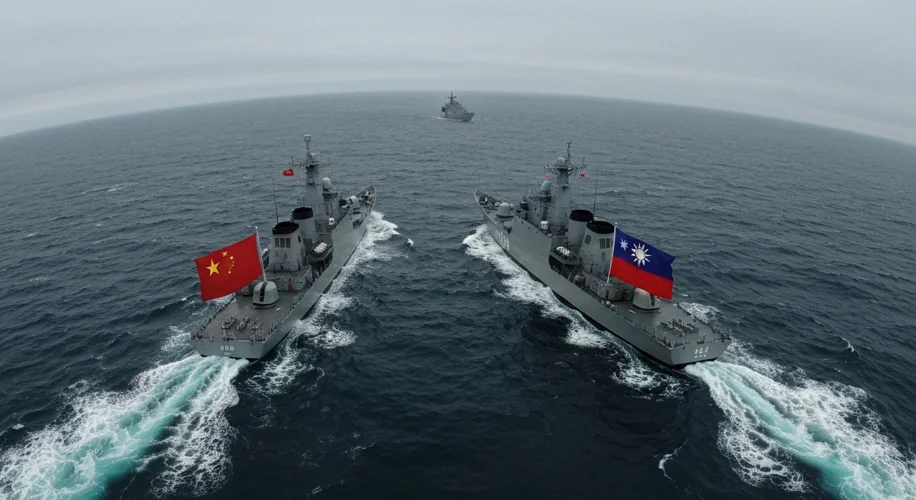
The Taiwan Strait, a narrow body of water separating mainland China from the island of Taiwan, has long been a geopolitical flashpoint. For decades, the specter of conflict has loomed, a persistent echo of historical division and competing national aspirations. In recent times, this tension has been amplified, culminating in what many observers have termed the Third Taiwan Strait Crisis. This isn’t just about abstract political theories; it’s about the lived experiences of millions, the complex historical currents that have shaped two distinct societies, and the ever-present danger of miscalculation.
The roots of this crisis stretch back to the Chinese Civil War, a brutal conflict that concluded in 1949 with the Communist Party of China (CPC) establishing the People’s Republic of China (PRC) on the mainland, while the defeated Nationalist Kuomintang (KMT) government retreated to the island of Taiwan. From that moment, two governments, each claiming to be the legitimate ruler of all of China, existed in a state of uneasy separation. For the PRC, Taiwan is an inalienable part of its territory, a province that must be reunified, by force if necessary. For Taiwan, officially the Republic of China (ROC), it is a self-governing democracy with its own distinct identity, a stark contrast to the mainland’s authoritarian rule.
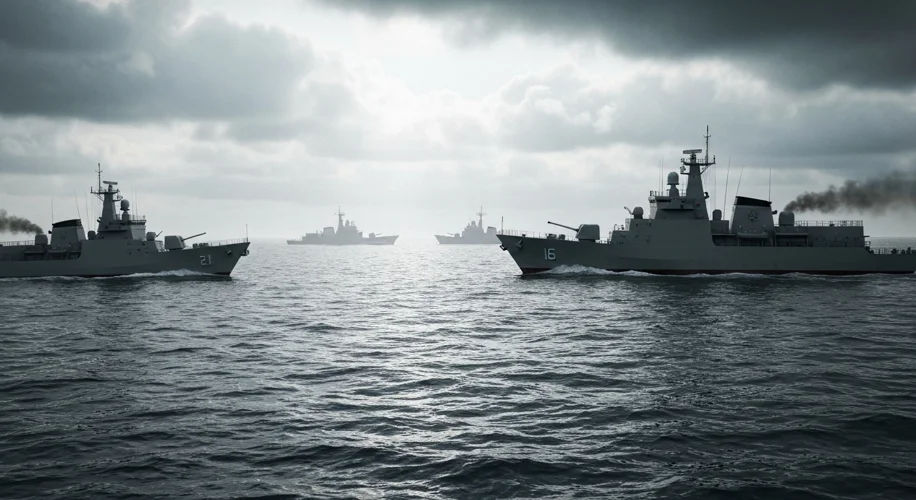
The ‘One China’ principle, a cornerstone of Beijing’s diplomatic stance, asserts that there is only one sovereign state under the name China, and that the PRC is its sole legitimate government. Taiwan, however, interprets this principle differently, often viewing it as a rhetorical tool used by Beijing to assert its claims without acknowledging Taiwan’s de facto independence. This fundamental disagreement forms the bedrock of the cross-strait conundrum.
The key actors in this unfolding drama are, of course, Beijing and Taipei. The leadership in the PRC, under President Xi Jinping, has increasingly vocalized its determination to achieve reunification, viewing it as a critical component of the “great rejuvenation of the Chinese nation.” This ambition is often coupled with assertive military displays and diplomatic pressure aimed at isolating Taiwan on the international stage. On the other side, Taiwan’s government, currently led by President Tsai Ing-wen and her Democratic Progressive Party (DPP), champions a distinctly Taiwanese identity and has sought to bolster the island’s defenses and international partnerships, particularly with the United States.
The ‘Third Taiwan Strait Crisis’ is not a single, isolated event, but rather a period of heightened tension characterized by escalating military exercises, incursions into Taiwan’s Air Defense Identification Zone (ADIZ), and increasingly aggressive rhetoric. While previous crises in 1954-55 and 1995-96 involved direct military confrontations and the threat of invasion, this most recent escalation (as of late 2025) has seen a more sustained and multifaceted approach from Beijing. This includes large-scale naval and air force drills simulating blockades and amphibious assaults, cyber warfare operations, and economic coercion.
The impact of such a crisis is profound and far-reaching. For the people of Taiwan, it means living under the constant shadow of potential conflict, a situation that affects their daily lives, their economy, and their sense of security. For the global community, particularly the United States, which has a long-standing, though strategically ambiguous, commitment to Taiwan’s defense, it poses a severe threat to regional stability and global trade. Taiwan is a critical hub in the global semiconductor industry, and any disruption would have catastrophic economic consequences worldwide.
The analysis of this crisis is complex. Is Beijing genuinely preparing for an imminent invasion, or is this a sophisticated strategy of intimidation and signaling? Are the military exercises designed to probe Taiwanese and US responses, or are they a prelude to decisive action? Perspectives vary wildly. Some analysts believe that China’s growing military might and economic influence make a forceful reunification increasingly feasible, while others argue that the economic and human costs of such an endeavor, coupled with potential US intervention, make a full-scale invasion a highly risky proposition.
What is undeniable is that the Third Taiwan Strait Crisis represents a critical juncture in international relations. The stakes are immense, and the potential for escalation is ever-present. The historical narrative of division, the ‘One China’ principle, and the competing aspirations of Beijing and Taipei have converged to create a powder keg. The world watches, holding its breath, as the delicate balance of power in the Indo-Pacific teeters on the edge.
Tags: Taiwan Strait Crisis, China-Taiwan Relations, Geopolitics, Military Tension