

The year is 1812. A chill, not of winter but of dread, grips the vast plains of Eastern Europe. Across the continent, the shadow of Napoleon Bonaparte, the “Little Corporal” turned Emperor, looms large. His Grande Armée, a mosaic of nations forged in the fires of revolution and conquest, stands poised to march into the heart of Russia, a land as unforgiving as it is immense.
The Napoleonic Wars (1803-1815) were more than just a series of battles; they were a continental earthquake that sent seismic waves of change across Eastern Europe. For centuries, this region had been a complex tapestry of empires, kingdoms, and principalities, often caught between the ambitions of larger powers. The arrival of Napoleon, with his revolutionary ideals of nationhood and his insatiable appetite for expansion, ripped apart this delicate balance.
Before Napoleon, the political map of Eastern Europe was a fragmented landscape. The vast Russian Empire, under Tsar Alexander I, stretched its influence westward. The Polish-Lithuanian Commonwealth, once a dominant force, had been brutally partitioned by Russia, Prussia, and Austria in the late 18th century, leaving a nation without a state, its people yearning for revival. The German states were a patchwork of principalities, many under the nominal suzerainty of the Holy Roman Empire, which Napoleon would soon dissolve. The Ottoman Empire, though in decline, still held sway over parts of the Balkans.
Napoleon, a master of political and military strategy, understood the power of national identity. He resurrected the Duchy of Warsaw in 1807, a puppet state that offered a glimmer of hope to Poles dreaming of a restored nation. This move not only served as a strategic buffer against Russia but also galvanized Polish support for his cause. Thousands of Polish soldiers, eager to reclaim their lost homeland, swelled the ranks of his Grande Armée.
The invasion of Russia in 1812 was Napoleon’s ultimate gamble. Driven by a complex mix of ambition, a desire to force Tsar Alexander I back into the Continental System (his economic blockade against Britain), and perhaps a touch of hubris, Napoleon led over 600,000 soldiers – the largest army Europe had ever seen – into the Russian wilderness. This colossal force was a testament to Napoleon’s ability to mobilize diverse peoples, but it also sowed the seeds of its own destruction. The army was a melting pot of French, Italian, German, Polish, and other nationalities, their loyalties often divided, their understanding of the war’s objectives varied.
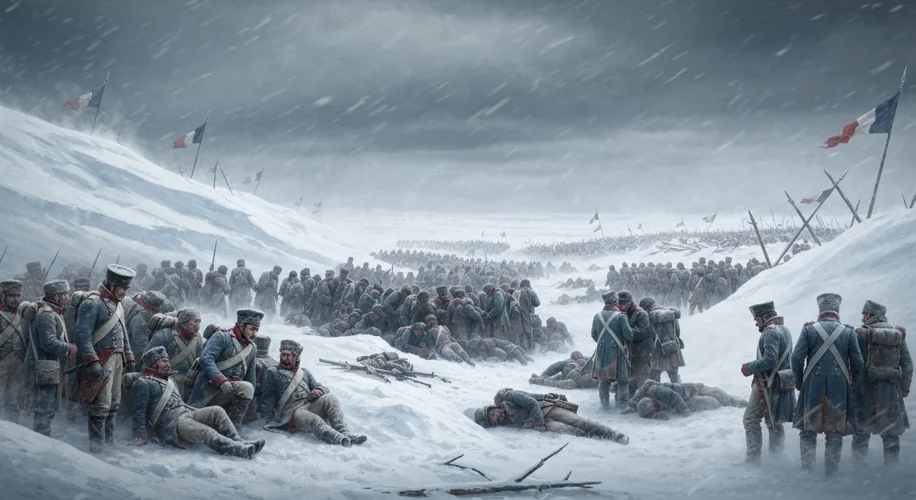
The initial campaign was a brutal dance of maneuver and scorched earth. The Russians, under the command of Mikhail Kutuzov, refused a decisive battle, instead retreating deeper into their territory, burning crops and villages as they went – a tactic that denied the invaders much-needed supplies.
The capture of Moscow in September 1812 was a Pyrrhic victory. The city, largely abandoned and then set ablaze, offered no respite. Napoleon’s army, depleted by disease, desertion, and the relentless Russian summer that gave way to an early, brutal winter, was trapped. The retreat from Moscow, beginning in October, became a legendary disaster. The Grande Armée, reduced to a ragged, starving mob, was harried by Cossacks and frozen by the unforgiving Russian winter. Less than 100,000 soldiers would survive the ordeal, a catastrophic loss that fatally weakened Napoleon’s hold on Europe.
The impact of Napoleon’s campaigns on Eastern Europe was profound and lasting. The partitions of Poland were effectively dissolved, leading to a surge in Polish nationalism and a persistent desire for statehood that would simmer for over a century.
The dissolution of the Holy Roman Empire in 1806, orchestrated by Napoleon, paved the way for the eventual unification of Germany. While Napoleon’s direct influence waned, the seeds of a unified German state were sown in the administrative and legal reforms he imposed on many of the German principalities. The Confederation of the Rhine, a French client state, served as a precursor to a more unified German entity.
The Napoleonic Wars also led to significant territorial shifts. Parts of the former Polish-Lithuanian Commonwealth were incorporated into the newly formed Kingdom of Italy and the Kingdom of Westphalia, further redrawing the political map. The balance of power in Europe was irrevocably altered, with France ascendant for a time, only to be eventually defeated by a coalition of powers, including Russia, Britain, Prussia, and Austria.
The Congress of Vienna in 1815, convened to restore order after Napoleon’s final defeat, attempted to re-establish the old order. However, the ideas of nationalism and liberalism unleashed by the French Revolution, and amplified by Napoleon’s conquests, could not be entirely suppressed. Eastern Europe, in particular, would continue to be a region of simmering nationalistic aspirations and strategic competition for decades to come.
Napoleon’s campaigns, especially the disastrous Russian invasion, served as a stark reminder of the limits of imperial ambition. They highlighted the critical role of logistics, the power of national resistance, and the unforgiving nature of geography. The wars left a legacy of redrawn borders, awakened nationalisms, and a profound shift in the European balance of power, setting the stage for future conflicts and the eventual emergence of new nation-states in the East.