
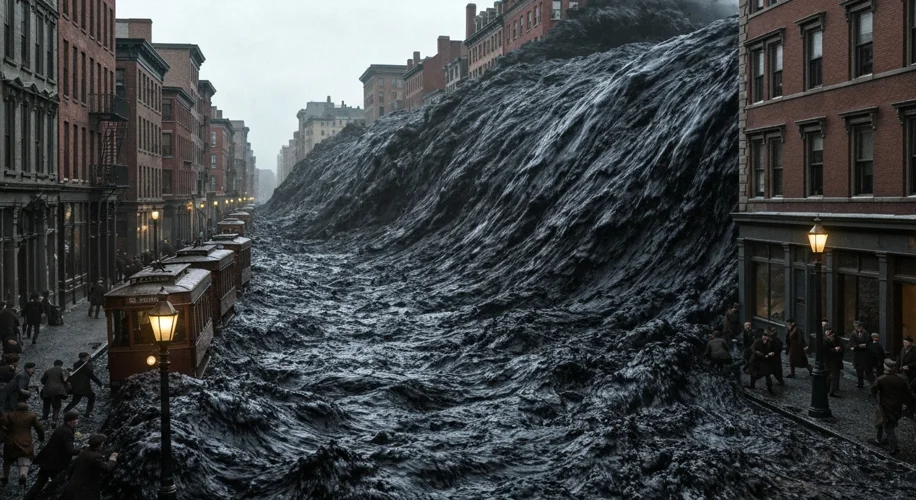
The air in Boston’s North End on January 15, 1919, was crisp and cold, carrying the usual briny scent of the harbor and the distant clang of industry. But as the afternoon wore on, a low rumbling began, a sound that quickly escalated into a terrifying roar. It wasn’t thunder, nor was it an approaching train. It was the sound of a colossal, 50-foot-high wave of molasses, moving at an estimated 35 miles per hour, engulfing everything in its path.

This was no act of nature, but a man-made catastrophe of sticky, dark proportions. The Purity Distilling Company, a subsidiary of United States Industrial Alcohol (USIA), had constructed an enormous steel tank, 50 feet tall and 90 feet in diameter, capable of holding over two million gallons of molasses. It sat conspicuously on the waterfront, a symbol of industrial might and the sweet, syrupy byproduct of the era’s booming rum production. For months, this tank had been a source of annoyance for locals. They reported groaning sounds, visible leaks, and the unsettling sight of the metal straining under the immense pressure. Some even claimed to have caught molasses in buckets from the leaks to sweeten their desserts. But their pleas for inspection and repair were largely ignored by a company more concerned with profit than public safety.
The tank was filled just days before the disaster, likely overloaded, to meet the demands of war-time production. The unusually warm temperatures that January day, a stark contrast to the usual winter chill, likely increased the pressure within the tank as the molasses expanded. Then, with a deafening bang, the tank burst.
The wave that followed was a monstrous, viscous tide. It smashed into buildings, crushing them or sweeping them off their foundations. Horses were drowned, people were engulfed, and the sheer weight and stickiness of the molasses made escape nearly impossible. Survivors described a suffocating, suffocating embrace, the sweet smell turning into a gagging horror as they struggled for air. Rescuers faced a nightmarish scene, wading through knee-deep, and in some places, chest-deep, molasses, trying to pull victims from the suffocating sludge. The sticky substance clung to everything, making it difficult to move, breathe, or even see.
In total, 21 people lost their lives, and an estimated 150 were injured. The aftermath was a grim testament to the disaster. For weeks, the North End was a sticky, brown mess. Firefighters, soldiers, and civilians worked tirelessly, using hoses and buckets to wash away the molasses, but the sweet, cloying odor lingered for months, a constant, nauseating reminder of the tragedy.
The Purity Distilling Company and USIA initially tried to blame the disaster on anarchists, a common scapegoat in the post-WWI era. However, a lengthy and public court case, one of the first class-action lawsuits in Massachusetts, revealed the company’s negligence. Evidence showed that the tank had been poorly constructed, inadequately tested, and that the company had ignored numerous warnings about its structural integrity. The company was eventually fined $600,000 (a substantial sum at the time), which was used to compensate victims and their families. The Great Molasses Flood became a stark symbol of industrial irresponsibility and the human cost of prioritizing profit over safety. It led to stricter building codes and regulations for hazardous materials, a sticky, but vital, lesson learned in the annals of industrial history.