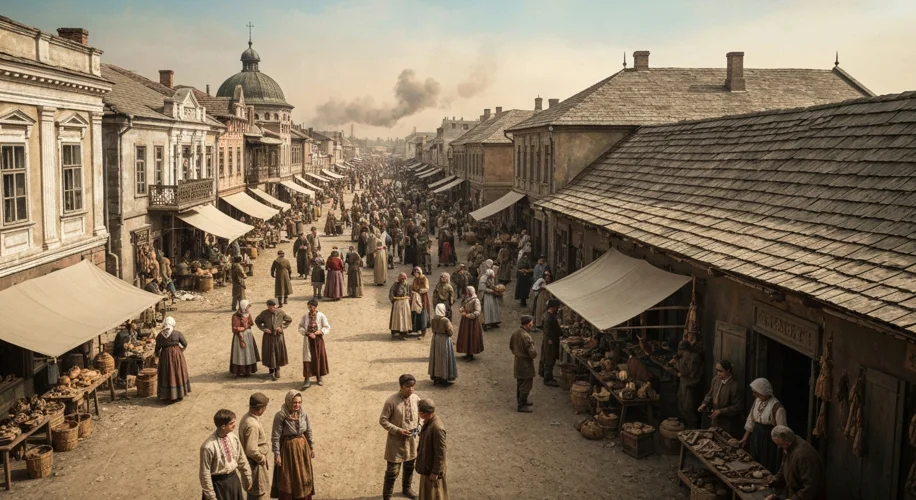
The year is 1917. The colossal edifice of the Russian Empire, a sprawling behemoth that had endured for centuries, began to crumble. Beneath the weight of a devastating world war, internal dissent, and the crushing poverty of its masses, revolution was not just a whisper, but a thunderous roar. In the heart of this maelstrom, on the fertile plains of Ukraine, a centuries-old yearning for self-determination began to stir with renewed vigor.
For generations, Ukraine had been a land caught between powerful empires, most notably the Russian and Austro-Hungarian Empires. Its cultural identity, rich with Cossack traditions, vibrant folk art, and a distinct language, had been systematically suppressed under Russian rule, a policy known as Russification. The Tsar’s regime viewed Ukraine not as a nation, but as ‘Little Russia,’ an integral part of the greater Russian entity. This suppression fueled a deep-seated resentment and a persistent dream of an independent future.
The February Revolution in Petrograd in 1917, which saw the abdication of Tsar Nicholas II, sent shockwaves across the empire. In Kyiv, the capital of Ukraine, a new national body, the Central Rada (Council), quickly emerged as a powerful voice. Initially seeking autonomy within a democratic Russia, the Rada, led by figures like Mykhailo Hrushevsky, a prominent historian, and Volodymyr Vynnychenko, a writer and political activist, began to assert Ukraine’s right to govern itself.
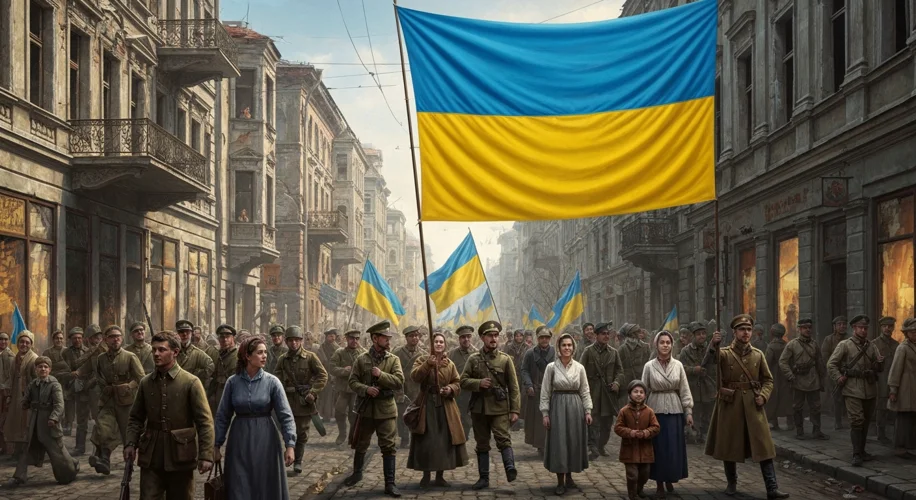
The Provisional Government in Russia, however, was too weak and preoccupied to grant Ukraine the full autonomy it desired. As the Bolsheviks, led by Vladimir Lenin, gained momentum, promising peace and land, the situation grew increasingly complex and volatile. The October Revolution in 1917, which brought the Bolsheviks to power, effectively shattered any hopes of Ukraine remaining within a unified Russian state under their control.
Facing the imminent threat of Bolshevik domination and the disintegration of central authority, the Central Rada took a monumental step. On January 22, 1918, it proclaimed the Ukrainian People’s Republic (UNR) as a sovereign and independent state. This declaration was a defiant cry for self-determination, a testament to the enduring Ukrainian spirit.
The UNR’s existence was, however, precarious. It was born into a maelstrom of conflicting forces. The Bolsheviks, intent on establishing Soviet power throughout the former empire, immediately declared war on the UNR. German and Austro-Hungarian forces, eager to capitalize on the chaos and secure their own interests, also intervened, eventually occupying much of Ukraine. The brief period of Ukrainian independence became a brutal tug-of-war between various factions: the Bolsheviks seeking to impose Soviet rule, the White Army loyalists aiming to restore a unified Russia, various nationalist groups, and the occupying Central Powers.
From 1918 to 1921, Ukraine became a brutal battleground. The UNR struggled to establish stable governance, facing internal divisions and constant external threats. Different governments rose and fell in Kyiv, each desperately trying to navigate the treacherous geopolitical landscape. The nascent Ukrainian army fought valiantly against overwhelming odds, but the dream of sustained independence proved elusive.
The Treaty of Brest-Litovsk in March 1918, signed between the Central Powers and Soviet Russia, formally recognized the UNR, but this was largely overshadowed by the subsequent German occupation. As World War I drew to a close and Germany withdrew, the Bolsheviks re-entered Ukraine, eventually establishing the Ukrainian Soviet Socialist Republic in 1922.
Despite the UNR’s short lifespan, its declaration of independence in 1918 was a pivotal moment. It was the first time in modern history that Ukraine had formally asserted its statehood on the international stage. This brief but intense struggle for independence forged a powerful narrative of national identity and resilience that would echo through the Soviet era and beyond.
The consequences of this period were profound. Ukraine, a land rich in resources and strategic importance, was forcibly incorporated into the Soviet Union. The Soviet regime, while granting Ukraine nominal statehood within the USSR, brutally suppressed any further attempts at genuine independence, culminating in the devastating Holodomor famine of the 1930s and subsequent waves of repression. Yet, the memory of the Ukrainian People’s Republic and its struggle for self-determination remained a potent symbol for generations of Ukrainians, a flicker of hope in the darkest of times, paving the way for the ultimate restoration of Ukrainian independence in 1991.
The Russian Revolution of 1917, a seismic event that reshaped the global order, inadvertently unleashed a powerful, albeit fleeting, wave of Ukrainian national aspiration. The struggle of the Ukrainian People’s Republic stands as a poignant reminder of the enduring human desire for freedom and the often brutal cost of achieving it, especially in the shadow of a dominant neighbor.