The year is 1917. Russia, a vast empire stretching across continents, is a tinderbox. Decades of autocratic rule, the brutal realities of World War I, and a gnawing hunger have pushed its people to the brink. Amidst this chaos, a seismic event is about to reshape not just Russia, but the entire globe: the Bolshevik Revolution, also known as the October Revolution.
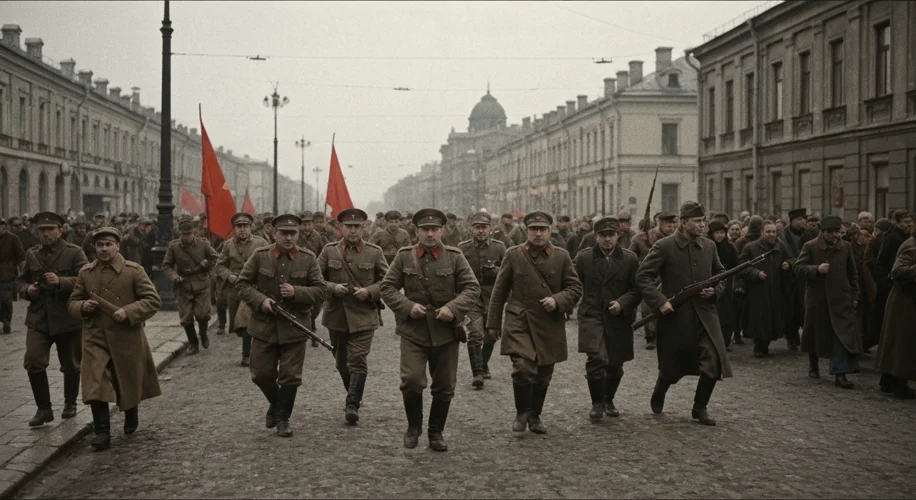
Imagine the scene in Petrograd (now St. Petersburg) in late October. The air crackles with a potent mix of desperation and revolutionary fervor. The Provisional Government, which had overthrown Tsar Nicholas II earlier that year, is teetering. It’s a government of well-meaning liberals and moderate socialists, but they’re paralyzed by indecision, unable to address the war or the widespread poverty. Meanwhile, the whispers of change are growing into a roar, amplified by a charismatic figure named Vladimir Lenin and his radical Bolshevik Party.
Lenin, an exiled lawyer with a steely resolve and a vision of a communist Russia, had returned to his homeland earlier in the year, famously smuggled back by the German government who hoped he would destabilize their enemy. His message was simple, yet electrifying: “Peace, Land, and Bread.” This resonated deeply with the war-weary soldiers, the land-starved peasants, and the hungry urban workers.
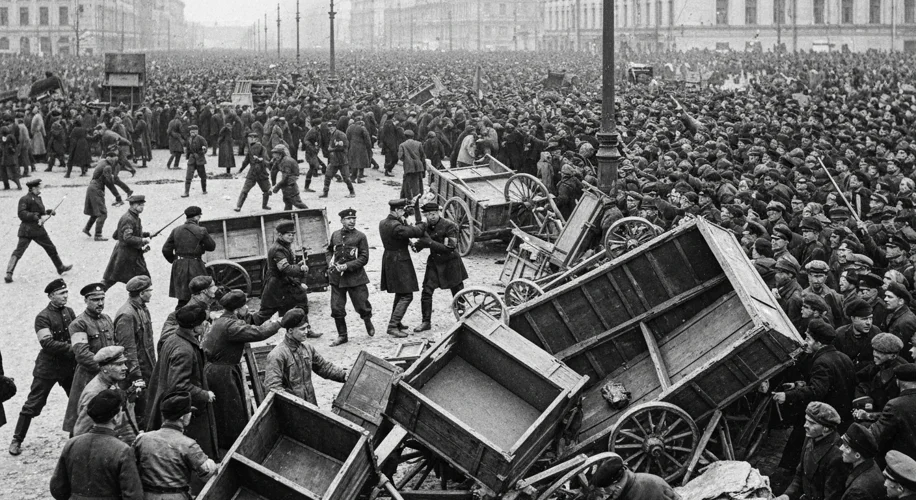
The Bolsheviks were not the majority party, but they were incredibly organized and strategically adept. They had successfully infiltrated the Soviets – workers’ and soldiers’ councils that had sprung up across the country and were gaining immense influence. Lenin, a master of revolutionary tactics, urged his followers to seize power decisively. He believed that the time was ripe for a socialist uprising, a proletarian revolution that would dismantle the old order and usher in a new era.
On the night of October 25th (November 7th by the Gregorian calendar, hence the ‘October Revolution’ name), the Bolsheviks, led by Leon Trotsky, initiated their move. Small detachments of Red Guards, sailors from the Baltic Fleet, and loyal soldiers began to occupy key points in Petrograd: the post offices, railway stations, bridges, and the State Bank. The Winter Palace, the seat of the Provisional Government, was surrounded.
The takeover was surprisingly swift and remarkably bloodless in its initial stages. The Provisional Government, lacking any real support or military backing, offered little resistance. By dawn, Petrograd was effectively under Bolshevik control. The Second All-Russian Congress of Soviets convened, and with the moderate delegates having walked out in protest, the Bolsheviks declared the transfer of power to the Soviets.
This wasn’t just a change of government; it was a radical reordering of society. The Bolsheviks immediately began to implement their agenda. Decrees on peace and land were issued, fulfilling Lenin’s promises. Russia withdrew from World War I, signing a punitive peace treaty with Germany that ceded vast territories. Land was redistributed from the aristocracy and the church to the peasants, though this was a complex and often violent process.
The immediate aftermath was far from peaceful. The revolution plunged Russia into a brutal civil war (1918-1922) between the Bolshevik ‘Reds’ and their diverse opponents, the ‘Whites,’ who were supported by foreign powers fearful of communism. This war, coupled with widespread famine and political repression, claimed millions of lives.
But the Bolshevik Revolution’s impact echoed far beyond Russia’s borders. It inspired communist movements worldwide, fundamentally altering the geopolitical landscape of the 20th century and setting the stage for the Cold War. The establishment of the Union of Soviet Socialist Republics (USSR) in 1922 created a new superpower, a model of communist governance that stood in stark opposition to the capitalist West.
The revolution’s legacy is complex and contested. It brought an end to centuries of Tsarist autocracy and initiated rapid industrialization and social change. However, it also ushered in an era of totalitarian rule, political purges, and immense human suffering under leaders like Stalin. The ideals of equality and liberation championed by the revolution often stood in stark contrast to the realities of its implementation.
In the end, the Bolshevik Revolution was not just an event; it was a cataclysmic force. It was a moment when a desperate people, fueled by radical ideas and visionary leaders, dared to tear down an old world and build a new one from its ashes. Its tremors are still felt today, a testament to its profound and enduring impact on the course of human history.