
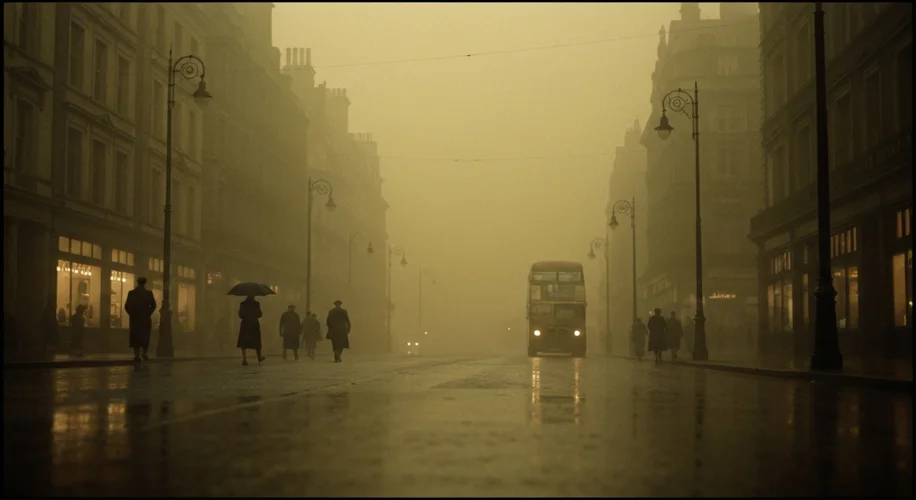
The year is 1952. London, a city pulsating with the post-war spirit of recovery and innovation, was about to face an enemy unlike any it had encountered before – an invisible, suffocating foe born from its very success.
For decades, Londoners had grown accustomed to a certain level of grimy air. The Industrial Revolution had irrevocably transformed the city’s skyline with towering chimneys, and domestic life relied heavily on coal for heating. The ubiquitous soot and smoke were almost a part of the city’s character, a visible sign of its bustling, productive heart. However, a perfect storm was brewing, one that would turn this familiar haze into a deadly, impenetrable shroud.
It began on Friday, December 5th, 1952. A period of unusually cold weather had descended upon the capital, prompting Londoners to stoke their fires with a fervor that would soon prove catastrophic. Simultaneously, an anticyclone, a vast dome of high atmospheric pressure, settled over the region. This meteorological phenomenon acted like a lid, trapping the cold air close to the ground and preventing any upward dispersal of pollutants. The wind, usually a city’s natural ally in clearing the air, was virtually absent.
As the day wore on, the familiar coal smoke from countless hearths, combined with emissions from factories and the city’s ever-increasing number of vehicles burning low-grade, sulfurous coal, began to accumulate. This wasn’t just ordinary smog; it was a toxic cocktail. Sulphur dioxide from the burning coal reacted with water vapor and other atmospheric chemicals, creating a thick, acrid fog laced with sulfuric acid. The smog descended, not as a gentle mist, but as a suffocating blanket, reducing visibility to mere yards, and in some places, to only a few feet.
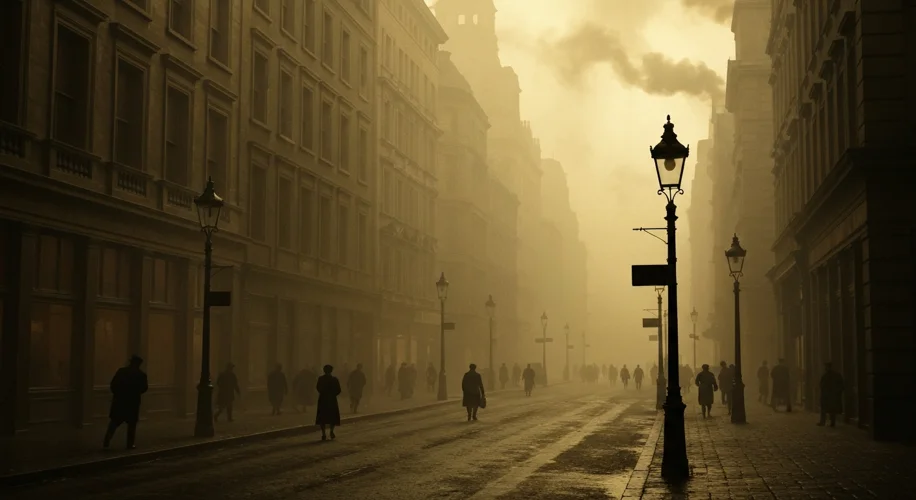
The city, so accustomed to its murky atmosphere, found itself utterly unprepared for the severity of this event. Public transport ground to a halt. Buses were unable to navigate the streets, and even within buildings, the air became thick and difficult to breathe. The smell was overpowering – a pungent, sulphurous stench that stung the eyes and throat. Many who ventured outdoors donned rudimentary masks, but these offered little protection against the insidious particles that permeated everything.
The true horror, however, lay unseen. The fine particulate matter and the acidic components of the smog wreaked havoc on the respiratory systems of London’s inhabitants. The initial death toll, estimated at around 4,000 in the five days of the smog, was just the beginning. In the weeks and months that followed, thousands more succumbed to respiratory illnesses, pneumonia, and bronchitis, their lungs irrevocably damaged by the toxic air. The elderly, the very young, and those with pre-existing respiratory conditions were particularly vulnerable.
Imagine the scene: a city shrouded in a perpetual twilight, the iconic landmarks of London obscured by an impenetrable yellow-brown haze. Gas lamps, normally a comforting beacon, cast weak, eerie glows that barely pierced the gloom. Sounds were muffled, and the omnipresent cough became the city’s grim soundtrack. Doctors and nurses worked tirelessly in hospitals, overwhelmed by the influx of patients struggling for every breath.
The Great Smog, as it came to be known, was not merely an environmental catastrophe; it was a profound societal shock. It forced a nation, and indeed the world, to confront the unintended consequences of industrial progress. The sheer scale of the death and suffering shattered the illusion that air pollution was simply an inconvenient byproduct of modernity.
The immediate aftermath saw a growing public outcry. The government, initially slow to react, was compelled to acknowledge the severity of the situation. Investigations were launched, and scientists began to piece together the complex chemical reactions that had created such a deadly phenomenon. It became clear that the reliance on low-grade, high-sulfur coal, combined with specific meteorological conditions, had created a perfect storm of pollution.
This tragedy, however grim, served as a powerful catalyst for change. The experience spurred the landmark Clean Air Act of 1956. This legislation introduced ‘smoke control areas’ where only smokeless fuels could be burned, and provided incentives for households to switch from coal fires to cleaner alternatives like gas and electricity. It also encouraged industries to adopt more stringent emission controls.
The Great Smog of London was a stark and tragic lesson. It demonstrated that the pursuit of progress, without due consideration for its environmental impact, could lead to devastating human costs. It was a pivotal moment that marked the beginning of a greater awareness of air pollution and the urgent need for environmental protection, a legacy that continues to shape our world today.
It serves as a potent reminder that even the most advanced societies can be brought to their knees by the very elements they seek to control, and that the air we breathe is a shared resource, a fragile inheritance we must diligently protect.