
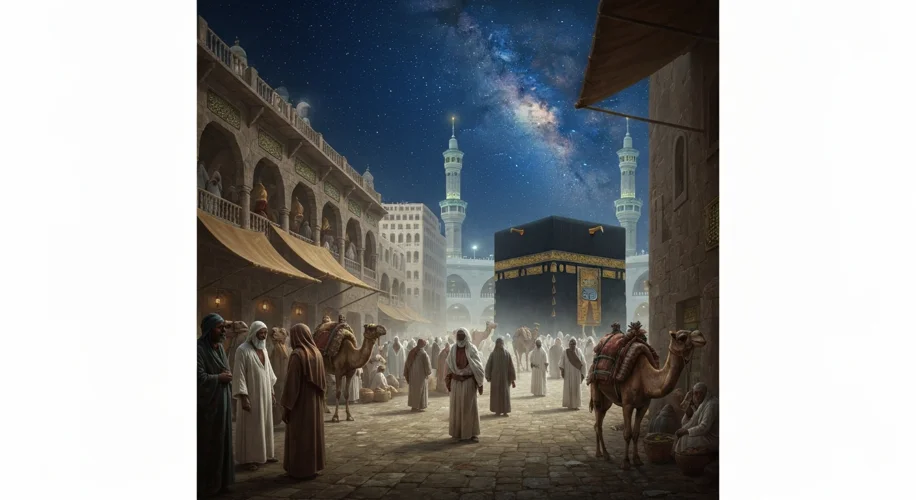
In the harsh, unforgiving landscape of the Arabian Peninsula, a revelation was about to shake the foundations of the world. It was the early 7th century CE, a time when tribal rivalries, ancient traditions, and a burgeoning trade economy defined life in cities like Mecca. Here, amidst the dust and the din of the marketplace, a man named Muhammad, known for his honesty and integrity, began to receive divine messages.
These weren’t just whispers on the wind; they were profound revelations from God, the One God, Allah, as conveyed through the Angel Gabriel. The first verses of what would become the Quran, Islam’s holy book, were revealed to Muhammad around 610 CE. Initially, these messages were shared with a small circle of close companions, speaking of monotheism, compassion, social justice, and accountability in the afterlife. The culture of pre-Islamic Arabia was deeply entrenched in polytheism, idol worship, and tribal loyalties. The radical message of Islam – the absolute oneness of God (Tawhid) and the equality of all believers before Him – was a direct challenge to the established order. This threat, coupled with the growing number of converts, soon led to persecution.
The Prophet Muhammad and his followers faced increasing hostility in Mecca. The turning point came in 622 CE when they were forced to migrate to the city of Yathrib, later renamed Medina. This pivotal event, known as the Hijra, marks the beginning of the Islamic calendar and signifies a new era of Islamic community building. In Medina, Muhammad established a political and social framework that integrated the religious teachings with the practicalities of governance. He became not only a spiritual leader but also a statesman, diplomat, and military strategist. The community, the Ummah, began to flourish, bound by faith and a shared purpose.
Meanwhile, in the Byzantine and Sasanian empires, the geopolitical landscape was fractured by centuries of warfare and internal strife. These vast empires, though powerful, were weakened and weary. Into this power vacuum, the nascent Islamic state, unified under Muhammad’s leadership and subsequently by his successors, the Rashidun Caliphs, began to expand. The early Islamic conquests were not merely military endeavors; they were often facilitated by the appeal of Islamic justice, the desire for liberation from oppressive rule, and the economic opportunities that came with establishing new trade routes.
Following the Prophet’s death in 632 CE, the expansion accelerated. The armies, driven by faith and a desire to spread the message of Islam, achieved astonishing victories. Within decades, they had conquered the Levant (Syria, Palestine, Jordan, Lebanon), wrested control of North Africa from the Byzantines, and shattered the Sasanian Empire, bringing Persia into the Islamic fold. The speed and scope of this expansion were unprecedented. The Umayyad Caliphate, established in 661 CE, pushed further west into North Africa and even crossed the Strait of Gibraltar in 711 CE, bringing Islam to the Iberian Peninsula. Simultaneously, expansion eastward saw the rise of Islamic influence in Central Asia and the Indus Valley.
This rapid spread was not just a military phenomenon; it was a cultural and linguistic one. As Islam moved across diverse lands, Arabic, the language of the Quran and Islamic scholarship, became a lingua franca for trade, science, and administration. Yet, Islam itself demonstrated remarkable adaptability. It didn’t erase existing cultures; rather, it often synthesized with them. In Persia, the rich intellectual traditions blended with Islamic theology and philosophy, leading to new forms of art, literature, and science. In India, Sufism, a mystical dimension of Islam, found resonance with existing spiritual traditions. In North Africa and Spain, Arabic script and Islamic architectural styles merged with local influences.
The impact of Islam’s expansion was profound and multifaceted. It laid the groundwork for vast empires like the Umayyad, Abbasid, and later the Ottoman and Mughal empires. These polities fostered an era of immense intellectual and scientific achievement, often referred to as the Islamic Golden Age. Scholars in Baghdad, Córdoba, and Cairo made groundbreaking advancements in mathematics, astronomy, medicine, philosophy, and literature. Works of ancient Greek scholars were translated, preserved, and built upon, preventing their loss to a fragmented Europe.
However, this expansion was not without conflict. The Byzantine Empire, though significantly weakened, continued to resist, leading to centuries of tension and warfare, particularly in Anatolia and the Balkans. The Crusades, launched by European Christians from the late 11th century onwards, represent a significant, albeit ultimately unsuccessful, attempt to reclaim the Holy Land. These conflicts, while often brutal, also facilitated further cultural exchange and a greater awareness of the