The vast, shimmering expanse of the Pacific Ocean, dotted with countless islands, was not always a known world to humankind. For millennia, it remained an enigmatic blue frontier, a seemingly insurmountable barrier. Yet, against all odds, a remarkable saga of human courage, ingenuity, and an almost supernatural connection to the sea unfolded. This is the story of the Polynesian navigators, the intrepid explorers who, armed with nothing but the stars, the waves, and an intimate understanding of nature, charted a course across this immense ocean and settled some of the most remote islands on Earth, including the breathtaking archipelago of Hawaii.
The story begins not with a single event, but with a slow, deliberate expansion. Originating from Southeast Asia, the ancestors of the Polynesians embarked on a seafaring journey thousands of years ago. Their culture was inextricably linked to the ocean. It was their highway, their larder, and their spiritual compass. They were not mere wanderers; they were sophisticated mariners who developed an unparalleled system of wayfinding.
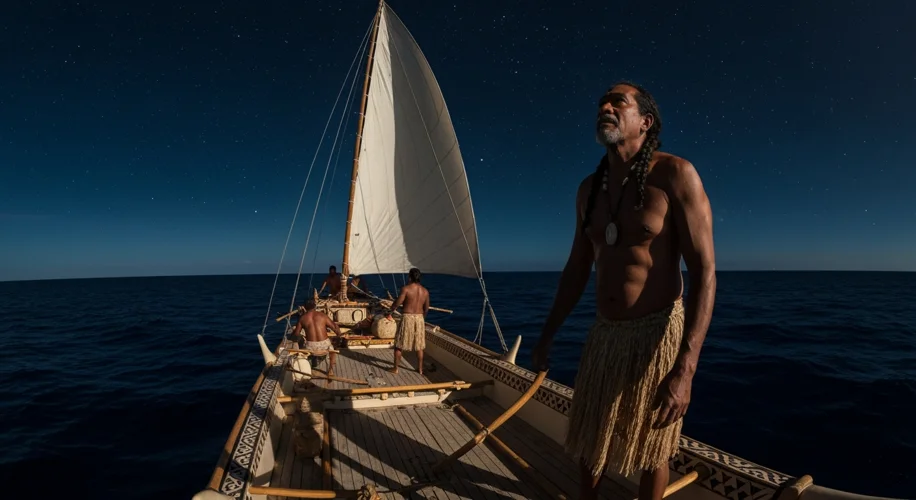
Imagine the scene: a double-hulled canoe, perhaps forty feet long, expertly crafted from local timber, its sails woven from pandanus leaves. On board, a crew of skilled voyagers, their faces etched with the sun and sea spray. The year is perhaps 500 CE, and they are setting sail from the Marquesas Islands, aiming for a new horizon. Their destination? The Hawaiian Islands, a distant landmass barely visible on the vast ocean canvas. How did they know where to go? Their knowledge was a living library. They read the stars – not just their positions, but their rising and setting points throughout the year, a celestial map that never changed. They felt the subtle shifts in the ocean swells, understanding how they were generated by distant landmasses and how they reflected off coastlines. They watched the flight patterns of birds, knowing that certain species would only fly a certain distance from land. They observed the clouds, as the formation of clouds over islands could be a tell-tale sign.
This was not guesswork; it was a science honed over centuries. These navigators were adept at what is known as ‘wayfinding’ or ‘star compass’ navigation. They mentally charted a ‘house’ or ‘station’ for each star as it rose and set on the horizon, using these as directional points. They also paid attention to the subtle changes in wave patterns, recognizing how the primary swells generated by distant winds interacted with secondary swells that had bounced off islands. The legendary navigator Mau Piailug, a master of this ancient art, famously described it as ‘seeing the ocean as a giant roadmap.’
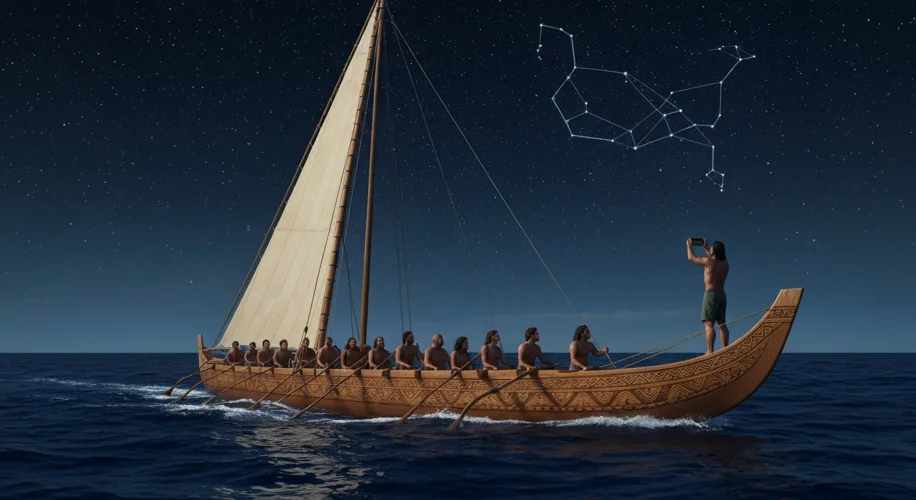
These voyages were not short day trips. Some journeys spanned thousands of miles, taking weeks or months, with no land in sight. The voyagers carried with them not only people but also essential plants and animals – taro, sweet potato, breadfruit, pigs, chickens, dogs – the very building blocks of a new society. This process, known as ‘settlement,’ was crucial. It wasn’t just about discovery; it was about establishing a new home, a new culture, far from their ancestral lands.
When the first Polynesian voyagers arrived in Hawaii, likely between 300 and 800 CE, they found a pristine paradise. Lush forests covered the volcanic slopes, teeming with unique flora and fauna. The impact of their arrival, however, was profound. The introduction of new species, while essential for their survival, also began to alter the delicate ecological balance. Pigs, for example, could decimate native vegetation, and the clearing of land for agriculture led to significant changes in the landscape, including increased soil erosion.
Consider the impact on the native bird populations. Hawaii had evolved in isolation, and many of its bird species were flightless and had no natural predators. The arrival of rats and pigs, carried by the voyagers, had a devastating effect. Furthermore, the establishment of agricultural societies led to the widespread clearing of forests, destroying habitats. This ecological transformation was a stark illustration of how human migration and settlement, even by peoples deeply connected to nature, inevitably reshape the environment. The very act of making a new home required transforming the old.
The legacy of these Polynesian navigators is immense. They were not just explorers; they were pioneers who expanded the human footprint across the largest geographical area on Earth. Their navigational techniques, developed without instruments, represent a pinnacle of human ingenuity and a testament to a profound understanding of the natural world. The islands they settled, from the vastness of Hawaii to the remoteness of Easter Island, became vibrant centers of unique Polynesian cultures, each with its own stories, traditions, and challenges. Their journeys are a powerful reminder that the seemingly empty ocean was, in fact, a vast highway, traversed by those who dared to dream beyond the horizon and possessed the knowledge to navigate by the stars.