Before the sails of Captain Cook first graced the horizon, before the shadow of human influence stretched across its shores, the Hawaiian Islands pulsed with a vibrant, unique symphony of life. This wasn’t the rhythm of drums or the melody of human voices, but the exquisite chorus of birdsong, a testament to isolation, adaptation, and a world untouched.
Imagine a realm where the air thrummed with the calls of creatures found nowhere else on Earth. These weren’t just any birds; they were the evolutionary masterpieces of the Hawaiian archipelago, forged in the crucible of isolation. For millions of years, these islands, born of volcanic fire and sustained by the vast Pacific, served as a natural laboratory, allowing avian life to diversify in spectacular ways.
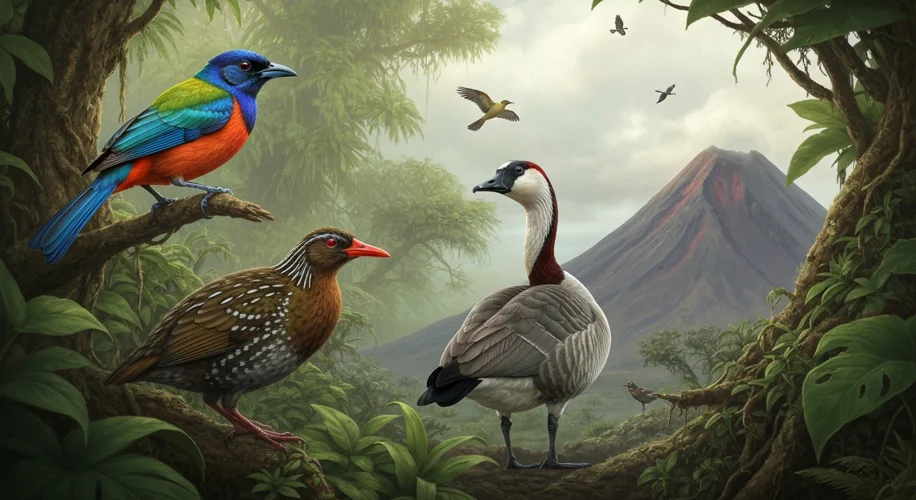
The story of pre-contact Hawaiian avifauna is one of incredible speciation. When the first land birds arrived, likely blown off course by storms or taking advantage of migratory routes, they found themselves in a paradise free from the competition and predation that plagued their mainland cousins. This absence of mammalian predators, in particular, was a game-changer. It allowed some species to lose the ability to fly altogether, while others evolved unique feeding strategies and brilliant plumage.
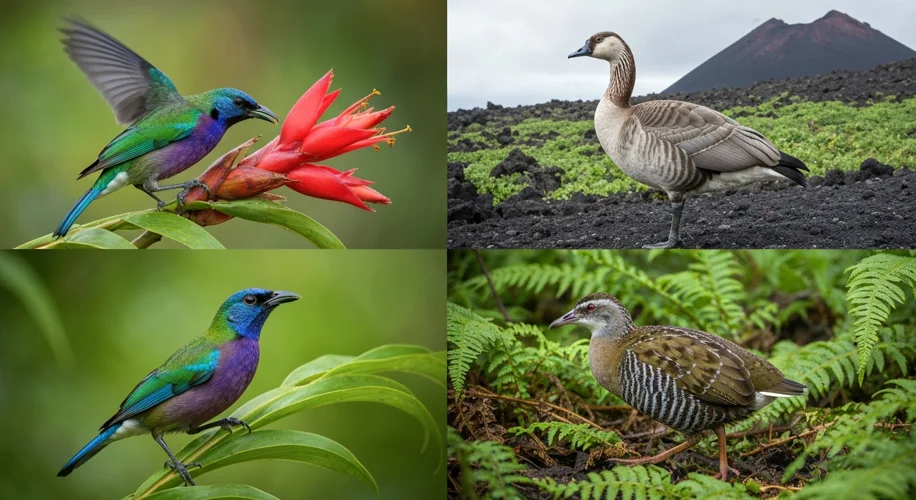
Chief among these evolutionary marvels were the Hawaiian honeycreepers (Drepanidinae). This incredibly diverse group, once numbering over 50 species, showcased nature’s ingenuity. From the sickle-billed i'iwi, with its vibrant scarlet plumage and long, curved beak perfectly suited for sipping nectar fromōhiʻa lehua flowers, to the `akialoa, with an extraordinarily long beak that rivaled a hummingbird’s, these birds were living examples of adaptive radiation. Their beaks evolved into an astonishing array of shapes and sizes, each tailored to exploit specific food sources – seeds, insects, nectar, and even the blood of other birds.
Consider the Palila (Palila sandwichensis), a striking bird with a yellowish head and greyish-green body. Its strong, conical beak was ideal for cracking the tough seeds of the māmane tree, its primary food source. Then there was the ʻUlaʻaiʻa (Hawaiian Crow, Corvus hawaiiensis), an intelligent and resourceful bird that scavenged and predated, playing a crucial role in seed dispersal and insect control.
The evolutionary narrative extends beyond the honeycreepers. The Hawaiian goose, or Nēnē (Branta sandvicensis), is a prime example of an animal adapting to a volcanic landscape. Unlike its more aquatic goose relatives, the Nēnē evolved non-webbed feet and a more terrestrial lifestyle, feeding on grasses and berries found in the arid lava fields. Its closest living relative, the Canada goose, highlights how far isolation can drive evolutionary divergence.
And who could forget the flightless wonders? The Hawaiian rail (Porzana sandwichensis), a plump, brownish bird, and its larger, flightless cousin, the Moa-nalo (a group of large, flightless geese-like birds), were ground-dwellers, perfectly content to forage on the forest floor, largely unmolested by predators.
These islands, a tapestry of diverse ecosystems – from lush rainforests to arid volcanic slopes and coastal wetlands – supported this incredible array of avian life. The `ōhiʻa lehua forests provided nectar and insects, the māmane forests offered seeds and insects, and the coastal areas teemed with invertebrates.
However, this Edenic existence was tragically fragile. The arrival of humans, beginning with Polynesian voyagers around 300-800 AD, marked the beginning of a profound ecological shift. While the initial impact was likely less severe than later European arrivals, the introduction of domestic animals like pigs and dogs, along with new plants, began to alter the delicate balance. The flightless birds, with no innate fear of predators, were particularly vulnerable.
The true catastrophe, however, was yet to come. The arrival of Europeans brought with it more invasive species – rats, mongooses, and cattle – along with devastating diseases against which the native Hawaiians and their unique wildlife had no immunity. Habitat destruction, driven by agricultural expansion and development, further squeezed the remaining populations. The once-vibrant chorus began to fade, species by species, until many were lost forever, becoming mere ghosts in the fossil record and scientific descriptions.
Today, the few surviving endemic Hawaiian birds, like the Nēnē and some of the hardier honeycreepers, are a poignant reminder of the lost symphony. Conservation efforts are valiant, striving to protect these irreplaceable treasures, but the pre-contact era represents a lost world, a testament to the incredible biodiversity that can flourish in isolation and the devastating consequences when that isolation is broken. The silence where vibrant birdsong once echoed is a stark, enduring lesson in the fragility of unique ecosystems.