
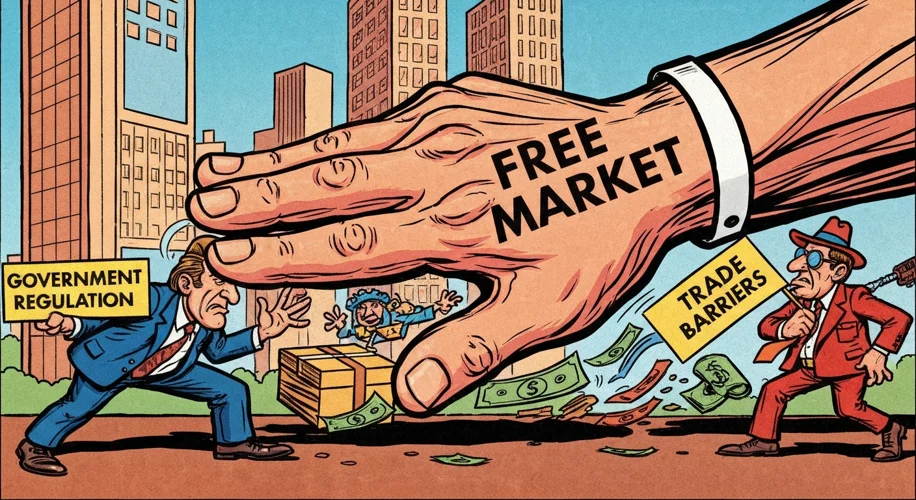
Imagine a world where borders melt away for goods and services, where governments shrink, and where the unfettered hand of the market dictates the flow of wealth. This isn’t a futuristic utopia or dystopia, but the reality that gradually took shape in the latter half of the 20th century, driven by a powerful economic philosophy: neoliberalism.
For decades, the post-World War II era was characterized by a mixed economy. Governments played a significant role in managing industries, providing social safety nets, and using trade policies to protect domestic markets. This period, often referred to as the “Golden Age of Capitalism,” saw robust economic growth and a rising standard of living for many in the developed world. However, by the 1970s, a confluence of factors – including rising inflation, oil shocks, and perceived government inefficiency – created fertile ground for new ideas.
Emerging from the intellectual shadows of earlier thinkers like Friedrich Hayek and Milton Friedman, neoliberalism offered a compelling alternative. Its core tenets were deceptively simple: free markets, deregulation, privatization, and fiscal austerity. The idea was that by unshackling businesses from government interference and reducing trade barriers, economies would become more efficient, innovative, and ultimately, more prosperous for everyone.
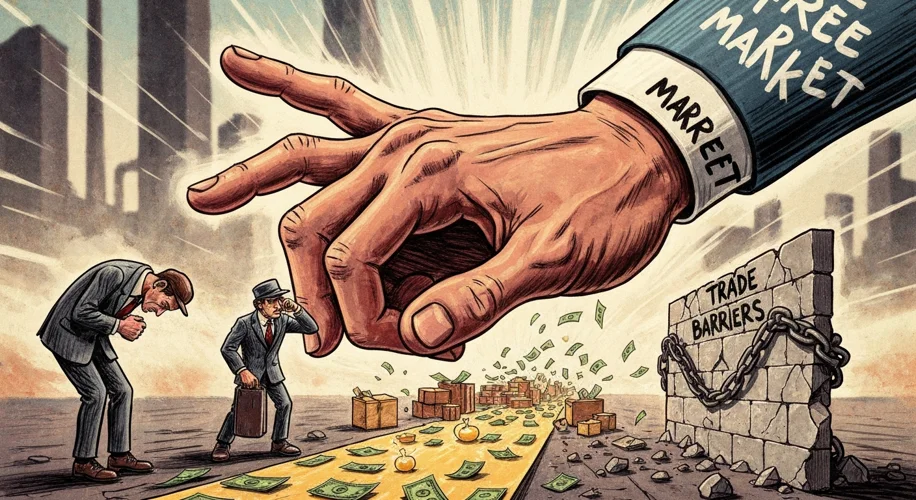
The intellectual heavyweights of this movement, such as Milton Friedman and Friedrich Hayek, argued passionately that government intervention in the economy was not only inefficient but actively harmful, stifling individual liberty and economic growth. They championed the idea that a truly free market, driven by competition and consumer choice, would naturally lead to the best outcomes.
Key actors in this unfolding drama were not just economists but also powerful political leaders. In the United Kingdom, Prime Minister Margaret Thatcher, with her unwavering resolve, began a radical program of privatizing state-owned industries, curbing the power of trade unions, and embracing free-market principles. Her famous declaration, “There is no alternative,” encapsulated the bold, almost revolutionary, spirit of the era. Across the Atlantic, U.S. President Ronald Reagan echoed these sentiments, championing tax cuts, deregulation, and a rollback of government spending. Their parallel actions, often dubbed “Reaganomics” and “Thatcherism,” became synonymous with the neoliberal turn.
This ideological shift wasn’t confined to the halls of power. It permeated academia, think tanks, and even international organizations. The International Monetary Fund (IMF) and the World Bank, once proponents of development aid and state-led growth, began to advocate for “structural adjustment programs” – policies that often required recipient countries to liberalize their economies, privatize state assets, and reduce trade barriers in exchange for loans. This led to a wave of trade liberalization agreements, most notably the establishment of the World Trade Organization (WTO) in 1995, which aimed to reduce tariffs and other obstacles to global trade.
The consequences of this seismic policy shift were profound and far-reaching. On one hand, proponents point to increased global trade, lower consumer prices for many goods, and significant economic growth in some developing nations that embraced market reforms. The rise of multinational corporations and the interconnectedness of the global economy are often cited as direct results of this era.
However, critics argue that neoliberalism also exacerbated income inequality, both within and between nations. The privatization of public services sometimes led to reduced access for vulnerable populations, while deregulation in financial markets contributed to economic instability, culminating in crises like the 2008 global financial meltdown. The “race to the bottom” in labor and environmental standards, as companies sought cheaper production costs, also became a significant concern. For ordinary workers, particularly in manufacturing sectors in developed countries, the era often meant job losses and stagnant wages as production shifted to lower-cost regions.
The legacy of neoliberalism is complex and continues to be debated. It undeniably reshaped the global economic landscape, fostering a more interconnected world but also creating new challenges. Understanding this period is crucial for comprehending the economic disparities, political tensions, and global challenges we face today. It reminds us that economic policies are not merely abstract theories but powerful forces that shape the lives of billions.