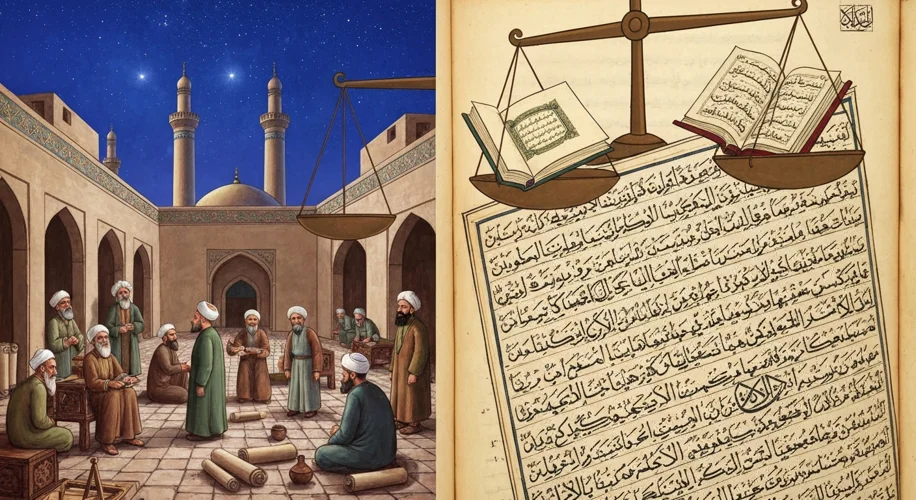
In the bustling intellectual centers of the early Islamic world, amidst the whispers of ancient philosophies and the fervent pronouncements of faith, a revolutionary school of thought emerged. It was a time when the foundations of Islamic theology were being rigorously examined, not just through scripture, but through the sharp, unblinking lens of reason. This was the era of Mu’tazilism, a rationalist movement that dared to ask profound questions about the very nature of God, human responsibility, and the intricate dance between divine will and human freedom.
Imagine the scene: Scholars in grand libraries, illuminated by oil lamps, poring over Greek texts translated into Arabic. The air is thick with debate, the passionate arguments of thinkers who believed that God, in His infinite wisdom, had endowed humanity with the capacity to reason, and that this faculty was not a threat to faith, but its most powerful ally. The Mu’tazilis, meaning ‘those who withdraw,’ often found themselves on the fringes, precisely because their approach was so distinct.
At its heart, Mu’tazilism was driven by a profound commitment to divine justice (adl) and divine unity (tawhid). They wrestled with the apparent contradictions that arose when trying to reconcile God’s absolute power and knowledge with the existence of evil and suffering in the world. If God is all-knowing and all-powerful, how can He be truly just if humans are not free agents capable of choosing their actions? This question became a central battleground.
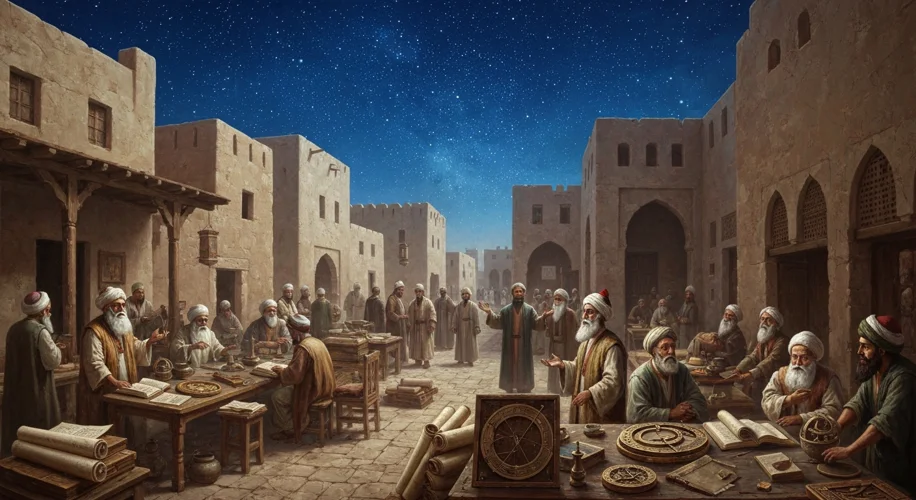
Central to their philosophy was the concept of human free will. The Mu’tazilis argued that God, in His justice, could not create evil. Therefore, humans must be the creators of their own actions, possessing genuine choice. This wasn’t a denial of God’s power, but rather an assertion that God’s wisdom was expressed through establishing a system where human actions had real consequences. They believed that God’s commands were understandable through reason, and that adherence to these rational principles was the path to divine favor.
Consider the intricate theological puzzle they faced: How to describe God without anthropomorphizing Him, a common pitfall for theological discourse? The Mu’tazilis championed the idea of God’s absolute transcendence. They insisted that divine attributes, like knowledge and power, were not separate entities but identical to God’s essence. This was a radical departure, seeking to purify the concept of God from any potential human-like characteristics. They famously argued that the Quran, while divinely revealed, was created in time, just as Jesus was created by God. This contrasted sharply with the orthodox Ash’ari school, which held the Quran to be eternal and uncreated, a view that eventually gained wider acceptance.
Key figures like Wasil ibn Ata, often considered the founder of the school, and his student Abu al-Hudhayl al-Allaf, were intellectual titans. They engaged in sophisticated debates, using logic and philosophical reasoning to defend their positions. Their influence was significant, particularly during the Abbasid Caliphate, a period known as the Islamic Golden Age. For a time, under Caliph al-Ma’mun, Mu’tazilite doctrine was even adopted as the state orthodoxy, leading to the infamous mihna, or inquisition, where scholars were pressured to affirm the created nature of the Quran.
The consequences of Mu’tazilism’s rise and eventual decline were profound. While their rationalist approach was eventually suppressed in favor of more traditional interpretations, their emphasis on reason, justice, and critical inquiry left an indelible mark on Islamic intellectual history. They laid the groundwork for later philosophical discussions and demonstrated the capacity for deep, rational engagement with religious texts.

The legacy of Mu’tazilism is a testament to the vibrant intellectual currents that flowed through the early Islamic world. They remind us that throughout history, faith and reason have often been in dialogue, sometimes in conflict, but always in a dynamic relationship that shapes our understanding of the world and our place within it. Their bold challenge to conventional thought, their unwavering pursuit of divine justice through the power of human intellect, continues to echo through the corridors of intellectual history, inviting us to ponder the enduring questions of existence, morality, and the divine.
While the Mu’tazili school itself faded from prominence, the spirit of rational inquiry it championed did not die. It seeped into other disciplines, influenced Sufi mysticism, and continued to fuel intellectual debates within Islam for centuries. Mu’tazilism’s story is a dramatic reminder that even when a particular school of thought recedes, its questions and its methods can inspire future generations to think differently, to question boldly, and to seek truth with all the faculties God has given them.