
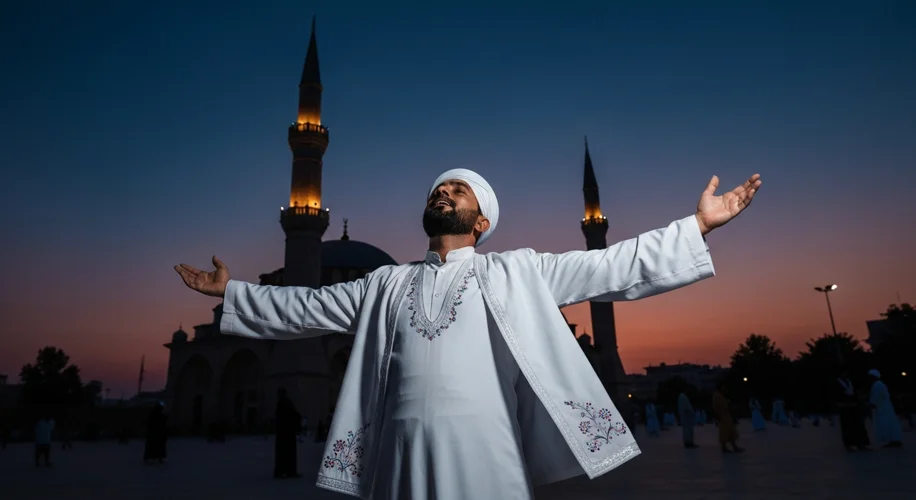
In the vast tapestry of human spirituality, few threads are as shimmering and profound as Sufism, the mystical dimension of Islam. Far from the rigid dogma that sometimes defines organized religion, Sufism offers a path of direct, experiential knowledge of the Divine. It is a journey inward, a quest for the Beloved, driven by love, devotion, and a burning desire to dissolve the self into the Universal Whole.
Imagine a bustling marketplace in 9th-century Baghdad. Amidst the clamor of commerce and the murmur of theological debate, a different kind of seeker emerges. Clad in simple wool (suf), these ascetics, known as Sufis, turn away from worldly distractions, dedicating their lives to purifying their hearts and experiencing the divine presence within. This was the nascent stir of Sufism, a movement born not from rebellion, but from a deep-seated yearning for spiritual intimacy that transcended mere ritual.
While the Quran and the Sunnah (teachings and practices of Prophet Muhammad) form the bedrock of Islamic faith, Sufis interpret these sources through a lens of inner meaning and symbolic truth. They believe that beneath the exoteric (outward) practice of Islam lies an esoteric (inward) reality, a divine essence accessible to all who purify their intentions and embark on the spiritual path.

This journey is not for the faint of heart. It is a rigorous discipline, often involving practices like meditation (dhikr – remembrance of God), asceticism, and the cultivation of virtues such as patience, gratitude, and surrender. The ultimate goal is fana, annihilation of the ego, and baqa, subsistence in God. It’s about shedding the illusion of a separate self and recognizing the divine unity that permeates all existence.
Over centuries, Sufism blossomed, producing a galaxy of luminaries whose wisdom continues to illuminate the path for millions. Consider the towering intellect of Abu Hamid al-Ghazali (c. 1058–1111). Once a celebrated theologian, al-Ghazali experienced a profound spiritual crisis that led him to abandon his prestigious academic career. His seminal work, The Revival of the Religious Sciences (Ihya Ulum al-Din), is a comprehensive exploration of Islamic jurisprudence, theology, and ethics, but crucially, it places immense emphasis on the inner spiritual dimension. Al-Ghazali argued that true faith was not just about intellectual assent but about the transformation of the heart, a sentiment that resonated deeply and helped to legitimize the mystical path within mainstream Islam.
Then there is Ibn Arabi (1165–1240), often referred to as the ‘Great Master.’ His philosophical contributions are immense, particularly his concept of Wahdat al-Wujud (Unity of Being). For Ibn Arabi, God is not separate from creation; rather, creation is a manifestation of the Divine. This pantheistic-leaning philosophy, while controversial for some, offered a profound vision of universal interconnectedness and divine immanence. His vast corpus, including The Meccan Revelations (Al-Futuhāt al-Makkiyya), delves into complex metaphysical and spiritual insights.
And who can speak of Sufism without invoking the ecstatic poetry of Jalal al-Din Rumi (1207–1273)? A 13th-century Persian poet, Islamic scholar, and Sufi mystic, Rumi’s verses are a testament to the overwhelming power of divine love. His masterpiece, the Masnavi, is an epic spiritual poem that uses parables and anecdotes to guide seekers toward union with God. Rumi’s teachings transcended cultural and religious boundaries, making him one of the most widely read poets in the world today. His followers, the Mevlevi Order, are famously known for their whirling dervishes, a practice designed to achieve ecstatic trance and spiritual communion.
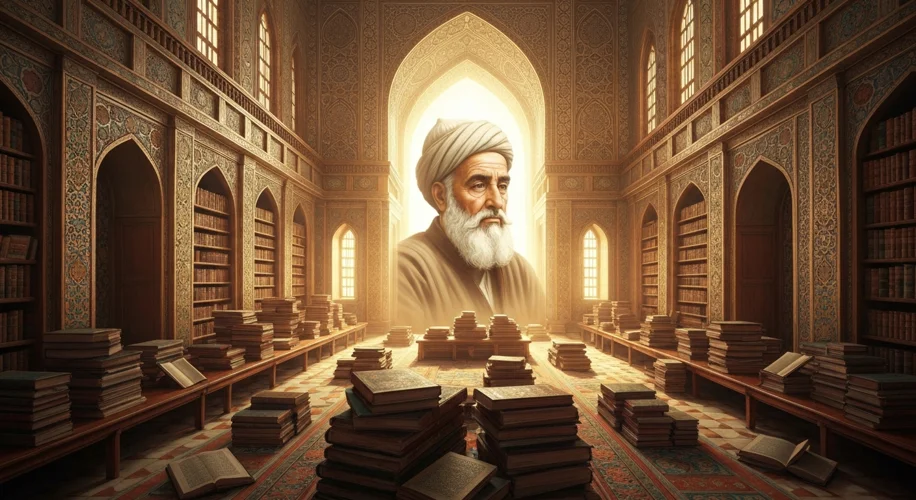
The impact of Sufism on Islamic culture is immeasurable. It has influenced art, music, literature, and social customs across the Muslim world. From the mesmerizing chanting and ecstatic dances of dervishes to the intricate geometric patterns in mosque architecture, Sufi aesthetics permeate the spiritual landscape. It has provided solace to the downtrodden, fostered a sense of community, and championed a message of tolerance and compassion that has often stood in stark contrast to more rigid interpretations of faith.
However, Sufism has not been without its challenges. Throughout history, it has faced opposition from more literalist and puritanical movements within Islam, who sometimes view its mystical practices and veneration of saints as innovations or even heresies. In recent times, certain extremist groups have targeted Sufi shrines and practitioners, deeming them infidels. Yet, despite these adversies, the heart of Sufism continues to beat, a testament to the enduring human quest for spiritual meaning and direct connection with the Divine.
Sufism, in essence, is Islam’s poetic soul, its mystical whisper, reminding us that faith is not just a set of rules, but a living, breathing relationship with the Infinite. It is a call to look beyond the veils of the mundane and discover the Divine light that shines within each and every one of us.