
The air in Boston’s North End on January 15, 1919, was thick with anticipation, but not from the usual briny sea air or the chill of a New England winter. It was a peculiar, sweet scent, a heady aroma that hinted at the industrial heart of the neighborhood. Tanks of molasses, a key ingredient in rum production, loomed over the streets, a constant, if usually unnoticed, presence.
On that fateful afternoon, the temperature had unseasonably risen, a deceptive warmth that would soon give way to unimaginable fury. The molasses tanks, owned by the Purity Distilling Company, were not merely holding syrup; they were storing the potent byproduct of America’s burgeoning industrial appetite. This particular tank, a behemoth standing 50 feet tall and 40 feet in diameter, had recently been filled with over 2.3 million gallons of molasses.
This wasn’t just any molasses; it was destined for rum, a staple of the American working class and a crucial commodity, especially with Prohibition looming on the horizon, making its production and stockpiling even more frantic.
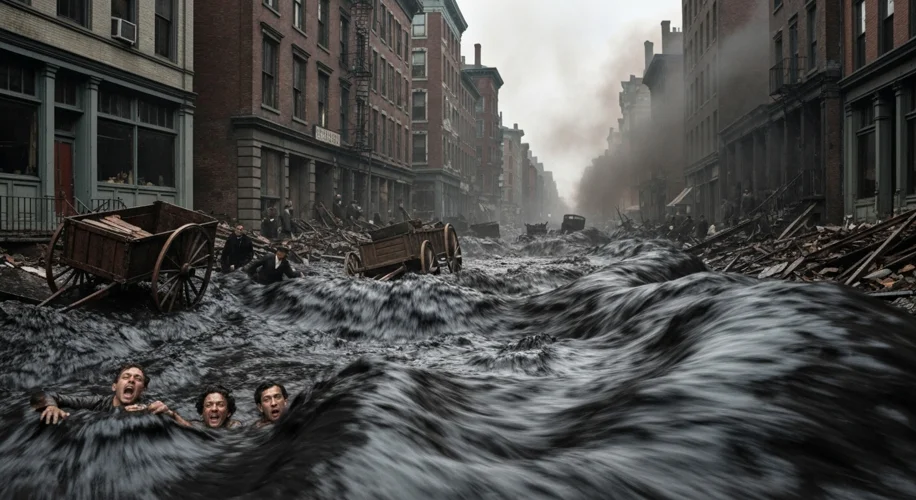
Suddenly, with a groan that echoed through the brick-lined streets, the tank buckled. A deafening roar followed as a colossal wave of dark, sticky molasses, estimated to be 25 feet high at its peak, erupted from the ruptured steel. It surged through the neighborhood at an estimated 35 miles per hour, a dark tide of destruction.
Buildings were ripped from their foundations, horse-drawn wagons were tossed like toys, and people were caught in the horrifying deluge. The sheer force of the wave was immense; it splintered wooden structures, crushed the legs of those caught in its path, and dragged victims under its viscous surface. The air, moments before filled with the sweet scent, was now choked with the suffocating, syrupy tide.

The aftermath was a scene of grim devastation. The initial rescue efforts were hampered by the sticky, clinging molasses, which made movement agonizingly slow and treacherous. Rescuers, wading through waist-deep syrup, found a scene of utter chaos. The sweet smell that had once been a sign of industry now hung heavy, a sickening perfume over death and destruction.
Nineteen people lost their lives, and over 150 were injured. The victims ranged from workers at the Purity Distilling Company to children playing in the street, to passersby caught in the wrong place at the wrong time. The molasses, thick and suffocating, acted like quicksand, trapping many in its deadly embrace.
The immediate question on everyone’s mind was: how could this happen? Investigations quickly began, and the Purity Distilling Company and its owners, United States Industrial Alcohol (USIA), faced intense scrutiny. Eyewitness accounts spoke of the tank groaning and creaking for months, and of dark, viscous liquid seeping from its rivets. Some even reported hearing a low rumbling sound just before the catastrophic failure.
It emerged that the tank had been hastily constructed and poorly maintained. It had been painted brown to hide the leaks, and even children were reportedly collecting the seeping molasses for their own use. The company had rushed its construction to meet demand, and crucial safety checks were either ignored or inadequate. The rising temperatures on that fateful day, coupled with the fermentation of the molasses, likely increased the internal pressure to a breaking point.
The ensuing legal battle was one of the first class-action lawsuits in Massachusetts history. USIA eventually settled, paying out the equivalent of millions of dollars today to the victims and their families. However, the disaster also led to significant changes in industrial safety regulations, demanding stricter oversight and inspection of large storage tanks.
The Great Molasses Flood remains a bizarre and tragic chapter in Boston’s history. It serves as a stark reminder of the potential dangers lurking within industrial progress and the vital importance of prioritizing safety. The sticky, dark legacy of that day, however, is not just one of destruction, but also of a hard-won lesson that continues to shape how we manage industrial risks today.
Even decades later, some residents claimed that on warm days, the distinct aroma of molasses could still be faintly detected, a ghostly reminder of the day a sweet treat turned into a deadly flood.