The year is 1772. Imagine a vibrant tapestry, rich with history, culture, and a unique blend of East and West, stretching across a vast expanse of Eastern Europe. This was the Polish-Lithuanian Commonwealth, a powerful entity for centuries, known for its elective monarchy, a noble democracy, and its position as a bulwark against Eastern expansion. But by the end of the 18th century, this once-proud nation would be systematically torn apart, vanishing from the map of Europe for over 120 years.
The seeds of this tragedy were sown in a complex web of internal strife and external ambition. For decades, the Commonwealth had been weakened by internal political paralysis, often exploited by its powerful neighbors: Tsarist Russia, Frederick the Great’s Prussia, and the Habsburg Monarchy of Austria. The Polish nobility, while cherishing their freedoms, often engaged in infighting, rendering the state incapable of effective governance or defense. This internal disarray became an irresistible lure for its ambitious neighbors, who saw opportunity in weakness.
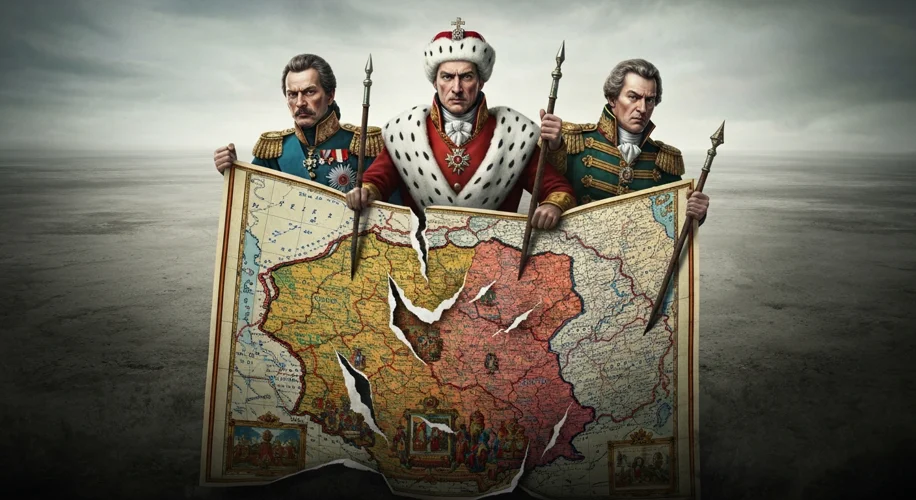
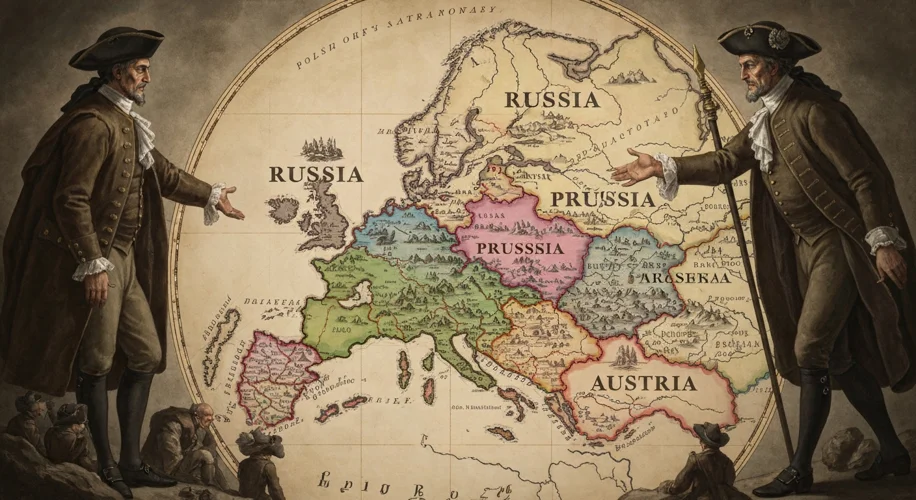
The stage was set for the first partition in 1772. Catherine the Great of Russia, Frederick the Great of Prussia, and Empress Maria Theresa of Austria, driven by a thirst for territorial gain and a desire to maintain a delicate balance of power amongst themselves, decided to carve up Poland. This wasn’t a war of conquest in the traditional sense, but a cold, calculated dismemberment. Russia claimed large swathes of Belarus and Livonia, Prussia took West Prussia, connecting its territories, and Austria annexed Galicia. The Polish Sejm (parliament), stripped of its power and facing overwhelming military pressure, was forced to ratify the seizure of nearly a third of its territory and over a third of its population.
What followed was a period of attempted revival and further decline. In a desperate bid to save their nation, Polish reformers enacted the May 3rd Constitution in 1791, Europe’s first modern written constitution and the world’s second. It aimed to create a stronger, more centralized government and abolish some of the debilitating privileges of the nobility. This was a beacon of hope, a testament to the enduring spirit of the Polish people. However, this reformist zeal was viewed with alarm by Russia and Prussia, who saw it as a direct threat to their influence and territorial gains.
The inevitable followed. Russia, under Catherine the Great, invaded Poland in 1793, leading to the Second Partition. This time, Prussia and Russia seized even more territory, leaving a small, Russian-dominated rump state. The final act of this national tragedy came in 1795. A desperate Polish uprising, led by Tadeusz Kościuszko, a hero of the American Revolutionary War, was brutally suppressed. Russia, Prussia, and Austria then carried out the Third Partition, erasing Poland from the map entirely. Its lands were divided amongst the three powers, and the once proud Commonwealth ceased to exist as an independent state.
For 123 years, Poland would exist only in the hearts and minds of its people, in its rich cultural heritage, and in the clandestine efforts of generations to regain independence. The partitions had profound and lasting consequences. They not only annihilated a sovereign nation but also significantly altered the geopolitical landscape of Eastern Europe. Russia’s western territories expanded dramatically, incorporating lands that are now part of Ukraine and Belarus, a historical legacy that continues to shape regional dynamics today.
The story of the Partitions of Poland is a somber reminder of the fragility of nations and the devastating consequences of unchecked imperial ambition. It is a tale of internal weakness exploited by external greed, but also a testament to the indomitable spirit of a people who, despite being erased from the political map, never truly surrendered their identity or their dream of a free homeland. The echoes of this tragedy resonate even today, a stark warning etched in the annals of European history.