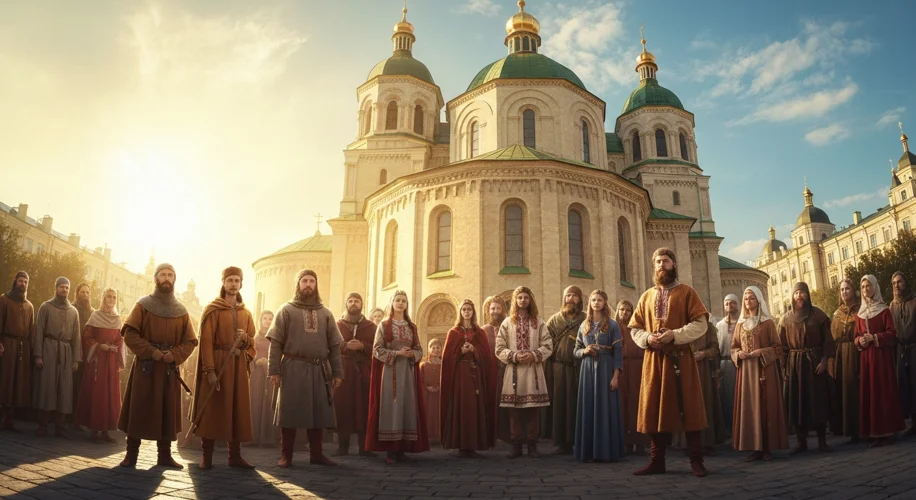
The mists of time often obscure the beginnings of nations, leaving us to piece together fragmented tales of ancient peoples and their nascent states. Today, we journey back to the 9th century, to the fertile lands of Eastern Europe, where a powerful entity known as Kievan Rus’ emerged, laying the very foundations for what would become Russia, Ukraine, and Belarus. This wasn’t a sudden eruption onto the world stage, but a gradual coalescing of Slavic tribes, Viking traders, and a unique cultural synthesis that would leave an indelible mark.
Imagine a sprawling landscape, crisscrossed by mighty rivers like the Dnieper and the Volga. These weren’t just waterways; they were the superhighways of their day, vital arteries of trade connecting the Baltic Sea with the Byzantine Empire and the Caspian Sea. Along these rivers, settlements began to grow, clusters of wooden houses surrounded by defensive palisades. The people here were largely East Slavic, engaged in agriculture, hunting, and craftsmanship.
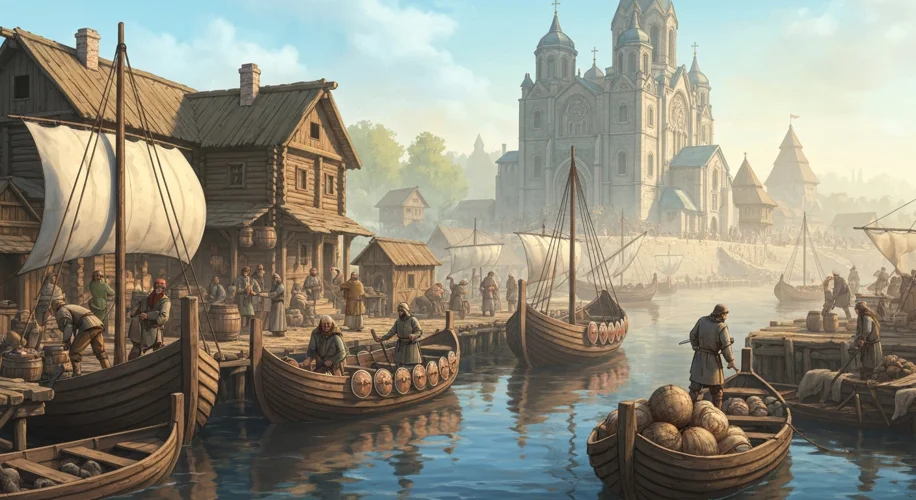
Into this vibrant, yet somewhat fragmented, world stepped the Varangians, Norsemen, or Vikings, as they are more commonly known. Driven by trade and perhaps by a thirst for new horizons, they sailed down the rivers, establishing outposts and, crucially, bringing a form of centralized authority. Legend, as recorded in the Primary Chronicle, speaks of the Slavic tribes inviting the Varangian chieftain Rurik to rule over them in 862 CE. While the historicity of this specific event is debated, it undeniably points to the significant role of these Norsemen in the early organization of the region. Rurik’s kin, particularly his successor Oleg, are credited with consolidating power and capturing the strategically vital city of Kyiv around 882 CE, effectively creating the nucleus of Kievan Rus’.
Kyiv, perched on the bluffs overlooking the Dnieper, became the heart of this new state. It was a melting pot of cultures. Slavic traditions blended with Norse martial prowess and administrative skills. The East Slavic languages began to evolve, and early legal codes started to form. For centuries, Kievan Rus’ would thrive, a powerful medieval state that commanded respect and engaged in extensive trade networks.
The most transformative event in Kievan Rus’ history, however, was its adoption of Orthodox Christianity in 988 CE under Prince Vladimir the Great. This wasn’t merely a spiritual shift; it was a profound cultural and political one. Vladimir, having witnessed the splendor of Constantinople and its Byzantine rites, saw the strategic advantage of aligning his vast realm with the sophisticated Christian East. This decision brought with it literacy, a written language (Old Church Slavonic, using the Cyrillic script developed by Saints Cyril and Methodius), a rich tradition of art and architecture, and a philosophical framework that would deeply influence the identity of Eastern Slavs for centuries to come.
The consequences of this conversion were far-reaching. It provided a unifying ideology for a diverse population and fostered strong ties with the Byzantine Empire, a major power of the era. Churches and monasteries rose across the land, becoming centers of learning and spiritual life. The imposing Saint Sophia Cathedral in Kyiv, with its magnificent mosaics and frescoes, stands as a testament to the artistic and architectural achievements of this golden age.
However, the sun of Kievan Rus’ was not destined to shine forever. Internal strife, the constant threat of nomadic incursions from the south (like the Pechenegs and later the Polovtsians), and a complex system of succession all contributed to its gradual weakening. The final, devastating blow came in the 13th century with the Mongol invasion. The Golden Horde, under Batu Khan, swept through the lands, sacking cities, including Kyiv in 1240 CE, and plunging the region into a period of subjugation that lasted for centuries.
Yet, the legacy of Kievan Rus’ was not extinguished. It lived on in the fragmented principalities that emerged from the ashes. The northern lands, influenced by the Golden Horde, would eventually coalesce into the Grand Duchy of Moscow, laying the groundwork for modern Russia. The western and southern territories, facing different pressures and interacting with different powers like Poland and Lithuania, would evolve into distinct Ukrainian and Belarusian identities. The adoption of Christianity, the development of a written culture, and the establishment of sophisticated political and trade structures by Kievan Rus’ provided the essential building blocks for these future East Slavic states.
In essence, Kievan Rus’ was the crucible where the distinct yet interconnected destinies of Russia, Ukraine, and Belarus were forged. Its story is a powerful reminder that national identities are rarely born in isolation, but are instead the product of centuries of interaction, adaptation, and the enduring echoes of a shared, vibrant past.