The year is 1480. The vast expanse of Eastern Europe, once bowed under the iron fist of the Golden Horde, is stirring. For over two centuries, the Mongol yoke had defined the political and economic landscape, leaving a mosaic of principalities beholden to the khans. But the Horde, once a fearsome monolith, was fracturing, its power waning like the setting sun.
Amidst this shifting geopolitical tide, one principality, small and unassuming, began to cast a long shadow: Moscow. Nestled in the dense forests of the Volga basin, its princes had, through a shrewd blend of diplomacy, ruthlessness, and sheer perseverance, navigated the treacherous currents of Mongol rule. They had served as tax collectors for the Horde, amassing wealth and influence, and slowly, incrementally, expanded their own domain.
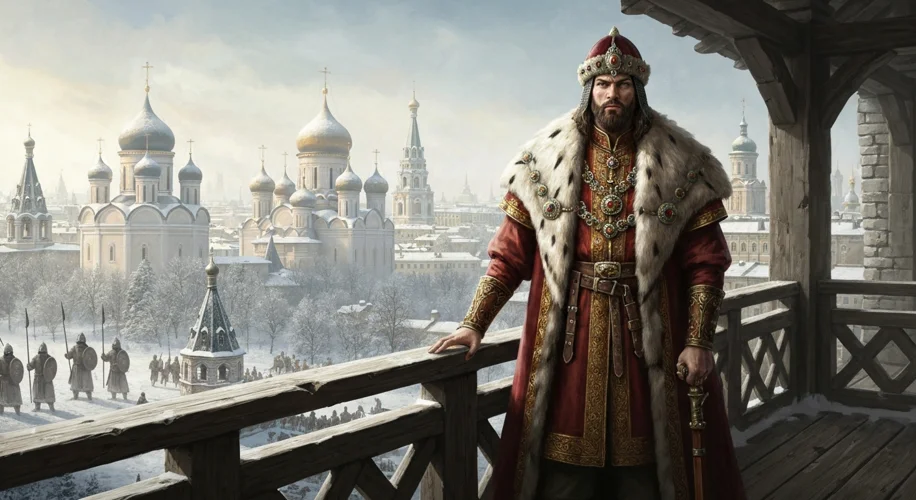
The figure who truly embodied this ascent was Ivan III, often known as Ivan the Great. Ascending the throne in 1462, he inherited a principality that was already a force to be reckoned with. But Ivan was not content with mere regional power. He looked south, to the wealthy trading cities of Novgorod, and west, to lands still under the sway of the Grand Duchy of Lithuania. His ambition was to unite the disparate East Slavic lands under Moscow’s banner.
Ivan’s methods were as varied as they were effective. He used marriage alliances, as when he wed Sophia Palaiologina, the niece of the last Byzantine Emperor, which lent Moscow an aura of imperial legitimacy. He also employed military might. The subjugation of Novgorod in 1471, a city renowned for its independent spirit and vast trading networks, was a pivotal moment. This was not a simple conquest; it was a statement. Moscow was no longer merely a vassal; it was a rising power that could challenge the established order.
But the true test came in 1480. Akhmat Khan, the ruler of the Great Horde, sought to reassert his authority and extract tribute. He marched his forces towards the Ugra River, the de facto border between Muscovy and the Horde’s lingering influence. For weeks, the two armies faced each other, the fate of Eastern Europe hanging precariously in the balance. Ivan, learning from his predecessors’ mistakes and bolstered by his growing military strength, refused to pay tribute. He had, in essence, declared independence.
The stand-off at the Ugra River was not a bloody battle, but a war of nerves. Akhmat Khan, facing internal dissent and aware of Muscovite preparations, eventually retreated. This non-event, this absence of a decisive clash, became a momentous symbol. It marked the definitive end of Mongol domination over Russia. The Golden Horde’s power was broken, and Moscow stood triumphant, its sovereignty undisputed.
Ivan III’s reign was thus a watershed moment. He not only expelled the Mongols but also laid the administrative and legal foundations for a unified state. He introduced the Sudebnik, a unified legal code, and began to centralize power in Moscow, weakening the autonomy of other boyars (nobles) and princes. He adopted the double-headed eagle as his symbol, a clear nod to the fallen Byzantine Empire, and began styling himself as ‘Gosudar’ (Sovereign).
This transformation culminated in the reign of his grandson, Ivan IV, famously known as Ivan the Terrible. In 1547, Ivan IV was crowned not as a Grand Prince, but as the first Tsar of All Russia. The title ‘Tsar’ (derived from Caesar) was a deliberate assertion of imperial ambition, placing him on par with the emperors of Rome and Byzantium. His coronation was a grand spectacle, symbolizing the birth of a new, powerful, and centralized Russian state.
The rise of Muscovy, from a modest principality to a formidable tsardom, was a complex process shaped by external pressures, internal ambition, and strategic brilliance. It was a story of princes who learned to play the long game, who understood that power could be consolidated through cunning as much as through conquest. The foundations laid by Ivan III and solidified by Ivan IV would echo through centuries, ultimately shaping the vast Russian Empire and its enduring legacy on the world stage.
This period, often overlooked in the grand narrative of European history, was crucial in forging a distinct Russian identity and setting the stage for its future imperial ambitions. The echo of the Tatar Yoke faded, replaced by the resonant pronouncements of a new, ambitious Tsardom, ready to carve its own destiny.