
The early medieval period, often painted as a time of isolated kingdoms and insular cultures, was far more dynamic than dusty textbooks might suggest. Imagine the year is 680 AD. The world is a tapestry of burgeoning empires, fading remnants of old powers, and vast, unexplored territories. Trade routes, though perhaps not as bustling as in Roman times, still threaded across continents, carrying not just goods, but people, ideas, and cultures. It was an era of profound movement, a time when the very map of Europe, and indeed the known world, was being redrawn not just by conquest, but by migration.
For too long, our understanding of this period has been like looking at a faded photograph, with blurry edges and missing details. We tend to focus on the great figures – the kings, the bishops, the warriors – and their grand pronouncements. But beneath this surface of recorded history lay the quiet, persistent currents of human movement. People moved for a myriad of reasons: seeking new opportunities, fleeing conflict or famine, or simply driven by an insatiable wanderlust that transcends any era.
Consider the vastness of the known world in the 7th century. To the East, the Byzantine Empire, though diminished, still held sway. To the West, the newly formed kingdoms of Anglo-Saxon England were solidifying their hold. And far to the South, across the vast expanse of the Mediterranean and the Sahara Desert, lay the vibrant and ancient civilizations of West Africa. It might seem extraordinary, even anachronistic, to consider a connection between these disparate regions. Yet, archaeological and textual evidence paints a picture far richer and more complex than we might have initially assumed.
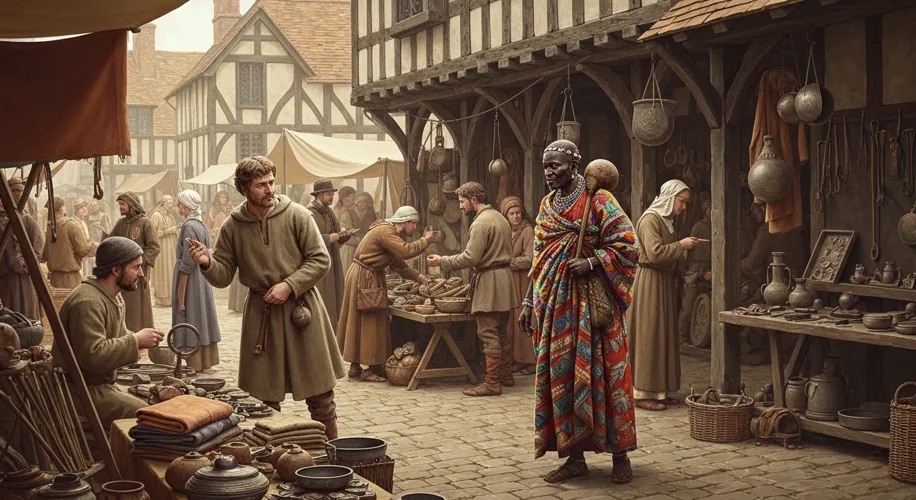
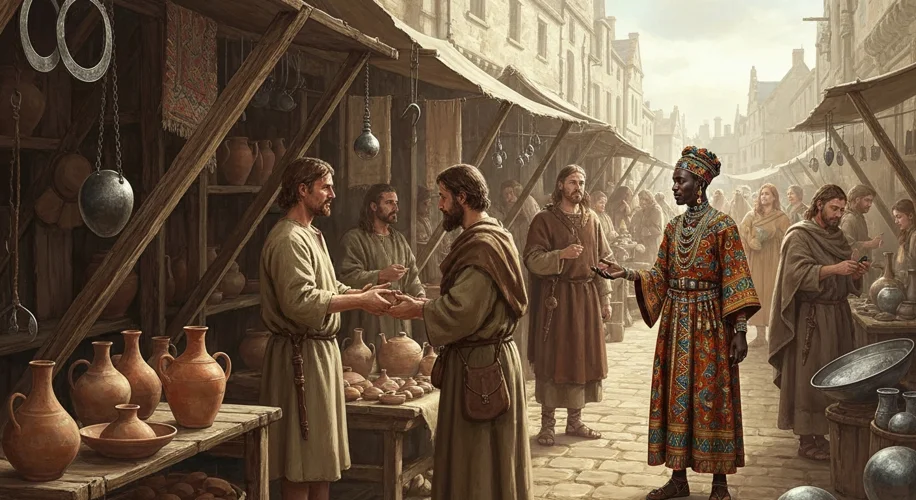
This isn’t about mass invasions or widespread settlement. It’s about the subtle, yet significant, presence of individuals. Think of the legendary tales of African merchants or envoys, their dark skin and exotic attire a stark contrast to the fair-haired inhabitants of Britannia. While definitive proof of large-scale settlements remains elusive, the presence of West African individuals in 7th-century England is not mere speculation. It speaks to the reach of trade networks that connected the Mediterranean world to lands far beyond.
These movements weren’t unidirectional. Europe itself was a migratory hub. The Anglo-Saxons themselves had arrived on British shores centuries earlier, displacing the Romano-Britons who, in turn, migrated to Brittany and other parts of the continent. The Franks, Lombards, and Goths had carved out kingdoms across the former Western Roman Empire. Further East, Slavic peoples were spreading across Eastern Europe, shaping the future of nations from Poland to the Balkans.
The nature of these migrations varied. Some were driven by conquest and the establishment of new political orders, like the Germanic tribes’ settlement in Roman Gaul. Others were more organic, driven by economic necessity or the search for fertile land. The expansion of agricultural communities, for instance, often led to the displacement or assimilation of existing populations.
Key actors in these movements weren’t just anonymous masses. They included skilled artisans seeking patronage, religious refugees fleeing persecution, and merchants whose livelihoods depended on traversing vast distances. Consider the Irish monks who, in their pursuit of knowledge and missionary zeal, established monasteries across Europe, from Iona to Fulda, becoming crucial centers of learning and cultural exchange.
The evidence for West African presence in England, though sparse, is tantalizing. It suggests that by the 7th century, the Mediterranean had become a vibrant nexus of exchange, linking North Africa with Southern Europe, and through existing trade routes, extending its influence further north. These were not isolated encounters but part of a broader, interconnected world.
What does this tell us? Firstly, it challenges the notion of a rigidly divided early medieval Europe. The existence of these far-reaching connections implies a level of global awareness and interconnectedness that we often underestimate. Secondly, it highlights the limitations of our historical sources. Much of this movement, particularly of ordinary people and merchants, went unrecorded, leaving us to piece together fragments from archaeology, linguistic studies, and the occasional textual reference.
The impact of these migrations was profound and multifaceted. They led to the blending of cultures, the spread of new technologies and ideas, and the very formation of the diverse European landscape we see today. The presence of individuals from distant lands, however small their numbers, acted as catalysts for cultural exchange, broadening horizons and challenging established norms.
Studying these early medieval migration patterns is like deciphering a complex mosaic. Each shard of evidence, whether it’s a pottery fragment, a stray mention in a chronicle, or an archaeological find, adds another layer to our understanding. It reminds us that history is not a static narrative but a dynamic process, shaped by the constant ebb and flow of human movement, a testament to our enduring drive to explore, connect, and build new lives, even across the vast distances of continents and centuries.
This understanding of movement isn’t just an academic exercise. It encourages us to look beyond simplistic narratives and embrace the full, complex, and often surprising story of human history. It’s a story of how the world, even in its nascent medieval stages, was already a much smaller, more interconnected place than we often imagine.