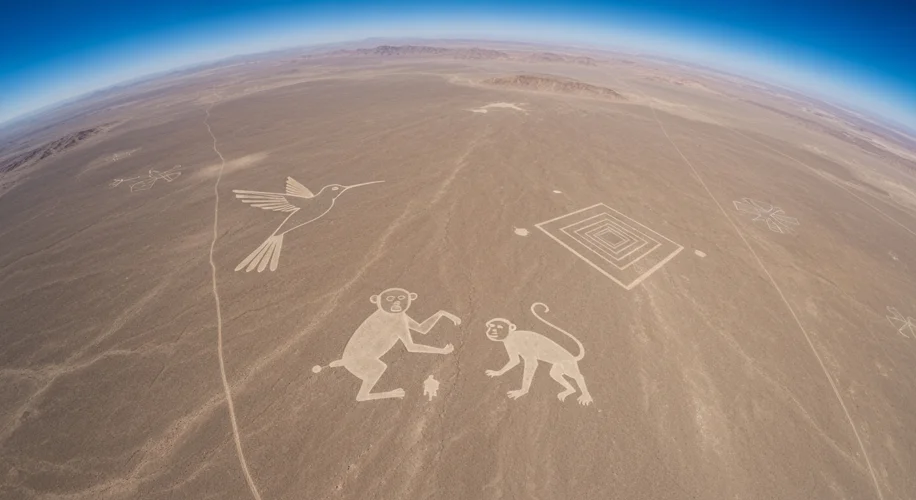
Imagine a vast, arid expanse stretching for miles under the relentless Peruvian sun. Now, picture that this seemingly barren landscape is, in fact, a colossal canvas, etched with intricate designs so immense they can only be truly appreciated from the heavens. These are the Nazca Lines, a UNESCO World Heritage site and one of archaeology’s most enduring mysteries. For centuries, their purpose, their creators, and the very method of their creation have baffled historians and scientists alike.
The story of the Nazca Lines is, in many ways, a story of the people who lived in this challenging environment thousands of years ago. The Nazca culture flourished in the arid coastal valleys of Peru from around 100 BCE to 800 CE. This was a civilization that mastered sophisticated irrigation systems, evidenced by their underground aqueducts, known as puquios, which still function today. They were also skilled artisans, producing exquisite pottery and textiles, often adorned with vibrant depictions of animals, gods, and geometric patterns.
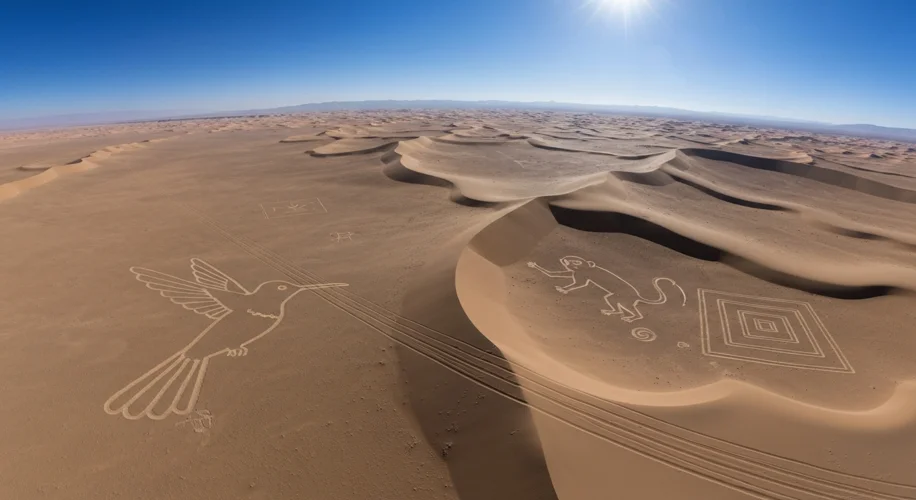
However, it was their monumental earth art that would cement their legacy. These geoglyphs, ranging from simple lines and trapezoids to complex representations of animals like hummingbirds, monkeys, spiders, and lizards, cover an area of approximately 450 square kilometers. They were created by removing the reddish-brown pebbles that cover the desert surface, revealing the lighter-colored earth beneath. The precision with which these massive figures were etched, some stretching over hundreds of meters, is astonishing, especially considering the tools available to the Nazca people.
For decades, the primary question has been: why? Early theories, often fueled by the era’s fascination with extraterrestrial visitors, suggested alien architects. However, more grounded archaeological research, spearheaded by figures like Maria Reiche, a German mathematician and archaeologist who dedicated her life to studying the lines, has pointed towards more terrestrial explanations. Reiche meticulously documented the lines, cleaning and preserving them, and proposed they served astronomical purposes, aligning with solstices and other celestial events. Her work, though sometimes debated, was foundational in understanding the Nazca’s connection to the cosmos.
Other prominent theories suggest the lines were part of elaborate ritual pathways, used for religious processions or ceremonies. The sheer scale and the fact that the figures are largely invisible from ground level strongly imply a ritualistic or ceremonial purpose, perhaps involving divine beings or sky gods. Some scholars believe they were also related to water rituals, given the Nazca’s reliance on water in such a dry region. The figures themselves, particularly the animals, often hold symbolic meaning in Andean cultures, representing fertility, abundance, or specific deities.
The mystery, however, is not just about the why but also the how. How did a pre-industrial society, without the benefit of aerial observation or advanced surveying tools, create such precise and enormous designs? While there’s no single definitive answer, the prevailing theories involve sophisticated knowledge of geometry and astronomy, coupled with the use of simple tools like stakes, ropes, and possibly sighting sticks. The Nazca likely used a system of proportional drawing, creating smaller-scale models which were then enlarged using a grid system or by sighting from elevated points.
The consequences and impact of the Nazca Lines extend far beyond their original purpose. They have become a powerful symbol of ancient ingenuity and a testament to human creativity. Their discovery and ongoing study have enriched our understanding of pre-Columbian South American civilizations, revealing a society with complex beliefs and advanced practical knowledge. Furthermore, the Nazca Lines are a significant tourist attraction, drawing visitors from around the globe and contributing to Peru’s economy, while simultaneously raising concerns about preservation and the potential impact of tourism on this fragile heritage.
Analyzing the Nazca Lines forces us to confront the limits of our own understanding and to appreciate the intellectual and artistic achievements of ancient peoples. They remind us that history is not always written in stone or parchment, but can also be etched into the very earth we stand upon. The whispering sands of the Nazca desert continue to hold their secrets, inviting us to ponder the minds that conceived such monumental art and the world they inhabited, a world both vastly different and eerily familiar to our own.