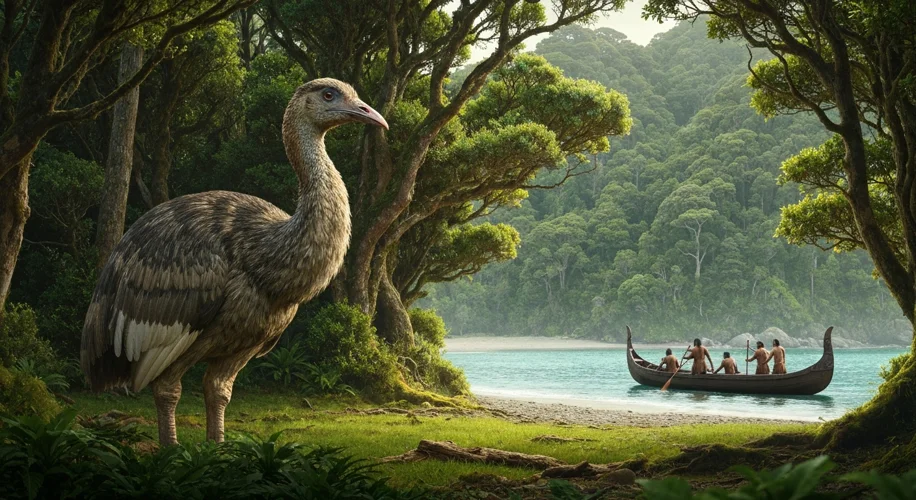
Imagine a land untouched by human footsteps, a sanctuary where colossal birds, some standing taller than a man, roamed freely. This was Aotearoa, the Land of the Long White Cloud, or as we know it today, New Zealand, before the arrival of Māori voyagers around 1300 CE.
For millennia, these magnificent creatures, the moa, were the undisputed giants of this isolated paradise. With over a dozen species, ranging from the stout, eagle-sized little bush moa to the towering giant moa that could reach 3.6 meters (12 feet) tall, they were the apex herbivores, shaping the very landscape with their grazing. They were flightless, their wings having atrophied over eons of isolation, rendering them vulnerable but also, for a time, supremely confident in their dominion.
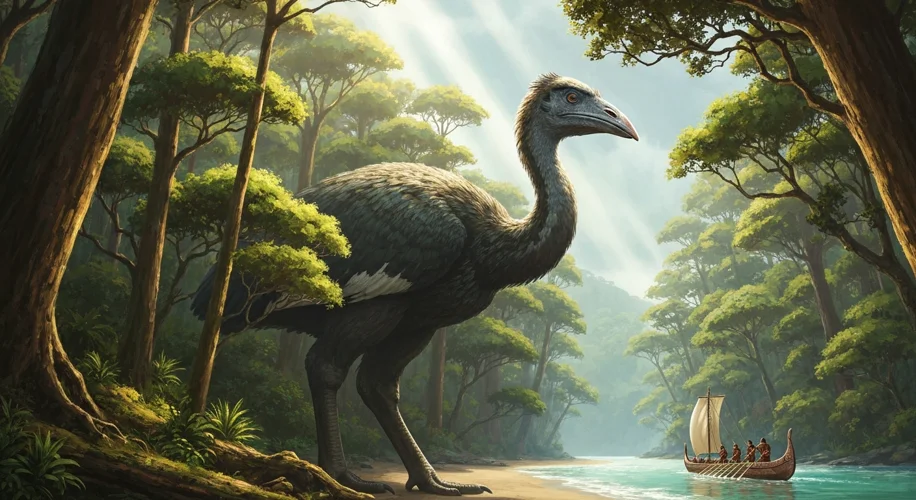
Then, the horizon changed. The first Polynesian navigators, skilled seafarers guided by stars and ocean currents, arrived in their waka. They were the ancestors of the Māori, bringing with them a culture rich in oral tradition, deep respect for the land (whenua), and a practical need to sustain their new home. They found a land teeming with life, including the moa, which, for the Māori, represented not just a potential food source but also a spiritual connection and a provider of valuable resources like feathers and bones.
The relationship between the Māori and the moa was complex. Early interactions were likely characterized by a balance, with moa hunting being a vital part of survival. Archaeological evidence, including moa bone middens (refuse heaps) and preserved eggshells, paints a picture of a diet that heavily featured these birds. The Māori developed sophisticated hunting techniques, and the moa’s sheer size and immobility made them an attractive target.
However, this delicate balance began to fray as the Māori population grew and their settlements became more established. The demand for moa resources—meat for sustenance, bones for tools and ornaments, and sinews for cordage—increased. The moa, so perfectly adapted to an environment without predators, proved ill-equipped to cope with the sustained pressure of human hunting.
Consider the timeline: While moa bones are found in archaeological sites dating back to the earliest Māori settlements, the widespread exploitation and subsequent decline seem to have accelerated between the 15th and 17th centuries. Some historians and scientists point to a phenomenon known as the “overkill hypothesis,” suggesting that human hunting was the primary driver of extinction. Others suggest a more nuanced view, incorporating the impact of introduced species like the Polynesian rat, which could have preyed on moa eggs and chicks, and potential environmental changes.
Regardless of the exact combination of factors, the outcome was tragic. By the early 18th century, the last of the moa had vanished. These magnificent giants, which had roamed New Zealand for millions of years, were gone forever, their existence reduced to stories, skeletal remains, and the poignant lessons they offer.
The extinction of the moa serves as a stark, albeit ancient, case study of human impact on island ecosystems. Islands, by their very nature, are often home to unique species that have evolved in isolation and lack defenses against novel threats. The moa’s story echoes across the globe, reminding us of the profound responsibility that comes with human expansion and the irreversible consequences of disrupting fragile ecological balances.
It’s a tale that transcends time, a haunting whisper from a lost world, urging us to be more mindful stewards of the planet we share. The moa’s silence is a powerful reminder of what can be lost when the scales tip too far, and the echoes of their vanished footsteps still resonate in the wild, untamed landscapes of New Zealand.