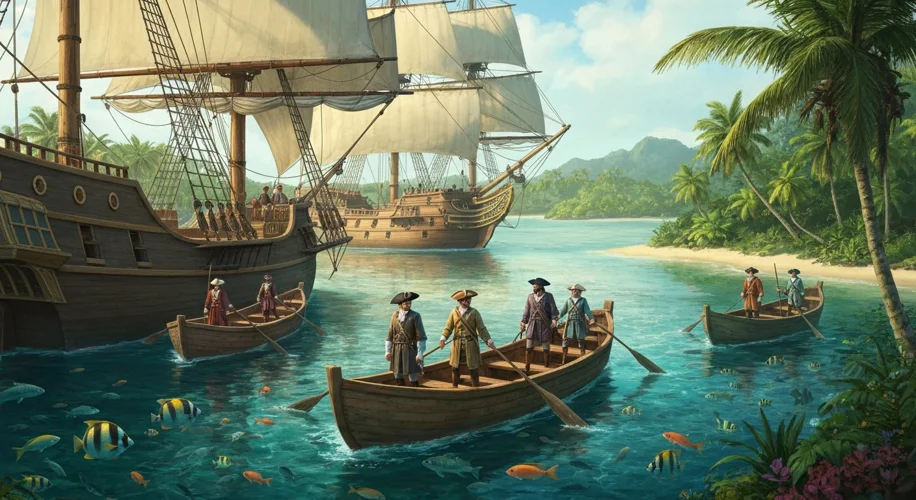
The year is 1769. Captain James Cook, a name that would soon echo across the vast Pacific, dropped anchor in the shimmering waters of Tahiti. His mission, ostensibly, was to observe the transit of Venus. But as his ship, the HMS Endeavour, lay at rest, a silent, yet profound, transformation began. The arrival of Europeans in the Pacific was not merely a chapter in human history; it was an ecological cataclysm, a wave of unintended consequences that would irrevocably alter the delicate balance of island life.
For millennia, the islands of the Pacific had existed in a state of remarkable ecological equilibrium. Separated by immense stretches of ocean, their unique flora and fauna had evolved in isolation, creating a biodiversity found nowhere else on Earth. The Polynesian peoples, skilled navigators and resourceful inhabitants, had long learned to live in harmony with these environments, developing sustainable practices that allowed them to thrive for centuries. Their canoes, laden with breadfruit, taro, and pigs, had carried life across the vast ocean, but their impact was carefully managed, a testament to their deep understanding of the natural world.
Then came the Europeans. Driven by a thirst for discovery, trade, and empire, ships like the Endeavour, and later the Resolution and Discovery, began to crisscross these ancient waters. To the indigenous populations, these arrivals were initially met with curiosity and, at times, wonder. The Europeans, clad in strange fabrics and wielding unfamiliar tools, represented a world beyond their wildest imaginings.
But beneath the veneer of exploration and scientific curiosity lay a biological Trojan Horse. Carried within the hulls of these ships, often unseen and unappreciated, were organisms that had no place in the Pacific’s isolated ecosystems. Rats, stowaways on virtually every voyage, became an immediate scourge. Their insatiable appetites decimated native bird populations, many of which had evolved without terrestrial predators and possessed no fear of these new invaders. Eggs, chicks, and even adult birds became easy prey. Imagine a world where the vibrant symphony of island birds, a constant companion for generations, slowly fell silent, replaced by the rustling of unseen rodents.
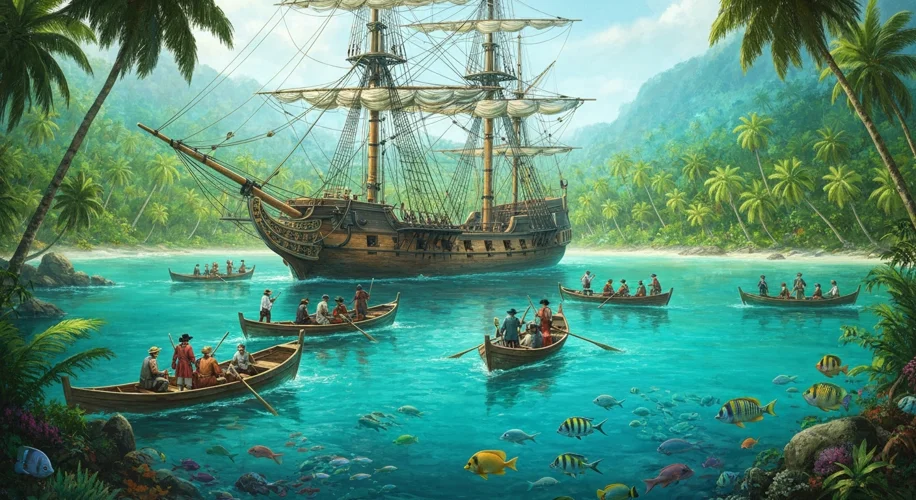
Beyond the ubiquitous rat, the Europeans brought other unwelcome guests. Goats, pigs, and cattle, introduced as potential food sources or simply as companions for the long voyages, wreaked havoc on island vegetation. Unaccustomed to grazing pressures, these animals stripped the land bare, leading to soil erosion and the destruction of native plant communities. Delicate ferns, once thriving, were trampled and consumed. Entire forests, the lifeblood of many islands, were reduced to barren landscapes.
Consider the humble sweet potato. Brought by Europeans from South America, it was a valuable crop. However, its introduction also brought with it pests and diseases that had previously been unknown to the Pacific. The very things meant to improve life could inadvertently sow destruction.
Even the explorers’ scientific endeavors carried unintended consequences. While meticulously documenting new species, they also facilitated the spread of invasive plants. Seeds clung to their boots, their clothing, and the hulls of their ships, hitching rides to new shores. These new plants, often more aggressive and adaptable than their native counterparts, outcompeted local flora for sunlight, water, and nutrients, further simplifying and impoverishing the island ecosystems.
The impact wasn’t confined to the terrestrial realm. European ships, with their iron hulls and growing reliance on ballast water, introduced marine species to new environments. Algae, barnacles, and other microorganisms, once confined to their home waters, found themselves transported across vast oceanic distances, disrupting local marine food webs and competing with native species.
For the indigenous peoples, this ecological disruption was often a devastating blow. Their traditional ways of life, deeply intertwined with the health of their local environments, were fundamentally challenged. The loss of native birds meant the loss of food sources, cultural symbols, and the very songs that echoed through their villages. The degradation of the land threatened their ability to sustain themselves, leading to food shortages and social upheaval.
Captain Cook and his contemporaries were, in many ways, pioneers. They pushed the boundaries of human knowledge and charted a world previously unknown to Europe. Yet, their voyages, driven by the ambitions of empires and the allure of the unknown, set in motion an ecological domino effect. The Pacific, a region of unparalleled natural beauty and unique evolutionary paths, became an early victim of globalization’s unintended ecological footprint. The rustle of a rat in the undergrowth, the stripped bark of a tree, the altered song of a bird – these were the quiet, yet profound, echoes of Europe’s arrival, a stark reminder that exploration carries a responsibility that extends far beyond the charted maps and scientific discoveries.
