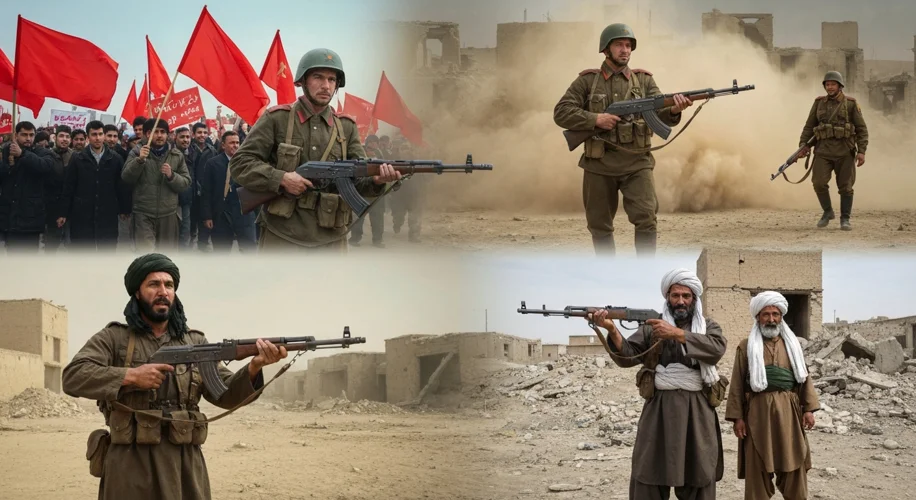
The year is 1978. Dust devils dance across the arid plains of Afghanistan, a land of ancient mountains and stoic peoples. But beneath the serene facade, a storm is brewing. The People’s Democratic Party of Afghanistan (PDPA), fueled by Marxist ideals and a desire to modernize a deeply traditional society, ignites the Saur Revolution. It’s a swift, brutal coup, overthrowing President Mohammed Daoud Khan and ushering in an era of radical change.
Imagine Kabul at this time. Gone are the whispers of royal intrigue; replaced by the sharp, urgent pronouncements of a new regime. Land reforms are decreed, women’s rights are championed, and a secular state is envisioned. For some, it’s the dawn of a new, progressive Afghanistan. For others, particularly in the deeply religious and tribal countryside, it’s an assault on their way of life, a foreign ideology tearing at the fabric of their ancient traditions. This seismic shift didn’t just alter political structures; it fractured the very soul of the nation.
The PDPA, however, was far from unified. Factionalism and internal purges quickly weaken the new government. Hafizullah Amin, a ruthless ideologue, consolidates power, his paranoia a palpable force. His rivals, fearing for their lives, look beyond Afghanistan’s borders for salvation. The Soviet Union, Afghanistan’s powerful neighbor and ideological ally, watches with growing unease. They had supported the coup, but Amin’s unpredictable nature and the internal strife within the PDPA threatened to destabilize the region.
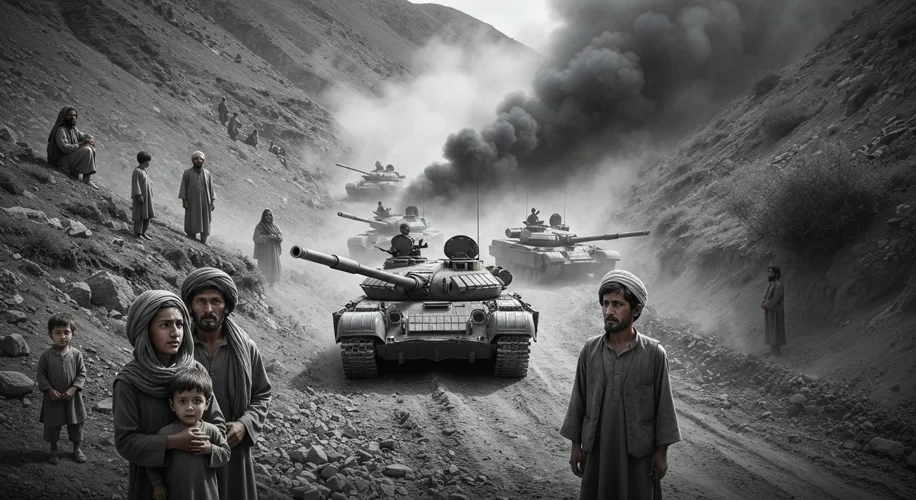
In December 1979, the storm truly breaks. Soviet tanks, thousands of them, pour across the border. Their stated goal: to support the Afghan government and thwart external interference. But for the Afghan people, it’s an invasion, an unwelcome occupation by a foreign power. The Saur Revolution, intended to liberate Afghanistan, has instead plunged it into a devastating war. The world watches, the Cold War a chilling backdrop, as the Soviet-Afghan War ignites.
This is where the landscape of conflict truly transforms. The mujahedeen, disparate groups of Afghan fighters united by their fierce opposition to both the communist government and the Soviet presence, rise to meet the challenge. From the rugged peaks of the Hindu Kush to the dusty villages of the south, they wage a brutal insurgency. Many are motivated by faith, by a desire to defend their homeland from infidels and foreign powers. They are supplied, trained, and armed by a clandestine coalition of nations, including the United States, Saudi Arabia, and Pakistan, all eager to bleed the Soviet Union in its own backyard.
Think of the human cost. Villages are flattened, families are torn apart, and millions are forced to flee their homes, becoming refugees in Pakistan and Iran. The iconic Soviet MiG jets fill the skies, dropping bombs, while the mujahedeen, armed with Stinger missiles gifted by the CIA, strike back with surprising effectiveness. It’s a war of ambushes, of hidden mountain strongholds, of brutal tactics on both sides. The Soviet military, accustomed to conventional warfare, finds itself bogged down in a quagmire, a stark contrast to their earlier boasts of a swift victory.
The war drags on for nearly a decade. The Soviets, facing mounting casualties and domestic pressure, finally withdraw in 1989, leaving behind a shattered country and a fractured government. But the fighting doesn’t stop. The mujahedeen, once united against a common enemy, now turn on each other. Warlords carve out their own fiefdoms, and Afghanistan descends into a brutal civil war. The hope for peace evaporates, replaced by the chilling sound of Kalashnikovs and the constant fear of violence.
Into this power vacuum steps a new force: the Taliban. Emerging from the religious schools in southern Afghanistan, these puritanical students, often perceived as bringing order to chaos, rapidly gain territory. By 1996, they control Kabul, imposing their strict interpretation of Islamic law. Music is banned, women are forced into purdah, and public life is dictated by religious decree. Afghanistan, once a land striving for modernity, is now a nation under a medieval-like grip.
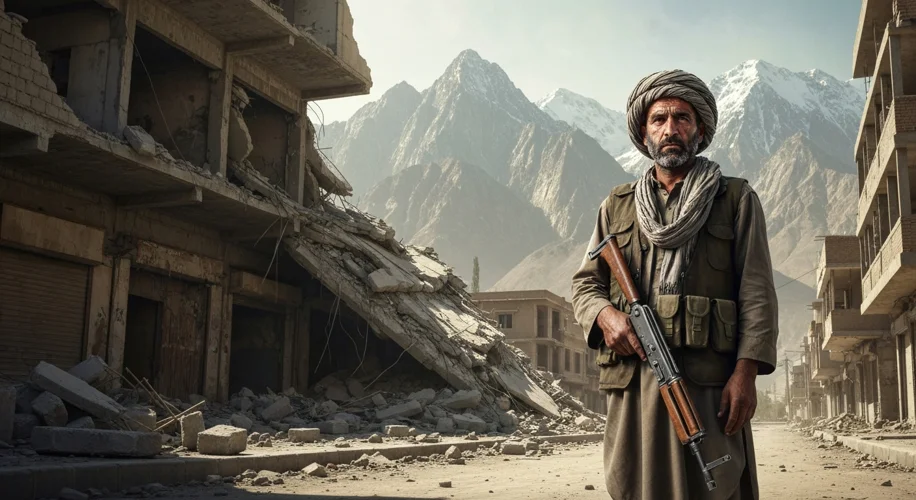
For nearly five years, the Taliban rule, their regime largely unrecognized internationally, save for Pakistan, Saudi Arabia, and the UAE. Their strict policies and human rights abuses create a climate of fear and oppression. Then comes September 11, 2001. The terrorist attacks on the United States, orchestrated by Osama bin Laden and his al-Qaeda network, harbored by the Taliban regime, change everything.
The world’s attention, now a laser-focused beam, turns to Afghanistan. The United States, along with its allies, launches Operation Enduring Freedom, aiming to dismantle al-Qaeda and remove the Taliban from power. The 2001 invasion marks the beginning of another chapter, a new phase in Afghanistan’s protracted struggle for stability and self-determination.
The war that began with the idealistic fervor of the Saur Revolution, escalated through the brutal pragmatism of the Soviet-Afghan War, and solidified under the rigid rule of the Taliban, leaves an indelible mark. It is a story of ambition, ideology, external interference, and the enduring resilience of a people caught in the relentless tides of conflict. The echoes of these decades of war continue to shape Afghanistan, a testament to the complex, and often tragic, journey of a nation.
Tags: Afghanistan War, Soviet-Afghan War, Taliban, Saur Revolution
Categories: World History, Modern History, Geopolitics
Seo Title: Afghanistan’s Crucible: Decades of Conflict from Saur Revolution to Taliban
Seo Focus Keyphrase: War in Afghanistan (1978-2001)
Seo Meta Description: Explore Afghanistan’s tumultuous history from the 1978 Saur Revolution through the Soviet-Afghan War and the rise of the Taliban, a period of immense conflict and transformation.