
The desert air in Tabas, Iran, hung thick and still on April 24, 1980. For 162 days, the world had watched, captivated and horrified, as 52 Americans were held hostage in the U.S. Embassy in Tehran. Their captors, a fervent group of Iranian students, had transformed the once-proud symbol of American diplomacy into a gilded cage. Back in the United States, a nation seethed with a mixture of anger, helplessness, and a desperate yearning for a swift resolution.
Behind the scenes, a plan was being hatched, a high-stakes gamble veiled in secrecy and fueled by the urgency of the unfolding crisis. It was codenamed Operation Eagle Claw, a daring, multifaceted rescue mission designed to snatch the hostages from the jaws of their captors and return them to American soil. The stakes couldn’t be higher, and the eyes of the world, though unaware of the specifics, were fixed on the unfolding drama.
The backdrop to this desperate act was the seismic shift in Iran’s political landscape. The Islamic Revolution of 1979 had toppled the Shah and ushered in a new, fervent Islamic Republic under Ayatollah Ruhollah Khomeini. The storming of the U.S. Embassy on November 4, 1979, was not merely an act of aggression; it was a defiant roar against the United States, which was perceived by many Iranians as having supported the Shah’s oppressive regime. The hostage crisis became a potent symbol of this revolutionary fervor, a way for the new regime to assert its power on the international stage and rally domestic support.
Inside the besieged embassy, the hostages endured a daily existence of uncertainty, fear, and indignity. They were subjected to interrogations, propaganda, and the constant threat of violence. Their plight became a national obsession in America, a wound that refused to heal. The U.S. administration, under President Jimmy Carter, felt immense pressure to act, but diplomatic channels had been exhausted, and economic sanctions had yielded little fruit.
Thus, the concept of a military rescue began to take shape. The plan was audacious, bordering on reckless. It involved a complex choreography of aircraft and helicopters inserting special forces deep into Iran, rendezvousing at a desert location known as ‘Desert One,’ and then proceeding to Tehran to extract the hostages. The teams involved were elite: U.S. Army Rangers, Delta Force operators, and Navy SEALs, all highly trained and ready for the most dangerous missions. However, they were about to confront an adversary far more formidable than they anticipated: the vast, unforgiving Persian desert and the unyielding hand of fate.
The night of April 24th arrived, cloaked in darkness and a chilling wind. The mission began with a fleet of C-130 transport planes and eight RH-53D Sea Stallion helicopters carrying the commandos. But almost immediately, the operation began to unravel. Poor weather conditions, including a dense desert dust storm, hampered visibility. One helicopter developed a critical mechanical failure and had to abort, while another landed safely but was grounded due to hydraulic issues. The plan, so meticulously crafted, was already fraying at the edges.
As more helicopters arrived at Desert One, the situation grew dire. Only five of the original eight helicopters were operational. The commander, Major General James Vaught, faced a heart-wrenching decision: press on with a depleted force or abort the mission. The risks of continuing with insufficient resources, particularly the number of helicopters needed to transport all the commandos and hostages, were deemed too high. President Carter, notified of the unfolding disaster, gave the order to abort. In the chaotic, hasty withdrawal, tragedy struck.
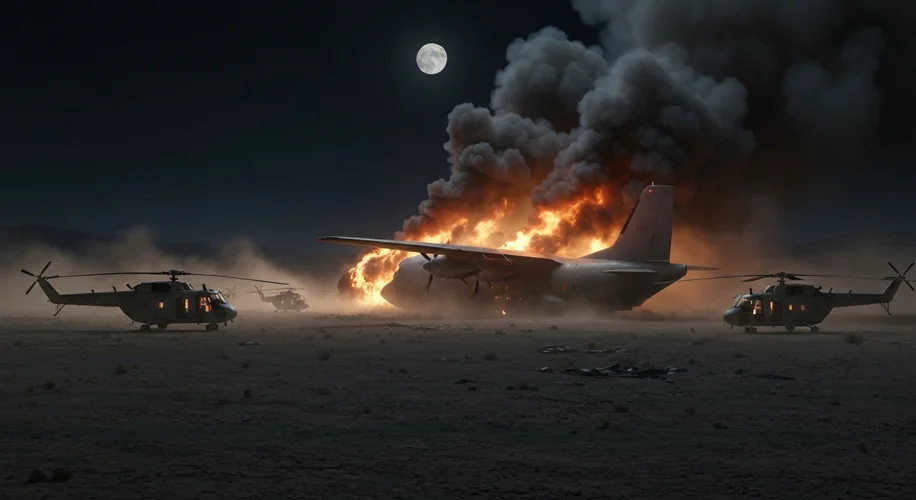
During the re-embarkation of forces, one of the operational helicopters, while maneuvering, collided with a C-130 transport aircraft. The resulting explosion and fire engulfed both aircraft, killing eight U.S. servicemen and injuring several others. The mission, intended to be a surgical strike of liberation, had become a devastating failure, a fiery tomb in the desert.
The aftermath of Operation Eagle Claw was a bitter pill for the United States to swallow. The failed rescue attempt only emboldened the Iranian regime and deepened the humiliation felt by the American public. It exposed critical flaws in inter-service coordination, equipment reliability, and the complex logistical challenges of such a daring operation. The mission’s failure led to significant soul-searching within the U.S. military, ultimately resulting in the restructuring of special operations forces and the creation of the U.S. Special Operations Command (SOCOM) in 1987.
The human cost was immense. Eight brave servicemen lost their lives in the desolate Iranian desert, their final moments a testament to their dedication. The hostages, still in captivity, faced an even more uncertain future. The psychological impact on the American psyche was profound, reinforcing the sense of vulnerability and the deep frustration of seeing fellow citizens held captive.
Operation Eagle Claw stands as a stark reminder of the immense challenges and inherent risks of military intervention, particularly in complex, unfamiliar environments. It was a mission born out of desperation, an attempt to reclaim a sense of agency in a crisis that had paralyzed diplomatic efforts. While the rescue itself failed, the lessons learned from its catastrophic shortcomings would, in time, lead to more refined and effective special operations capabilities, ensuring that the sacrifice made in the desert was not entirely in vain. The memory of Eagle Claw serves as a somber epigraph in the annals of American foreign policy, a cautionary tale of a desert mirage that promised salvation but delivered tragedy.