
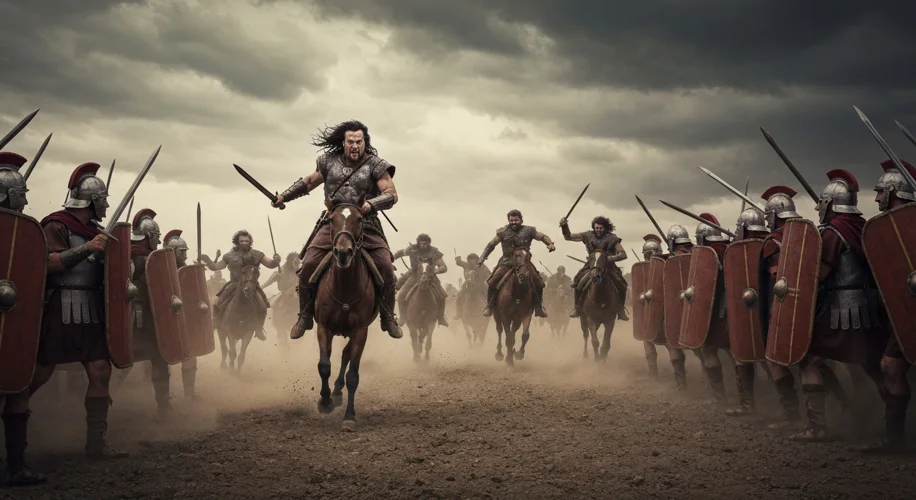
The year is 451 CE. Imagine the scene: a vast plain in Gaul, the air thick with the scent of sweat, fear, and horseflesh. Before one army stands the formidable Roman Empire, its legions a symbol of order and might. Facing them is a force of nature, a whirlwind of destruction led by a man whose very name would become synonymous with terror: Attila the Hun.
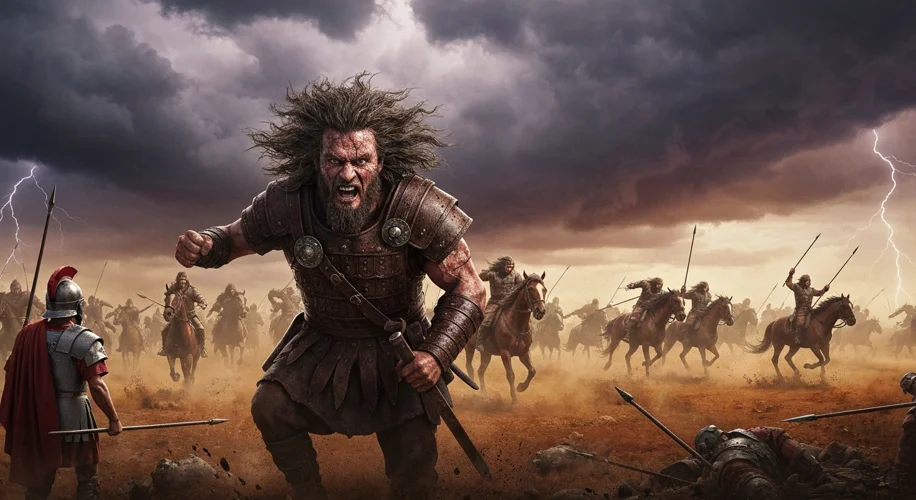
For decades, the Huns, a nomadic people from the Eurasian Steppe, had been a creeping dread along the Roman frontiers. Their arrival in Europe in the late 4th century had destabilized everything, pushing Germanic tribes like the Goths and Vandals westward, directly into the Roman Empire’s vulnerable territories. But it was under Attila, who rose to sole leadership of the Hunnic Empire around 434 CE, that the Hunnic threat coalesced into a singular, apocalyptic force.
Attila was not merely a brutal chieftain; he was a cunning strategist and a master of psychological warfare. He understood the power of fear. His warriors, renowned for their horsemanship, archery skills, and ferocity in battle, struck with a speed and savagery that left their enemies bewildered and broken. His empire stretched from the Volga River to the Danube, a vast dominion built on tribute, conquest, and the terror he inspired. He was, in the eyes of many Romans and Christians, the “Scourge of God,” an instrument of divine wrath unleashed upon a sinful world.
Attila’s ambition knew no bounds. His campaigns were not just about plunder; they were about subjugating rivals and extracting ever-greater tribute from the weakened Western Roman Empire. In 451 CE, he turned his gaze westward, marching his vast host into Gaul. His target: the heart of Roman power in the West. He besieged cities, burned villages, and left a trail of devastation in his wake. The Roman general Aetius, a man of remarkable skill and resilience, recognized the existential threat. He rallied the remnants of Roman strength and, crucially, forged an alliance with former enemies – the Visigoths, led by Theodoric I.
On June 20, 451 CE, the two armies met on the Catalaunian Plains, near modern-day Châlons-en-Champagne. It was a titanic clash, a battle that has echoed through history. The Huns fought with their characteristic ferocity, but the combined might of the Romans and their Germanic allies held firm. Theodoric I, fighting bravely at the head of his men, fell in the melee. Yet, by day’s end, Attila’s seemingly invincible army had been checked. It was a costly victory for the Romans, but it had blunted the Hunnic advance and saved Gaul from utter destruction.
Attila, however, was not one to accept defeat easily. The following year, in 452 CE, he turned his attention to Italy. His hordes swept across the northern plains, sacking cities like Aquileia, Padua, and Milan. Rome itself seemed to tremble. Legend has it that Pope Leo I, a charismatic and influential figure, personally met Attila on the banks of the Mincio River and, through his impassioned plea and perhaps a hefty tribute, persuaded the Hunnic king to turn back. While the historical accounts are debated, the retreat of the Huns from Italy remains a pivotal moment.
Attila’s reign of terror, however, was surprisingly short-lived. In 453 CE, he died unexpectedly on his wedding night, reportedly from a hemorrhage. His vast empire, held together by his iron will and the fear he commanded, quickly fragmented upon his death. His sons squabbled over the spoils, and the subjugated peoples rose in revolt. The Hunnic threat, which had loomed so large for decades, dissolved as quickly as it had appeared.
But the impact of Attila and the Huns was profound and lasting. Their invasions were a catalyst for monumental change. They accelerated the decline of the Western Roman Empire, contributing significantly to its eventual collapse in 476 CE. They spurred the great migrations of Germanic tribes, reshaping the ethnic and political map of Europe. The very fear Attila instilled became a potent cultural memory, cementing his place in history as the “Scourge of God,” a terrifying force that, in its brutal passage, irrevocably altered the course of Western civilization. The echoes of his campaigns continued to resonate, shaping the nascent kingdoms and empires that would rise from the ashes of Rome.