
In the vast, silent theatre of our solar system, Jupiter reigns supreme, a colossal monarch attended by a dazzling retinue of moons. For decades, we have gazed upon this gas giant, marveling at its swirling storms and enigmatic Great Red Spot. Yet, the true extent of its influence, particularly its intricate dance with its celestial companions, remains a captivating frontier.
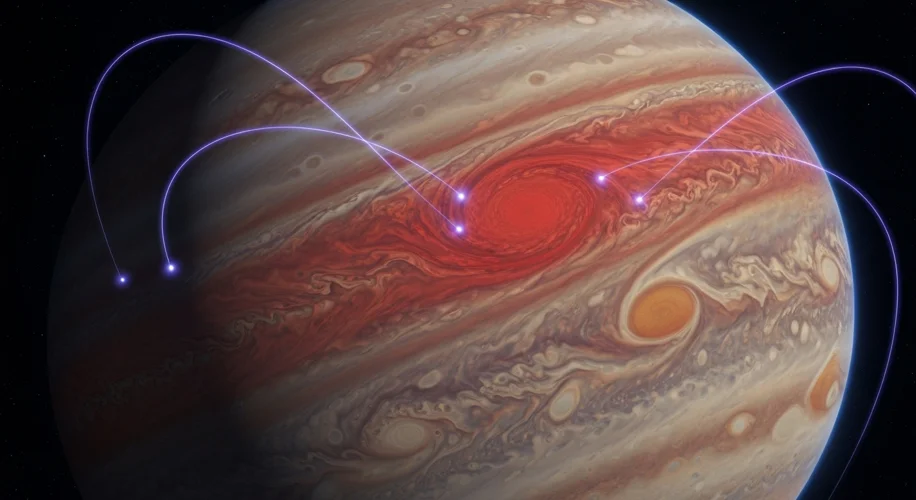
Now, the Juno spacecraft, a tireless explorer orbiting Jupiter, has unveiled a new layer of this grand cosmic ballet. For the first time, scientists have detected what are being called “auroral footprints” – tangible evidence of an interaction between Jupiter’s immense magnetosphere and its ancient, heavily cratered moon, Callisto. This groundbreaking discovery, published today, offers a tantalizing glimpse into the complex, dynamic relationship between a planet and its satellites.
Jupiter’s magnetosphere, a vast bubble of magnetic field lines extending millions of kilometers into space, is a powerful force that shapes the environment of the giant planet and its moons. Callisto, the third-largest moon of Jupiter and one of the most heavily cratered bodies in the solar system, orbits far from the planet, seemingly too distant to be significantly influenced. However, Juno’s sensitive instruments have revealed that this is far from the truth. The spacecraft detected faint, fleeting emissions of ultraviolet light near Jupiter’s poles – the tell-tale signs of auroras.
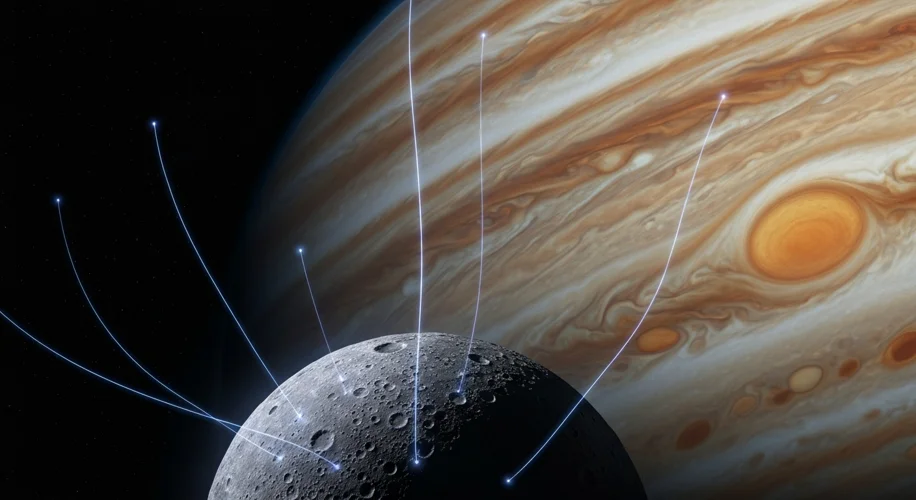
These auroras, beautiful ethereal displays of light in a planet’s atmosphere, are typically caused by charged particles, often channeled by magnetic fields, colliding with atmospheric gases. What makes these particular auroras so significant is their connection to Callisto. The observations suggest that as Callisto hurtles through Jupiter’s magnetosphere, it generates its own weak magnetic field and induces electrical currents. These currents then travel along Jupiter’s powerful magnetic field lines, eventually striking the planet’s atmosphere at the poles, creating these subtle auroral displays – the “footprints” of Callisto’s passage.
Imagine Callisto, a silent, ancient world, forging its way through the invisible currents of Jupiter’s magnetic field. As it moves, it leaves behind a subtle disturbance, a ripple in the electromagnetic ocean. It’s as if the moon is drawing invisible lines in Jupiter’s magnetic field, lines that are only revealed when they connect to the planet’s atmosphere and ignite in a faint, spectral glow.
This discovery is not merely a curiosity; it has profound implications for our understanding of planetary systems. It demonstrates that even moons in the outer reaches of a giant planet’s embrace can have a measurable impact on the planetary environment. It suggests that Jupiter’s magnetosphere is far more interconnected and responsive than previously thought, with distant moons playing a role in its complex workings. This has broader implications for studying other gas giants, like Saturn, and their numerous moons.
The Juno mission, launched in 2011, has been on an exceptional journey, providing unprecedented close-up views of Jupiter since its arrival in 2016. Its suite of advanced instruments, including the Ultraviolet Spectrograph (UVS), has been crucial in detecting these faint auroral signatures. The UVS instrument, in particular, is designed to observe the faint ultraviolet light emitted by planetary atmospheres, making it ideal for capturing phenomena like these auroral footprints.
The scientific community is abuzz with the implications of this find. It opens up new avenues of research into the electrodynamic coupling between giant planets and their moons. Future observations will aim to map these auroral footprints with greater precision, perhaps even revealing the subtle magnetic signatures of other Jovian moons, like Ganymede, which possesses its own intrinsic magnetic field.
This discovery reminds us that the universe is a place of constant, subtle interactions, where even the most distant objects can leave their mark. The silent journey of Callisto, a moon that has witnessed eons of cosmic history, has now revealed a hidden connection to its colossal parent, painting a new picture of the dynamic Jovian system. The echoes of this discovery will resonate through planetary science for years to come, urging us to look closer, listen more intently, and appreciate the intricate symphony of the cosmos.