
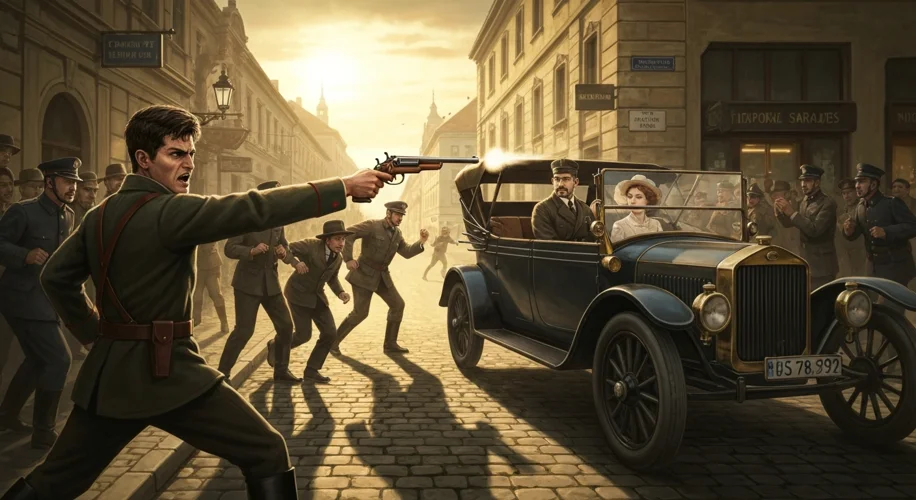
The summer of 1914 in Sarajevo was a picturesque scene, bathed in the warm Balkan sun. Archduke Franz Ferdinand, heir to the Austro-Hungarian throne, was visiting the city, a proud display of imperial power in a region simmering with nationalist fervor. The air, however, was thick not just with the scent of linden blossoms but with a volatile mix of ethnic tensions and political resentments that had been brewing for decades.
For years, the Austro-Hungarian Empire, a sprawling, multi-ethnic entity, had been struggling to maintain its grip on its diverse populations. Among these were the South Slavs, many of whom, like the Bosnian Serbs, yearned for an independent nation free from imperial rule. Secret societies and nationalist groups plotted in the shadows, fueled by a potent ideology of self-determination and a deep distrust of foreign domination. One such group, the Black Hand, a Serbian nationalist secret society, was particularly active, aiming to unite all South Slavs under Serbian leadership.
Into this charged atmosphere stepped Gavrilo Princip, a young, fervent Bosnian Serb nationalist. He was a pawn in a much larger game, a product of a generation that felt wronged and disenfranchised. His mind was set on a singular, explosive goal: to strike a blow against the empire that he believed was stifling his people’s destiny. He saw Archduke Franz Ferdinand not just as a representative of the Austro-Hungarian monarchy, but as a symbol of oppression.
On that fateful Sunday, June 28th, 1914, the Archduke’s motorcade made its way through Sarajevo. The morning had already been marred by a failed assassination attempt – a bomb thrown by another conspirator had bounced off the Archduke’s car and exploded nearby. Despite the clear danger and a heightened security presence, the Archduke’s plans were altered, leading his open-topped car down a route that unexpectedly brought him face-to-face with Gavrilo Princip. It was a moment of terrifying coincidence, a confluence of fate and meticulously laid, yet ultimately flawed, plans.
Princip saw his chance. Adrenaline surging, he stepped forward and fired two shots. The first struck the Archduke’s wife, Sophie. The second found its mark in Franz Ferdinand himself. The Archduke, a man who had been destined to inherit a vast empire, slumped over, his lifeblood staining the opulent uniform. The cheers of the crowd turned to gasps of horror, then to a chaotic scramble as Princip was apprehended, his act of defiance echoing through the stunned silence.
The assassination was not merely a regional tragedy; it was the flint that ignited the tinderbox of Europe. Austria-Hungary, outraged and seeking to punish Serbia, issued a harsh ultimatum. Serbia’s partial rejection of these demands triggered a cascade of pre-existing, intricate alliances. Russia, allied with Serbia, mobilized its forces. Germany, allied with Austria-Hungary, declared war on Russia and France. Britain, obligated to defend Belgium, declared war on Germany. In a matter of weeks, the continent plunged into the abyss of World War I, a conflict that would engulf the globe and claim millions of lives.
The assassination of Archduke Franz Ferdinand stands as a stark, chilling reminder of how a single act of violence, born from deeply rooted historical grievances and political aspirations, can have unimaginably catastrophic consequences. It was the ultimate, tragic illustration of how the personal becomes profoundly political, and how the spark of a single bullet can set the world ablaze.