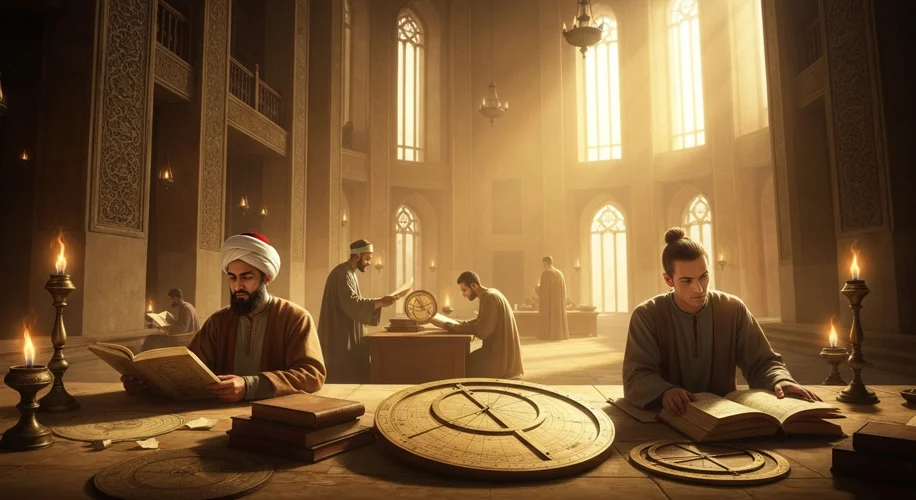
The year is 830 CE. Imagine the bustling heart of Baghdad, the Abbasid Caliphate’s magnificent capital. This city, a vibrant metropolis of scholars, merchants, and artisans, was about to become the epicenter of an intellectual revolution that would echo through centuries. At its core lay a place unlike any other – the Bayt al-Hikma, the House of Wisdom.
This was not a mere library, though it held an unparalleled collection of scrolls. It was a dynamic center of learning, a vibrant hub where the greatest minds of the era converged, driven by an insatiable thirst for knowledge. Under the ambitious patronage of Caliph al-Ma’mun, and fueled by the immense wealth and stability of the Abbasid Empire, a monumental undertaking began: the Translation Movement.
The world of the 8th and 9th centuries was a mosaic of ancient wisdom, much of it lying dormant in languages like Greek, Persian, and Sanskrit. These were the voices of Plato, Aristotle, Euclid, Ptolemy, the great Indian mathematicians, and the brilliant minds behind Persian philosophy. Yet, for the burgeoning intellectual community of the Islamic world, these voices were largely silenced by the barriers of language.
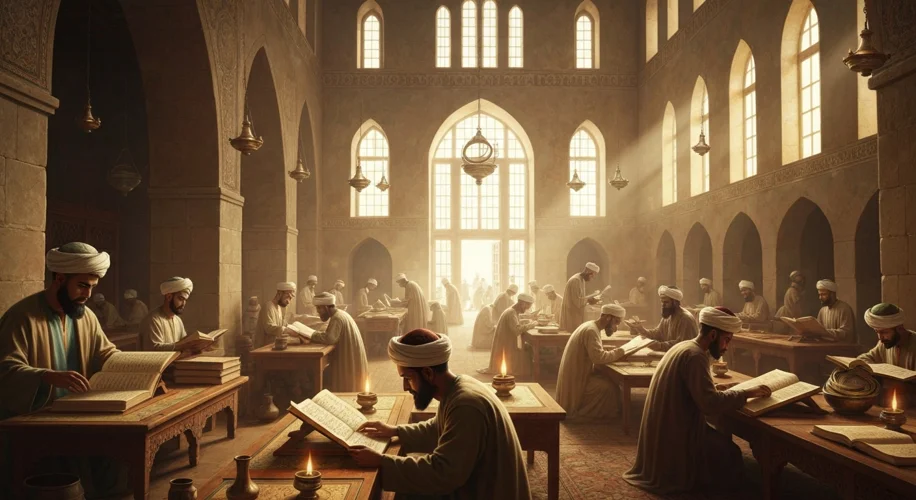
This is where the House of Wisdom stepped in. It was a beacon, actively seeking out these lost treasures. Scholars, often multilingual themselves, were tasked with the monumental effort of translating these intricate texts into Arabic. Imagine the scene: translators hunched over ancient papyri, their quills scratching across parchment, meticulously rendering complex philosophical arguments, precise scientific observations, and profound mathematical theorems into a language that was rapidly becoming the lingua franca of scholarship.
Key figures emerged from this intellectual fervor. Hunayn ibn Ishaq, a Nestorian Christian scholar, was a linchpin in this movement, renowned for his accurate translations of Greek medical and scientific works. His dedication ensured that the medical knowledge of Galen and Hippocrates, and the astronomical observations of Ptolemy, were preserved and disseminated. Persian scholars brought their rich literary and administrative traditions, while Indian scholars introduced a sophisticated understanding of mathematics, including the revolutionary concept of zero and the decimal system.
The impact of this movement was nothing short of transformative. The translated texts weren’t just passively absorbed; they were actively engaged with, critiqued, and built upon. Greek philosophy, for instance, found a fertile ground for reinterpretation, leading to profound advancements in Islamic philosophy by thinkers like al-Kindi and al-Farabi. The mathematical and astronomical knowledge from India and Persia laid the foundation for groundbreaking work by scholars like al-Khwarizmi, whose algorithms gave us the very word ‘algorithm’ and whose astronomical tables became standard references.
The House of Wisdom was more than just a translation bureau; it was an incubator of new ideas. Here, medicine, astronomy, mathematics, philosophy, and alchemy flourished. Observatories were built, laboratories were established, and fierce debates between scholars of different faiths and backgrounds were commonplace. This cross-pollination of ideas, facilitated by the translation movement, created a unique intellectual environment that propelled Islamic civilization to its Golden Age.
The legacy of the House of Wisdom and its Translation Movement is immeasurable. When Europe was mired in its own ‘Dark Ages,’ Baghdad was a radiant hub of intellectual activity, preserving and expanding upon the knowledge of the ancients. The Arabic texts translated and developed in Baghdad eventually found their way into Europe, particularly through Spain and Sicily, playing a crucial role in sparking the Renaissance and the Scientific Revolution. The very foundations of modern science and philosophy owe a profound debt to the diligent work done within the walls of the House of Wisdom.
Looking back, the Translation Movement in Baghdad wasn’t just about translating words; it was about translating worlds. It was a testament to the power of intellectual curiosity, the importance of cross-cultural exchange, and the enduring human drive to understand the universe around us. The echoes of those ancient voices, painstakingly brought back to life in Arabic at the House of Wisdom, continue to resonate in our world today, a powerful reminder that knowledge knows no borders and that wisdom, when shared, can illuminate the path for all humanity.