
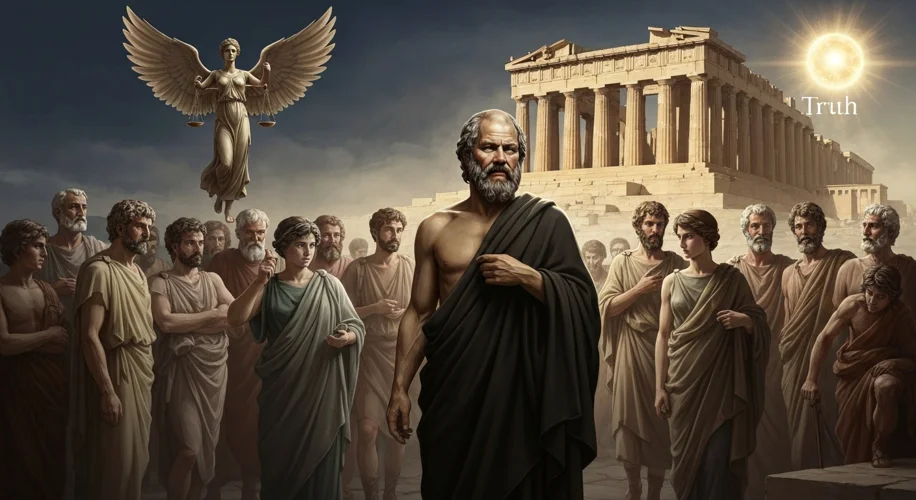
The Athenian Agora, a bustling marketplace and the heart of civic life, was no stranger to impassioned speeches and public debates. Yet, in 399 BCE, this vibrant space became the stage for a drama that would echo through millennia. Socrates, the barefoot, famously ugly philosopher, stood accused of crimes that struck at the very core of Athenian society: impiety and corrupting the youth. This was not just a legal battle; it was a clash of ideologies, a testament to the fragile nature of democracy, and the ultimate sacrifice of a man who lived and died by his philosophical convictions.
Socrates was a product of Athens’ Golden Age, a period of unparalleled artistic, intellectual, and political flourishing. However, his trial occurred in the shadow of the Peloponnesian War, a devastating conflict that had left Athens defeated, humbled, and deeply suspicious of its own institutions and citizens. The Thirty Tyrants, a brutal oligarchic regime installed by Sparta, had recently been overthrown, and Athens was attempting to re-establish its democratic ideals. In this climate of political instability and lingering resentment, any perceived threat to the social order was viewed with extreme caution.
Socrates himself was a peculiar figure. He engaged in what he called the “Socratic method,” a form of cooperative argumentative dialogue between individuals, based on asking and answering questions to stimulate critical thinking and to draw out ideas and underlying presumptions. He wandered the streets, engaging anyone who would listen – from prominent politicians to humble artisans – in relentless questioning about virtue, justice, and the good life. He famously claimed to know nothing, yet his persistent probing exposed the ignorance and inconsistencies in the beliefs of his fellow Athenians, earning him both admiration and considerable animosity.
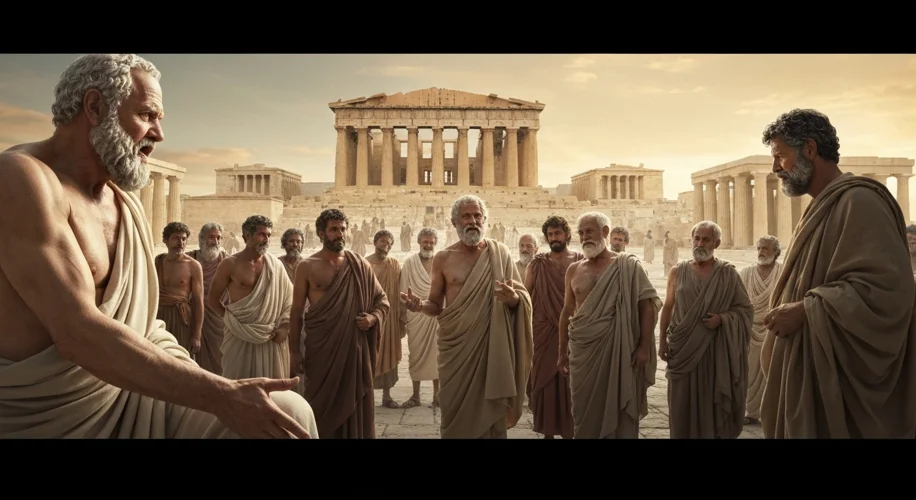
The charges against him were twofold. First, “impiety” – that he did not recognize the gods of the city and introduced new divinities. This was a serious accusation in a society where religious observance was deeply intertwined with civic identity. His accusers pointed to his “divine sign” or “daimonion,” a sort of inner voice that warned him against certain actions. Second, “corrupting the youth” – this stemmed from his influence on young aristocrats, such as Alcibiades and Critias, who later became controversial figures in Athenian politics. The prosecution argued that Socrates’ teachings led them astray, undermining their respect for traditional values and authority.
Socrates, in his defense, as recorded by his student Plato in the “Apology,” “Crito,” and “Phaedo,” did not beg for mercy or recant his beliefs. Instead, he embraced his role as a gadfly, stinging the Athenian conscience into self-examination. He argued that his philosophical pursuit was a divine mission, a service to the god Apollo, and that his influence on the youth was beneficial, encouraging them to question and strive for a more virtuous life. He saw his questioning not as corruption but as a form of intellectual midwifery, helping others to give birth to their own understanding.
When the verdict came, it was a close one. The jury, composed of 501 Athenian citizens, found him guilty. In the Athenian legal system, the convicted then had the opportunity to propose an alternative penalty. Socrates, in a move that further cemented his reputation for defiance and philosophical integrity, proposed that he should be honored with free meals in the Prytaneum, the city’s civic hall, as a reward for his services to the state – a subtle, yet powerful, indictment of the jury’s judgment.
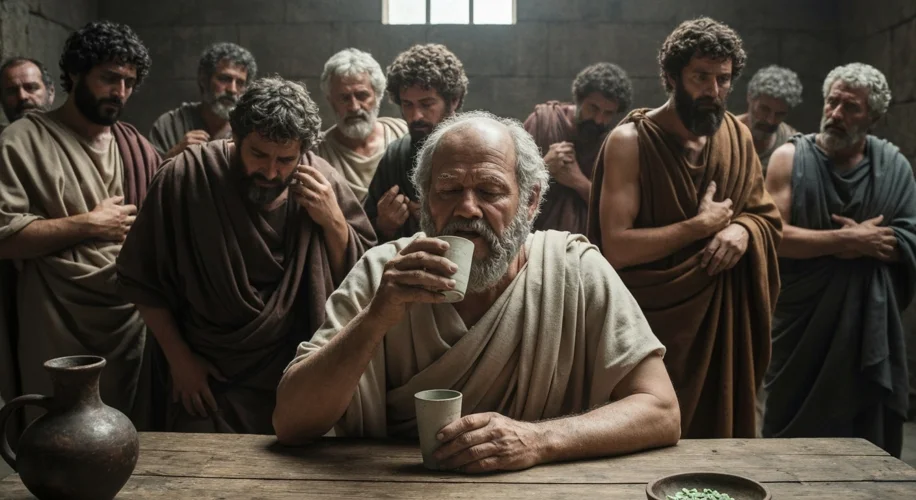
When this was rejected, the death sentence was passed. His friends, including Crito, urged him to escape, offering him opportunities and funds. However, Socrates refused, arguing that it would be a betrayal of his principles and the laws of Athens, which he had lived under and benefited from his entire life. He believed that to flee would be to admit guilt and to violate the social contract. His final hours, as depicted in Plato’s “Crito” and “Phaedo,” were spent calmly discussing philosophy with his devoted followers, drinking hemlock – a potent poison – with dignity and unwavering resolve.
The consequences of Socrates’ execution were profound. While Athens might have believed it had silenced a troublesome voice, it had, in fact, created a martyr. Socrates’ unwavering commitment to truth and his philosophical integrity in the face of death became a powerful inspiration for future generations of thinkers. His method and his life’s work, preserved through the writings of Plato and Xenophon, laid the groundwork for Western philosophy. His trial became a case study in the tension between individual conscience and state authority, a timeless reminder of the dangers of unchecked political power and the courage required to uphold intellectual freedom.
Socrates’ legacy is not one of political victory or legal vindication, but of profound philosophical martyrdom. He demonstrated that the examined life is the only one worth living, and that the pursuit of truth, even unto death, is the highest calling. His trial remains a poignant lesson on the delicate balance between societal order and individual liberty, a dialogue that continues to resonate in democracies around the world.