
The Shadow in the Tapestry: Unveiling Africa’s Presence in Medieval Europe
The year is 690 AD. In the windswept fens of East Anglia, near the village of Loveden, a peculiar burial takes place. Among the typical Anglo-Saxon graves, archaeologists in the late 20th century unearthed something unexpected: the skeletal remains of an individual whose physical characteristics strongly suggest African descent. This was not a solitary anomaly, but a subtle thread woven into the rich tapestry of early medieval England. For centuries, the prevailing narrative of European history has often overlooked or minimized the presence of people of African origin, consigning them to the margins or erasing them from the record altogether. But what if the story is far richer, more complex, and more interconnected than we’ve been led to believe?
Beyond the Moors: Early Encounters and Trade
The presence of Africans in Europe before the Age of Exploration (roughly 15th century onwards) is not a modern invention. It is a historical reality that predates the trans-Atlantic slave trade and colonial expansion. While the Loveden burial offers a tantalizing glimpse into 7th-century England, the story stretches further back. Roman North Africa, a vibrant hub of trade and culture, was deeply integrated with the Roman Empire. Soldiers, merchants, administrators, and scholars of North African origin, many of whom were Black Africans, served and lived throughout the Roman territories, including Britain.
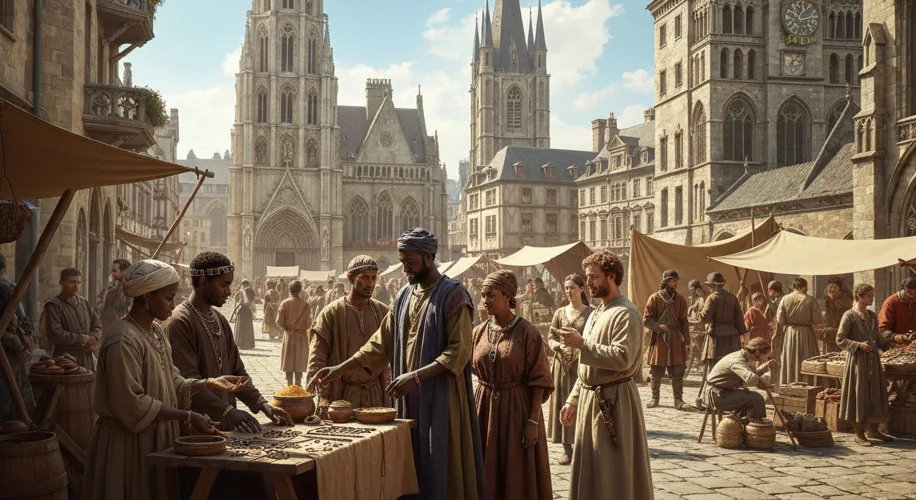
Imagine the bustling port of Londinium in the 2nd century. Among the diverse crowd of traders from distant lands, you might see a dark-skinned merchant from Leptis Magna, his stall laden with exotic spices and fine pottery. Perhaps a Nubian soldier, his skin darkened by the African sun, stands guard at the city gates, his presence a testament to the vastness and interconnectedness of the Roman world. These were not isolated individuals but part of a flow of people facilitated by Roman infrastructure and the shared Mediterranean world.
The Moors and the Iberian Peninsula: A Cultural Bloom
The most significant and well-documented chapter of African presence in medieval Europe arguably begins with the Umayyad Caliphate’s conquest of the Iberian Peninsula in 711 AD. For nearly eight centuries, large parts of what is now Spain and Portugal, known as Al-Andalus, were under Muslim rule, largely populated by Berbers and Arabs, many of whom were of Black African descent. This era, often referred to as the period of the Moors, was a golden age of cultural, scientific, and intellectual flourishing.
Cities like Cordoba, Seville, and Granada became centers of learning, attracting scholars from across the known world. Think of the Great Mosque of Cordoba, a breathtaking architectural marvel, its hypostyle hall echoing with the debates of scholars. Here, figures like Ibn Rushd (Averroes), a philosopher of Berber descent, made profound contributions to Islamic and Western philosophy. Sephardic Jews and Mozarabic Christians lived and worked alongside their Muslim neighbors, creating a vibrant multicultural society. African scholars, physicians, and artists played crucial roles. The court of Cordoba was renowned for its patronage of the arts and sciences, and Black African courtezans and musicians were celebrated for their talents.
Beyond Iberia: Scattered Seeds Across Europe
While Al-Andalus was a focal point, the influence and presence of Africans extended beyond the Iberian Peninsula. Trade routes, particularly those connected to the Mediterranean and the burgeoning Italian city-states, facilitated the movement of people. Genoese and Venetian merchants, whose ships plied the waters between Europe and North Africa, would have encountered and interacted with Black Africans regularly. Some of these individuals would have traveled to European cities as merchants, servants, or even diplomatic envoys.
Consider the courts of medieval kings and nobles. While often portrayed as homogenous, these courts were dynamic centers of diplomacy and trade. Historical records, though often sparse and biased, hint at the presence of Black Africans in various capacities. Illuminated manuscripts, often created for elite patrons, sometimes depict figures with darker skin tones. For instance, in the 14th-century manuscript of the ‘Grandes Chroniques de France’, there are depictions that suggest the presence of Black individuals in royal entourages or as attendees at significant events.
Challenging the Narrative: The Importance of Re-examination
The evidence, though sometimes fragmented, challenges a Eurocentric view of medieval history. The presence of people of African descent was not a mere footnote but an integrated element that contributed to the cultural, intellectual, and economic landscape of medieval Europe. The Anglo-Saxon burial, the scholars of Al-Andalus, the figures in illuminated manuscripts – these are not just curiosities but windows into a more diverse and interconnected past.
Re-examining these historical threads allows us to move beyond simplistic narratives and appreciate the complex mosaic of human migration, interaction, and contribution. It underscores the dynamic nature of history and the often-overlooked diversity of past societies. The echoes of Africa in medieval Europe are subtle but undeniable, a testament to a world far more interwoven than often imagined.