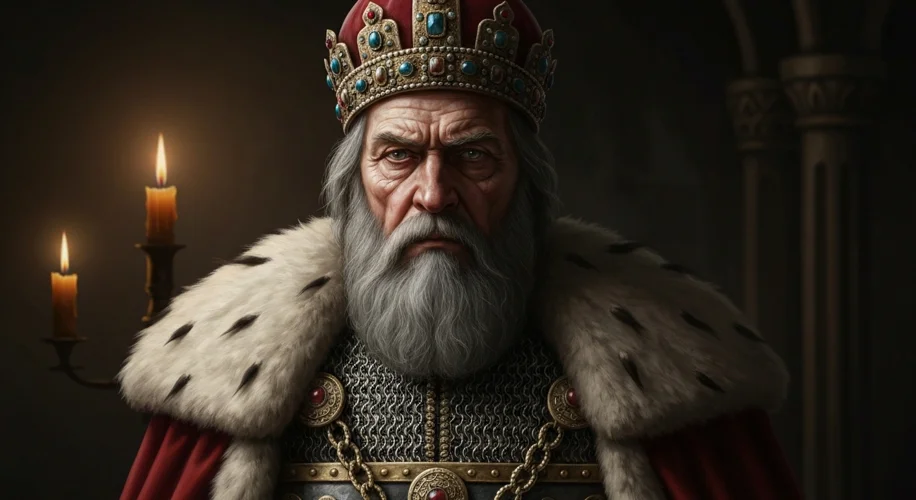
The year is 1547. A young man, barely out of his teens, stands before his people. He is Ivan IV Vasilyevich, Grand Prince of Moscow, and today, he takes a title previously unheard of in his land: Tsar of All Russia. This is not merely a change of name; it is the proclamation of a new era, an era forged in ambition, tempered by paranoia, and stained by the blood of those who dared to stand in his way. This is the dawn of the reign of Ivan the Terrible.
Ivan’s early life was a crucible. Ascending to the throne at the tender age of three, his childhood was a brutal ballet of courtly intrigue and power struggles. His mother, Elena Glinskaya, was a formidable regent, but her death when Ivan was just eight plunged the kingdom into chaos. The boyar aristocracy, hungry for power, clashed violently, leaving young Ivan feeling abandoned, vulnerable, and deeply mistrustful. The glittering halls of the Kremlin, meant to be his sanctuary, became a harsh lesson in survival, where loyalty was a fleeting commodity and betrayal a constant shadow.
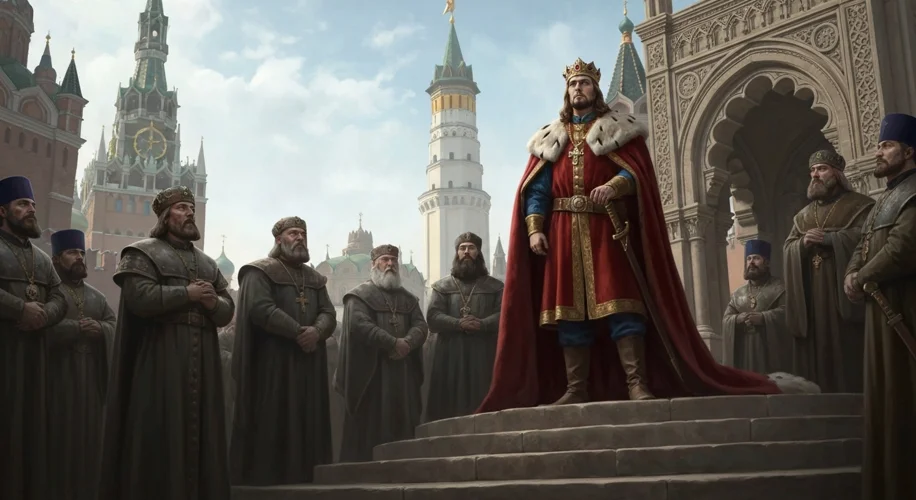
This tumultuous upbringing undeniably shaped the man he became. By the time he crowned himself Tsar, Ivan had developed a fierce intellect and a burning desire to unify and strengthen Russia. He initiated sweeping reforms, known as the Chosen Council, which modernized the legal system, established a standing army (the streltsy), and even created the Zemsky Sobor, an early form of parliament. These were the actions of a visionary ruler, a man intent on building a powerful, centralized state.
But beneath this veneer of progressive reform lurked a deeply troubled soul. His marriage to Anastasia Romanovna, a member of a respected noble family, brought a period of relative stability and happiness. Yet, her death in 1560 plunged Ivan into a profound grief that morphed into an even deeper suspicion and rage. He became convinced that the boyars had poisoned her, and the seeds of his later atrocities were sown.
It was in 1565 that Ivan unleashed his most infamous creation: the Oprichnina. This was a vast, personal territory carved out of Russia, governed by Ivan and his own loyal guard, the Oprichniki. Dressed in black robes and bearing symbols of a dog’s head and a broom (to sniff out and sweep away treason), these feared enforcers operated outside the law. They were granted sweeping powers to confiscate land, arrest, torture, and execute anyone suspected of disloyalty, often with horrific brutality. Cities like Novgorod were ravaged, their populations decimated in a wave of terror designed to crush any perceived opposition and consolidate Ivan’s absolute power.
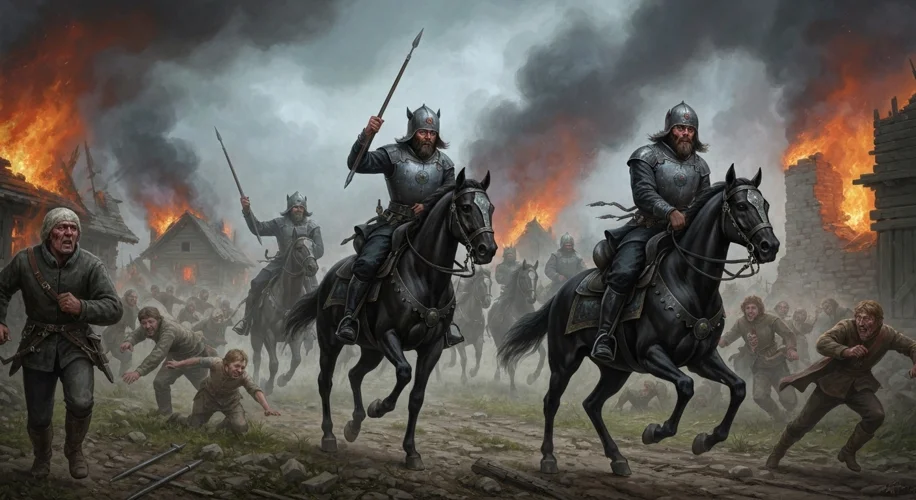
The infamous Novgorod massacre of 1570 stands as a chilling testament to the Oprichnina’s savagery. Accused of plotting to defect to Lithuania, the city was brutally sacked. Thousands were killed, many drowned in the Volkhov River, with Ivan himself reportedly participating in the bloodshed. This act, along with countless others, cemented his terrifying moniker: the Terrible.
Yet, Ivan’s reign was not solely defined by terror. He continued to expand Russia’s borders, most notably conquering the Kazan Khanate in 1552 and the Astrakhan Khanate, opening vital trade routes along the Volga River and extending Russian influence into the Caucasus. These military successes were significant achievements, transforming Russia into a formidable power.
One of the most tragic episodes, however, occurred in 1581. In a fit of rage, fueled by paranoia and perhaps drunken fury, Ivan struck his son and heir, Ivan Ivanovich, with his Tsar’s scepter. The blow, intended to be merely punitive, proved fatal, leaving Ivan without a clear successor and plunging the kingdom into further uncertainty. This personal tragedy underscored the volatile and destructive nature that had come to define his rule.
Ivan the Terrible’s legacy is a complex tapestry of contradictions. He was a reformer who modernized Russia, an expansionist who forged a vast empire, and a patron of the arts and church. Yet, he was also a despot whose reign was marked by extreme violence, paranoia, and psychological torment. His actions created a deep-seated fear of autocratic power that would reverberate through Russian history for centuries.
When Ivan died in 1584, he left behind a kingdom profoundly changed, a nation still reeling from the excesses of its first Tsar. The Oprichnina was eventually dismantled, but the psychological impact of Ivan’s reign, the chilling efficiency of his terror, and the enduring image of a ruler consumed by his own demons, ensured that his name would forever be synonymous with the terrifying potential of absolute power.