
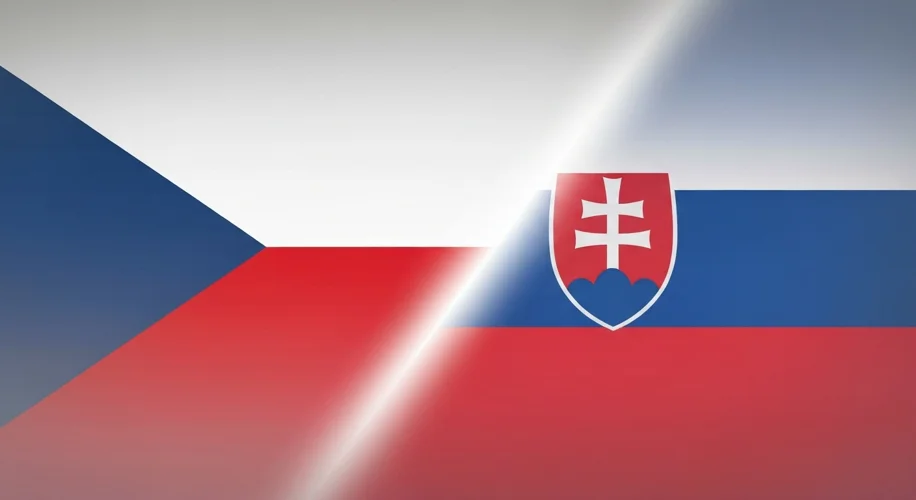
In the annals of modern history, few political dissolutions are as remarkably serene as the “Velvet Divorce” of Czechoslovakia. On January 1, 1993, after decades of shared existence, the federal republic peacefully separated into two sovereign nations: the Czech Republic and the Slovak Republic. This event, a stark contrast to the often-violent fragmentation witnessed elsewhere in the post-Soviet world, stands as a testament to diplomatic negotiation and the power of peaceful self-determination.
Czechoslovakia, born from the ashes of World War I in 1918, was a nation forged by the aspirations of Czechs and Slovaks seeking independence from the Austro-Hungarian Empire. Its early years were marked by a vibrant democracy and a shared vision of a unified state. However, the specter of Nazi Germany loomed large, leading to its dismemberment during World War II and a subsequent Soviet-imposed communist regime that lasted over four decades.

The seeds of separation, though perhaps sown much earlier, began to sprout more visibly in the wake of the 1989 Velvet Revolution. This largely non-violent overthrow of the communist government ushered in an era of democratic reform and renewed national aspirations. While the revolution united Czechs and Slovaks against a common oppressor, it also brought to the surface underlying national identities and differing visions for the future. The federal government, led by President Václav Havel, a Czech playwright and dissident, initially sought to preserve the union. However, growing political and economic disparities, coupled with distinct cultural and historical trajectories, created an undeniable momentum towards separation.
Key figures in this pivotal moment included Václav Klaus, the Czech Prime Minister, and Vladimír Mečiar, his Slovak counterpart. Klaus, an economist, favored a more rapid transition to a market economy and saw separation as a pragmatic solution to divergent economic policies. Mečiar, a charismatic and often controversial figure, championed Slovak sovereignty, believing that an independent Slovakia could better chart its own course. Negotiations between their respective governments were intense, often fraught with disagreement, yet consistently underscored by a commitment to avoiding conflict.
The process was remarkably devoid of the ethnic tensions and violence that plagued other post-communist transitions. Instead of confrontation, the leaders engaged in meticulous negotiation, hammering out the details of division, from state property and borders to international treaties and currency. The term “Velvet Divorce” perfectly captured the spirit of this transition – a deliberate, measured, and ultimately peaceful separation.
The consequences of the Velvet Divorce were profound, creating two distinct geopolitical entities in the heart of Central Europe. The Czech Republic, with its capital in Prague, quickly integrated into Western European structures, joining NATO in 1999 and the European Union in 2004. Slovakia, with Bratislava as its capital, followed a similar path, joining NATO in 2004 and the EU in the same year. Both nations have since forged their own unique identities and economic paths, demonstrating the success of their peaceful separation.
The Velvet Divorce remains a compelling case study in peaceful state dissolution. It highlights the importance of dialogue, mutual respect, and a shared commitment to non-violence in navigating complex political transitions. It serves as a powerful reminder that even in the face of deeply held national aspirations, a peaceful resolution is not only possible but can lead to stable and prosperous futures for all involved. The echoes of this “Velvet” transition continue to resonate, offering valuable lessons for a world still grappling with the complexities of national identity and self-determination.