

The air in the Oval Office crackled with a tension so thick it could be tasted. It was October 1962, and the world held its breath. Thirteen days that would forever be etched into the annals of history, a chilling reminder of how close humanity had come to self-annihilation.
The Cold War had been a simmering pot of ideological conflict and proxy wars for years, but this was different. This was a direct confrontation between the two nuclear superpowers: the United States and the Soviet Union. The spark? Soviet ballistic missiles, capable of delivering nuclear warheads, were discovered on the island nation of Cuba, just 90 miles off the coast of Florida.
From the perspective of U.S. President John F. Kennedy, this was an unacceptable provocation. The placement of these missiles dramatically altered the strategic balance, placing major American cities within striking distance of Soviet nuclear weapons. Imagine the scene: crisp autumn air, but inside the White House, a suffocating heat of fear and strategic calculation. Kennedy and his advisors, a group known as the Executive Committee of the National Security Council (ExComm), grappled with unthinkable choices. Should they launch a preemptive air strike against the missile sites? An invasion of Cuba? Or opt for a naval blockade, a less aggressive but potentially less effective measure?
Meanwhile, across the Atlantic, Soviet Premier Nikita Khrushchev saw his move as a strategic necessity. Cuba, under Fidel Castro, was a communist ally in America’s backyard. Placing missiles there was, in his view, a defensive measure to deter any further American aggression against the island, similar to how the US had missiles stationed in Turkey, bordering the Soviet Union.
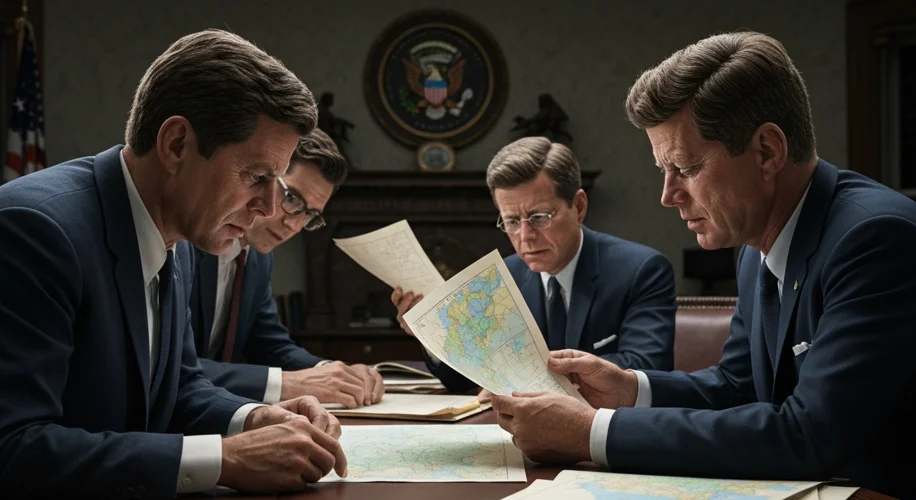
The days that followed were a blur of secret meetings, coded messages, and public posturing. On October 22nd, Kennedy addressed the nation, revealing the discovery of the missiles and announcing a naval quarantine (a blockade, but the administration preferred the less belligerent term) around Cuba. The world watched, glued to their radios and televisions, as Soviet ships steamed towards the quarantine line.
Would they challenge the blockade? The tension was palpable. Every passing hour felt like an eternity. The stakes couldn’t have been higher. A single misstep, a moment of panic, could have triggered a chain reaction leading to nuclear war. The human cost was unimaginable – cities vaporized, populations decimated, a planet plunged into radioactive twilight.
One particularly harrowing moment occurred on October 27th, often referred to as “Black Saturday.” A U.S. U-2 spy plane was shot down over Cuba, killing the pilot, Major Rudolf Anderson Jr. The pressure on Kennedy to retaliate intensified. Simultaneously, a Soviet submarine, harassed by U.S. naval forces, nearly launched a nuclear torpedo, an act that was only averted by the refusal of one of the submarine’s officers, Vasili Arkhipov.
Back channels, however, were also buzzing. Secret negotiations took place between Robert Kennedy, the President’s brother and Attorney General, and Soviet Ambassador Anatoly Dobrynin. The world was teetering on the edge, but behind the scenes, a desperate effort to pull it back was underway.
Finally, on October 28th, a resolution emerged. Khrushchev agreed to dismantle the missile sites in Cuba and return the missiles to the Soviet Union. In return, the U.S. publicly pledged not to invade Cuba. Secretly, the U.S. also agreed to remove its Jupiter missiles from Turkey, a concession that, while not public at the time, was crucial to Khrushchev saving face.
The immediate threat of nuclear war receded, leaving behind a profound sense of relief but also a stark realization of the dangers of the nuclear age. The Cuban Missile Crisis served as a wake-up call. It demonstrated the terrifying potential for escalation and the urgent need for better communication and de-escalation strategies between the superpowers.
In the aftermath, a direct teletype link, the “hotline,” was established between Washington and Moscow to facilitate direct communication during future crises. Arms control talks gained new momentum, leading to treaties like the Limited Test Ban Treaty of 1963. The crisis also highlighted the complex dynamics of brinkmanship and the crucial role of individual decision-makers in shaping global events. It underscored that while ideologies clashed, the shared instinct for survival could, at times, prevail.
The thirteen days in October 1962 remain a potent symbol of human vulnerability and resilience. They remind us that even in the darkest hours, diplomacy, courage, and a touch of luck can steer the world away from the precipice.