
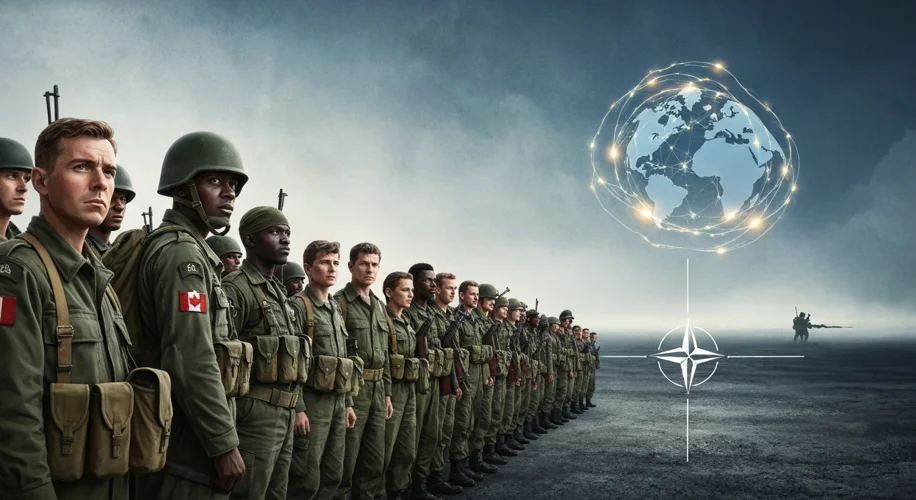
In the swirling geopolitical winds of 2025, Canada’s commitment to supplying Ukraine with crucial military equipment through NATO channels might seem like a contemporary response to a fresh crisis. Yet, this act of solidarity is not an isolated incident; it is a resonant chord struck within a long and intricate symphony of international alliances and military aid, a tradition honed over decades in response to perceived threats and persistent geopolitical instability.
From the ashes of World War II, a new world order began to take shape, one defined by the existential dread of nuclear annihilation and the ideological chasm of the Cold War. It was within this charged atmosphere that the North Atlantic Treaty Organization (NATO) was born in 1949. Its stated purpose: to provide collective security against the perceived Soviet threat. Canada, a nation forged in the crucible of two World Wars and keenly aware of the fragility of peace, was a founding member. This wasn’t merely a diplomatic handshake; it was a solemn vow, a military commitment to stand shoulder-to-shoulder with allies against any aggression.
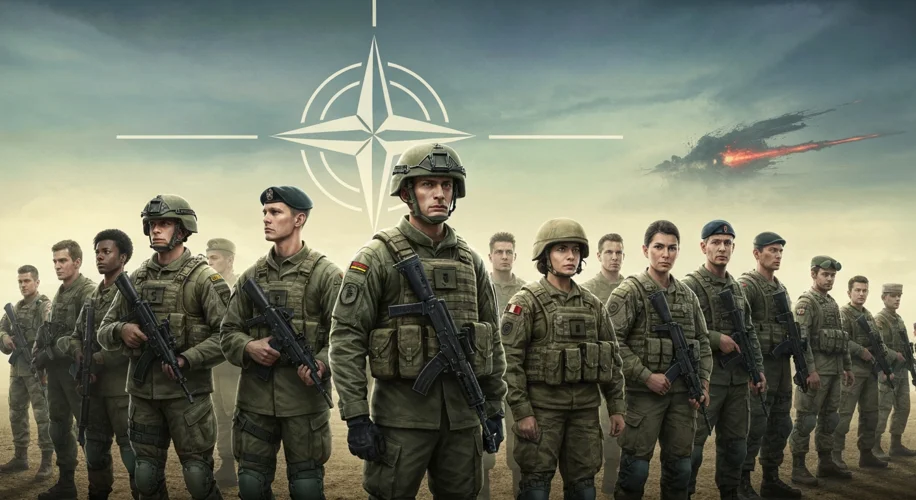
This era saw the normalization of military aid as a cornerstone of foreign policy. The Marshall Plan, though primarily economic, was intrinsically linked to securing Western Europe against Soviet influence, and it laid the groundwork for recipient nations to bolster their own defenses, often with American- or Canadian-supplied equipment. Canada, while not wielding the same military might as its southern neighbor, carved out a vital niche. It became known for its reliable contributions, its focus on peacekeeping, and its specialized equipment.
Consider the Korean War (1950-1953). Canada, as part of the United Nations Command, dispatched troops and military hardware, demonstrating its willingness to commit resources to collective security far from its own shores. This was not an act of altruism alone; it was a strategic investment in a global order that prioritized stability and deterring potential adversaries. The commitment was tangible: destroyers patrolled Korean waters, artillery units engaged in fierce battles, and medical teams provided vital care.
As the Cold War wore on, the nature of alliances evolved. NATO expanded, and its members deepened their military cooperation. Canada’s role often involved providing specialized assets, such as its strong contingent of fighter jets and reconnaissance aircraft, capable of operating in challenging Arctic conditions – a direct response to the thawing geopolitical landscape in the North. The commitment to NATO wasn’t static; it adapted to new threats, whether they were conventional troop movements or the increasingly sophisticated espionage and technological competition that characterized the latter half of the 20th century.
Beyond NATO, Canada also engaged in bilateral military aid agreements. The Colombo Plan in the 1950s, for instance, saw Canada provide military training and equipment to developing nations in Asia, aiming to foster stability and friendly relations. These initiatives, while perhaps less dramatic than front-line combat deployments, were crucial in building diplomatic bridges and projecting influence.
The fall of the Soviet Union in 1991 seemed to herald a new era of global peace. However, the ensuing decades proved that the landscape of conflict was merely shifting, not disappearing. The rise of asymmetric warfare, the resurgence of authoritarian regimes, and the growing interconnectedness of global security threats meant that the need for alliances and military aid persisted, albeit in new forms.
The post-Cold War era saw Canada actively participate in various peacekeeping and stabilization missions under UN and NATO mandates, from the Balkans to Afghanistan. These operations often involved providing equipment, training, and logistical support, reinforcing the idea that military aid was not just about offense, but also about building capacity and fostering stability in fragile regions.
This brings us to the present day, to Ukraine. Canada’s provision of weapons, armored vehicles, and financial support is not a novel departure. It is the latest chapter in a long history. It echoes the commitments made during the Korean War, the defensive posture adopted during the Cold War, and the stabilization efforts in the post-Soviet era. It is a testament to the enduring belief that collective security and mutual defense are not mere idealistic notions, but practical necessities in a world where threats can emerge with alarming speed and devastating effect.
The evolution of military aid and alliances, as exemplified by Canada’s actions, reveals a consistent thread: a recognition that peace is not passively maintained but actively defended. It is a story of nations recognizing their interconnectedness, understanding that a threat to one, if left unchecked, can ultimately become a threat to all. Canada’s contributions, whether in the past or present, serve as a powerful reminder that the strength of alliances lies not just in their formation, but in their sustained and unwavering commitment to mutual security.

From the existential threat of the Soviet Union to the current challenges in Eastern Europe, Canada has consistently understood that its security is inextricably linked to the security of its allies. The military equipment flowing to Ukraine today is more than just hardware; it is a tangible manifestation of this historical understanding, a continuation of a legacy built on shared responsibility and the unwavering pursuit of a more stable world.