
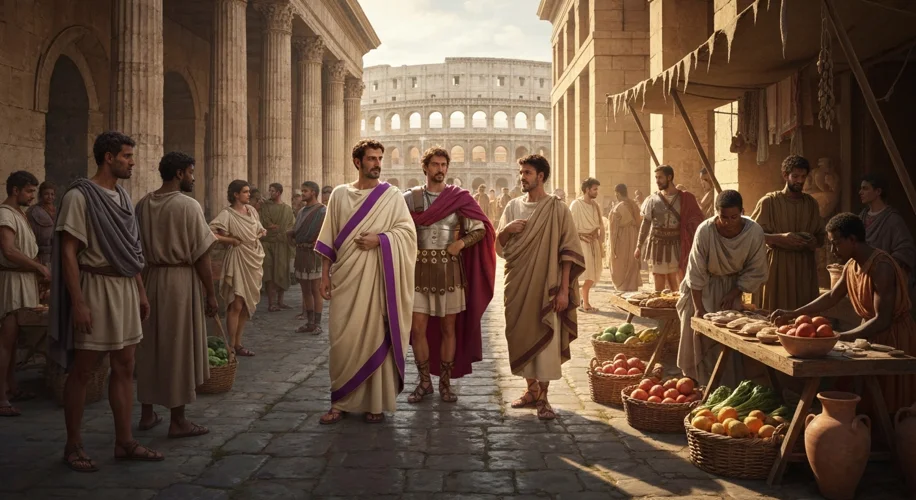
The grandeur of Rome. We see it in the colossal Colosseum, the majestic Pantheon, and the sprawling forums that once echoed with the voices of senators and citizens. But beneath this veneer of power and prosperity lay a society rigidly stratified, a pyramid of power and privilege with the elite at its apex and the enslaved at its base. To understand Rome is to understand its social hierarchy, the intricate web of classes that defined existence for millions.
Imagine walking through the bustling streets of Rome, circa 100 CE. The air is thick with the scent of baking bread, sweat, and the distant aroma of exotic spices. The sounds are a cacophony: the rumble of cartwheels on cobblestones, the shouts of merchants, the murmur of a thousand conversations in Latin and Greek. Yet, the people you see are not all equal. Their clothing, their bearing, the very space they occupy on the street, all speak of their place in the Roman world.
At the very top stood the Patricians. These were the ancient noble families, the descendants of Rome’s founding fathers. Their lineage was their power, their wealth immense, derived from vast estates and political influence. They wore the toga praetexta with its distinctive purple border, a clear symbol of their status. Life for them was one of luxury, education, and political maneuvering. They were the arbiters of Roman society, their decisions shaping the fate of the empire.
Beneath them, but still vastly privileged, were the Equestrians. Originally, this class comprised the cavalry, men wealthy enough to afford a horse. By the Imperial period, wealth, not just military service, defined them. They were the financiers, the businessmen, the tax collectors, and held many administrative positions. While not as socially prestigious as the patricians, their economic power was formidable, and they often rivaled the senatorial class in wealth and influence.
Then came the vast majority: the Plebeians. This was a broad category, encompassing everyone from wealthy merchants and skilled artisans to small farmers and day laborers. The struggle of the plebeians against patrician dominance was a defining feature of the early Roman Republic, eventually leading to greater political rights. Yet, even within the plebeian class, disparities were immense. A well-to-do plebeian merchant might live in relative comfort, while a poor laborer might struggle daily for survival. Their clothing was simpler, usually the toga virilis, a plain woolen garment.
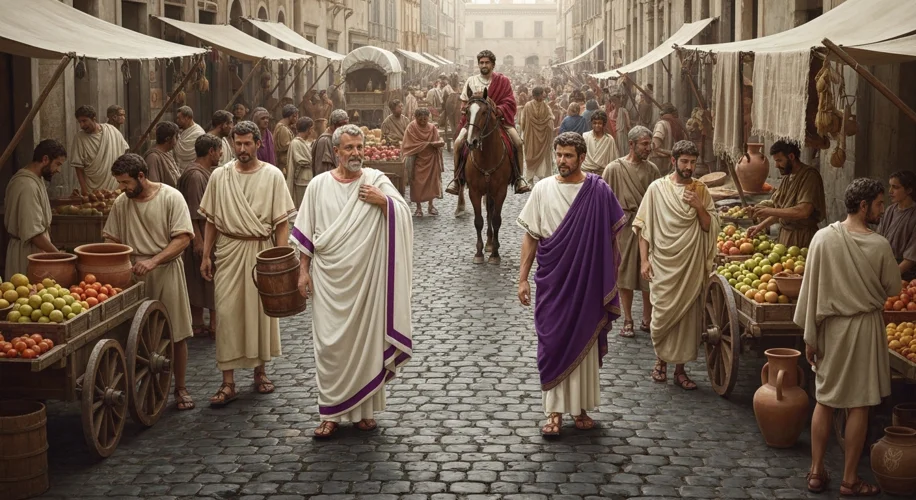
Further down the social ladder were the Freedmen (liberti). These were former slaves who had been granted their freedom. While no longer enslaved, their lives were often still constrained. They carried the stigma of their past and had legal obligations to their former masters. Many excelled in trades and commerce, and their children could eventually attain full citizenship, but their own lives were a constant negotiation between newfound liberty and lingering social barriers. Some freedmen amassed considerable wealth, becoming patrons themselves.
And then, the bedrock of Roman society, the group that powered its economy and built its infrastructure, yet possessed no rights or freedoms: the Slaves. The sheer scale of slavery in Rome is staggering. Estimates suggest that at times, up to 20-30% of the population was enslaved. They were prisoners of war, victims of debt bondage, or born into servitude. Their lives were a spectrum of brutal hardship and occasional relative comfort, depending entirely on their owner and their assigned task.
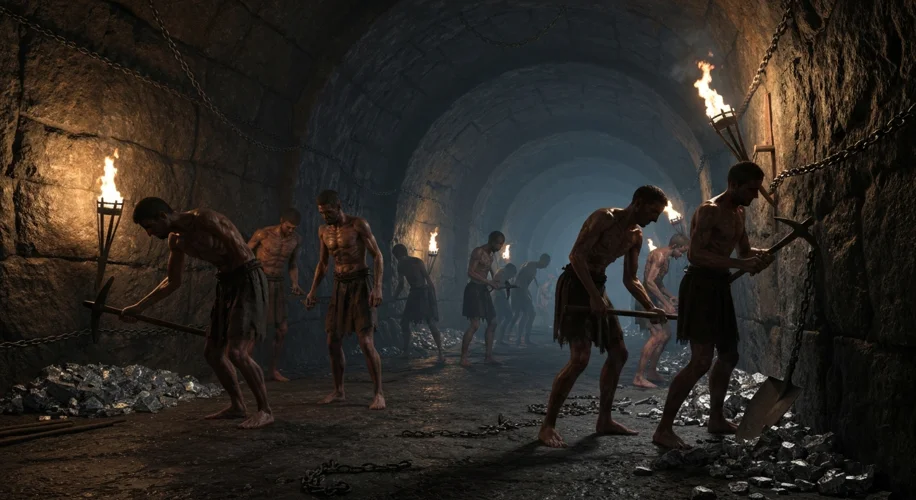
Imagine the life of a mine slave in the silver mines of Spain. It was a life of relentless toil, darkness, and danger. Cramped in suffocating tunnels, they chipped away at rock with rudimentary tools, often chained together. Food was meager, punishments harsh, and disease rampant. Life expectancy was tragically short. These were the individuals whose suffering fueled Rome’s insatiable demand for resources.
Contrast this with the life of a household slave. Some slaves in wealthy Roman villas were educated and skilled. They might serve as tutors, scribes, musicians, or even physicians. While still property, their lives offered a degree of intellectual engagement and perhaps even a semblance of personal connection with their owners. However, even here, freedom was never guaranteed, and their fate remained precariously tied to the whims of their master. A prized tutor could be sold at any moment, a skilled craftsman could be worked to death.
There were also public slaves, employed by the state in tasks like maintaining temples, aqueducts, and roads, or serving as attendants in public baths. Their conditions varied greatly but were generally less brutal than those in mines or on latifundia (large agricultural estates).
What is crucial to understand is that slavery was not a monolithic experience. A slave’s life was dictated by their owner’s status, their own skills, and their location. A farmer’s slave in rural Italy faced a different reality than a scribe in a senator’s urban domus.
This rigid social structure, from the opulent villas of the patricians to the brutal mines where slaves toiled, was the engine of the Roman Empire. It created immense wealth and power for a few, but at a cost borne by the many. The legacy of this stratification, the echoes of its economic disparities and the brutal reality of its enslaved population, continues to shape our understanding of this pivotal civilization.