
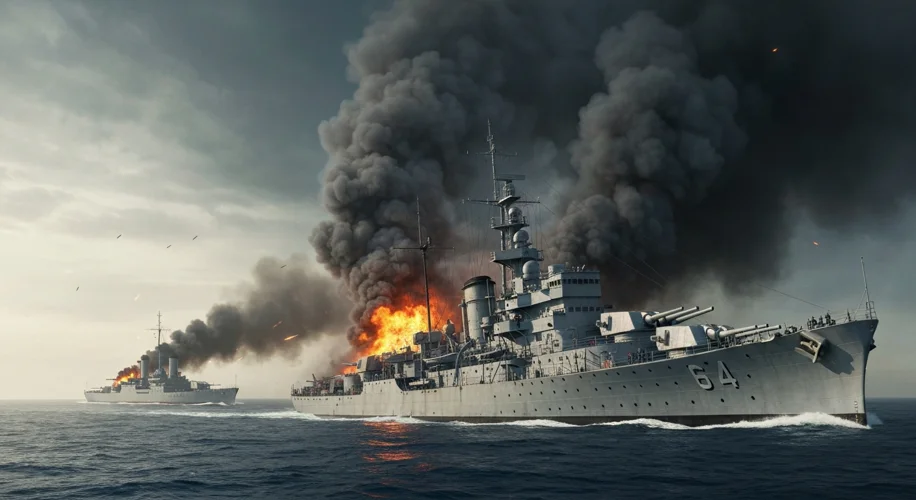
The year is 1941. The world is ensnared in the brutal grip of World War II. For the young Australian nation, the war had already brought its share of sacrifice and heroism. But on a clear November day, off the coast of Western Australia, a tragedy would unfold that would forever etch itself into the nation’s maritime history: the Battle of the Cocos Islands and the mysterious sinking of HMAS Sydney.
HMAS Sydney, a light cruiser, was a proud symbol of the Royal Australian Navy, a veteran of Mediterranean campaigns and escort duties. She was known for her speed, her agility, and the camaraderie she fostered among her crew. On November 19th, 1941, Sydney was returning to Fremantle after escorting a troop convoy, a routine mission that belied the lurking danger.
That danger came in the guise of the German auxiliary cruiser Kormoran. Disguised as a Dutch merchant ship, the SS Straat Malakka, Kormoran was a wolf in sheep’s clothing. Her mission was to roam the seas, disrupting Allied shipping and sowing chaos. As Sydney approached what appeared to be a distressed vessel, the Kormoran dropped its disguise, revealing its true, menacing identity. The Kormoran’s captain, Theodor Detmers, saw an opportunity too good to pass up – an unsuspecting, powerful enemy right in his gunsights.
The engagement was swift and brutal. Sydney, caught off guard by the sudden revelation and the Kormoran’s unexpected maneuver, fought valiantly. However, the Kormoran, armed with torpedoes and a formidable array of guns, unleashed a devastating barrage. The surprise, the close range, and the Kormoran’s well-executed attack proved too much for Sydney. Hit by torpedoes and shells, the Australian cruiser erupted in flames, a funeral pyre against the azure sky.
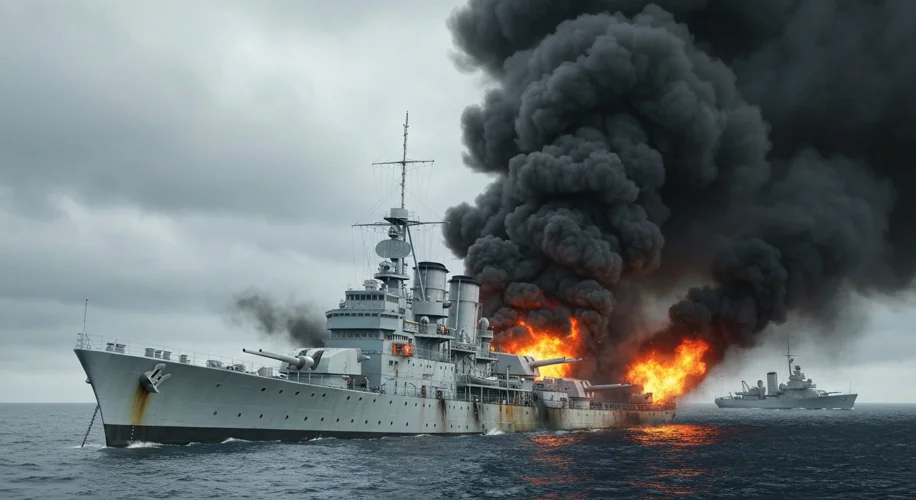
In the aftermath, the Kormoran, also heavily damaged, limped away. But the true horror was yet to be fully understood. Sydney had sunk, taking with her all 645 souls aboard – every officer, every rating. There were no survivors. The Kormoran, finding itself critically damaged and unable to make repairs, was scuttled by her own crew the following day, with only 318 of her 360 crew members surviving to tell their fragmented tale.
The loss of HMAS Sydney sent shockwaves through Australia. The complete annihilation of her crew was unprecedented and deeply unsettling. Speculation ran rampant. How could such a modern warship be so utterly destroyed? Official inquiries and fervent public debate ensued. Some questioned Sydney’s captain, Hector Waller, a respected officer, suggesting he had made tactical errors. Others pointed to the Kormoran’s deception and the element of surprise as the decisive factors.
As the years passed, fragments of the story emerged from the surviving Kormoran crew. They spoke of Sydney’s final moments, the desperate fight, and the grim realization of their fate. The discovery of Sydney’s wreck in 2008 and Kormoran’s in 2019 provided crucial evidence, helping to piece together the last desperate minutes of the battle. These discoveries confirmed that Sydney had indeed been lured into a trap, her crew caught tragically unaware by a cunning enemy.
The Battle of the Cocos Islands remains a stark reminder of the brutal realities of naval warfare and the devastating consequences of deception. It stands as a poignant symbol of Australia’s wartime sacrifice, a testament to the courage of those who served, and an enduring mystery that continues to fascinate and mourn. The silence from Sydney’s decks that fateful day echoes across the ocean, a somber reminder of the 645 lives lost to the unforgiving sea.