
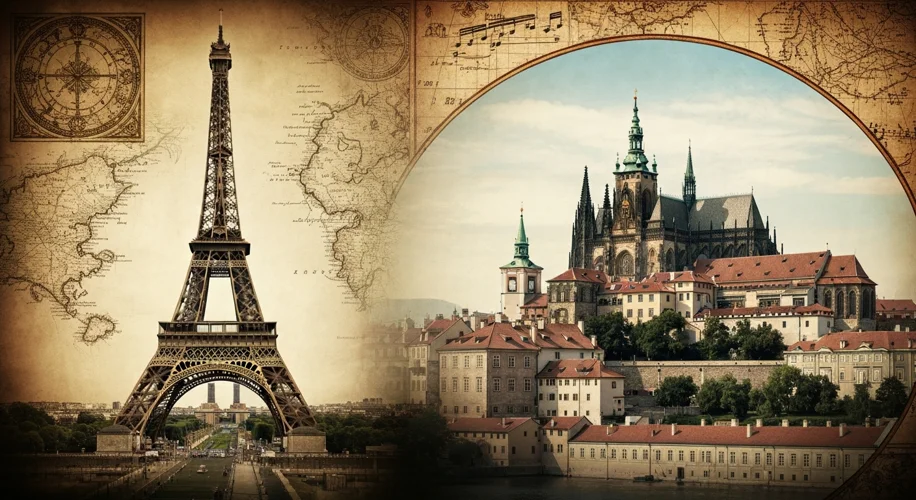
The whispers of history often carry tales of distant lands, of peoples whose destinies, though seemingly disparate, are woven together by threads of shared experience, cultural exchange, and sometimes, stark contrast. Today, we journey to the heart of Europe, to explore the captivating narratives of the Czech Republic and France – two nations with distinct national identities, forged in the crucible of centuries, yet bound by an enduring, albeit complex, historical relationship.
From the rolling vineyards of Bordeaux to the mystical Bohemian forests, the cultural tapestries of France and the Czech Republic are rich and vibrant, yet remarkably different. France, often heralded as the cradle of Western civilization, boasts a language that has long been the idiom of diplomacy and high culture, its national narrative deeply intertwined with the ideals of the Enlightenment, the grandeur of its monarchy, and the tumultuous waves of revolution. Its cultural identity is a powerful amalgam of artistic prowess, philosophical inquiry, and a deep-seated pride in its historical legacy.
The Czech lands, on the other hand, present a narrative shaped by a different set of forces. Nestled at the crossroads of empires, Bohemia, Moravia, and Silesia have been a battleground for competing powers for centuries. Their cultural identity is one of resilience, of quiet strength, and of a fierce, often unyielding, spirit. The Czech language, with its Slavic roots, carries a unique cadence, and its history is marked by periods of fervent religious reform, national awakening, and a persistent struggle for self-determination against larger, more dominant neighbors.

Let us rewind the clock. The historical connection between France and the Czech lands, while not as overt as some Franco-Germanic or Franco-Slavic ties, has been shaped by broader European geopolitical currents. During the medieval period, the Holy Roman Empire, of which Bohemia was a part, often found itself in complex diplomatic dance with the Kingdom of France. Bohemian kings, such as Charles IV, a Holy Roman Emperor, even maintained ties with the French court, reflecting a certain interconnectedness within the European elite.
The flames of religious fervor in the 15th century cast a long shadow. Jan Hus, the Czech religious reformer, whose ideas predated Martin Luther, ignited a spiritual revolution that shook Bohemia to its core. While France was grappling with its own internal conflicts and the Hundred Years’ War, the Hussite Wars in the Czech lands were a brutal testament to the power of religious conviction and national identity. Though the direct impact on France was minimal, the very idea of challenging established religious and political order resonated across the continent.
The 18th and 19th centuries saw a rise in national consciousness across Europe, and both France and the Czech lands were swept up in this powerful tide. France, of course, experienced its own seismic shifts with the French Revolution, exporting its ideals of liberty, equality, and fraternity across the continent. For the Czechs, this era was marked by a fervent national awakening, a desire to reclaim their language, culture, and history from centuries of Germanization under the Habsburg Empire. While France was in the throes of revolution and empire, the Czech intellectuals and artists were meticulously rediscovering and reasserting their unique Slavic heritage.
The 20th century proved to be a period of intense, and often tragic, convergence. The aftermath of World War I saw the dismantling of empires and the birth of new nations. France, a victorious power, played a significant role in shaping the new European order, including the establishment of Czechoslovakia. This was a period of hope, of a shared vision for a more democratic and stable Europe. However, the specter of aggressive expansionism, particularly from Nazi Germany, would soon cast a dark pall.
The tragic events of the Munich Agreement in 1938, where France, alongside Britain, appeased Hitler by ceding the Sudetenland – a region of Czechoslovakia with a significant German-speaking population – to Nazi Germany, represent a particularly poignant and painful chapter in Franco-Czech relations. It was a moment when French foreign policy, driven by a desire to avoid another devastating war, had devastating consequences for a nation that had once looked to France as an ally.
Yet, even in the darkest hours, the spirit of solidarity endured. During World War II, Czechoslovak legions fought alongside the Allies, including French forces, against the Axis powers. After the war, both nations found themselves on opposing sides of the Iron Curtain, France a founding member of NATO, and Czechoslovakia, a satellite state of the Soviet Union. The Prague Spring of 1968, a brief but fervent attempt at liberalization, was brutally crushed by Soviet tanks, a stark reminder of the geopolitical realities that shaped their post-war destinies.
Today, the Czech Republic and France stand as sovereign nations, united within the European Union. Their relationship is one of mutual respect, cultural exchange, and shared democratic values. French cinema, literature, and philosophy have long captivated Czech audiences, while Czech art, music, and literature have found appreciation in France. From the Gothic architecture of Prague to the Impressionist masterpieces of Paris, the artistic legacies of both nations continue to inspire and captivate.
Their linguistic heritage, though rooted in different branches of the Indo-European family tree, tells a story of evolution and adaptation. French, a Romance language, carries the echoes of Latin, while Czech, a West Slavic language, is characterized by its rich consonant clusters and grammatical complexity. Yet, both languages have served as powerful vehicles for national identity and cultural expression.
In conclusion, the historical and cultural relationship between the Czech Republic and France is a complex tapestry woven with threads of diplomacy, conflict, shared ideals, and starkly different national narratives. It is a story of resilience, of cultural richness, and of the enduring human spirit that continues to shape the destinies of these two remarkable European nations. Their distinct identities, while deeply rooted in their own unique histories, are also a testament to the interconnectedness of the European story, a narrative that continues to unfold with each passing generation.