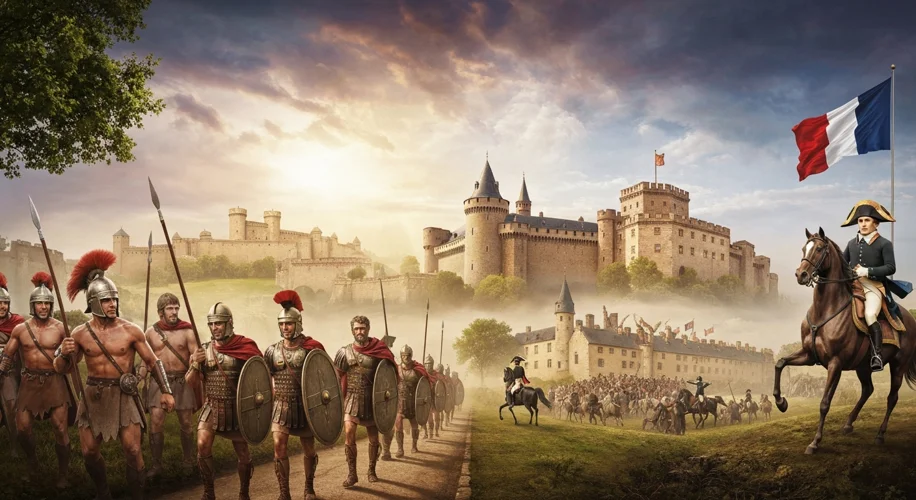
Imagine a land where ancient forests whispered secrets to druids, where mighty legions marched under the Roman eagle, and where kings, queens, and revolutionaries carved their destinies into the very stone of Europe. This is France, a nation whose history is a saga as rich and complex as its finest wines.
Our story begins not with castles and crowns, but with the fierce, independent tribes known as the Gauls. These were proud warriors, skilled artisans, and devoted pagans who lived in a land of rolling hills, dense forests, and mighty rivers. Their culture was vibrant, their society structured around tribes, and their spiritual life deeply connected to nature.
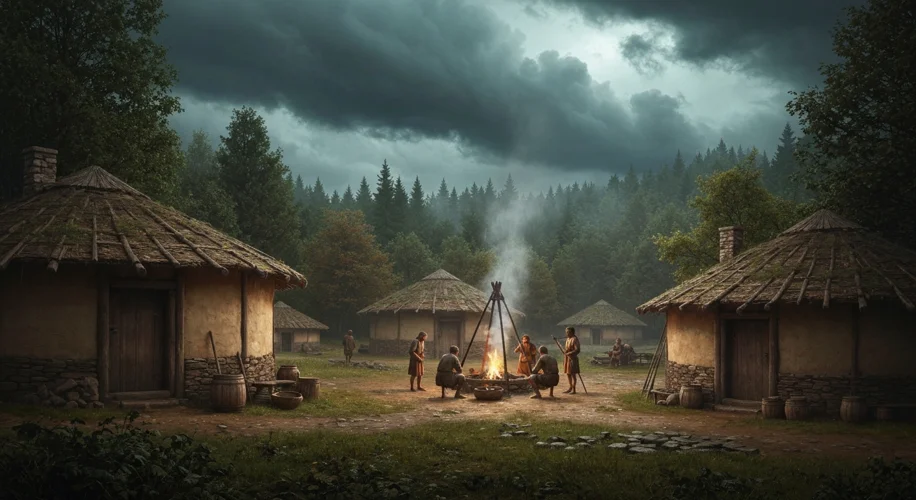
Then came the legions of Rome. In the 1st century BCE, Julius Caesar, driven by ambition and Roman expansionism, turned his gaze towards Gaul. The Gallic Wars (58-50 BCE) were a brutal, protracted struggle. Figures like Vercingetorix, a chieftain who united many Gallic tribes against the Roman juggernaut, became legendary symbols of resistance. Despite their valiant efforts, Gaul eventually fell under the dominion of Rome, a conquest that would forever reshape its destiny. Roman rule brought roads, cities, law, and Latin, laying the foundations for the French language and culture we know today. For centuries, Romanized Gauls, or Gallo-Romans, lived and thrived, their lives intertwined with the vast Roman Empire.
The collapse of the Western Roman Empire in the 5th century CE ushered in a new era of migration and conflict. Germanic tribes, including the Franks, moved into the vacuum left by Rome. It was the Franks, under leaders like Clovis I, who would eventually give France its name and forge a new kingdom. Clovis’s conversion to Christianity in the late 5th century was a pivotal moment, aligning the nascent Frankish kingdom with the powerful Church and setting the stage for centuries of religious and political influence.
Fast forward to the 10th century, and we find the Capetian dynasty rising to power. Hugh Capet, elected King of the Franks in 987, laid the groundwork for a centralized monarchy that would slowly, painstakingly, expand its authority over feudal lords and vast territories. This period, the High Middle Ages, saw the construction of magnificent cathedrals, the flourishing of chivalric culture, and the gradual consolidation of royal power. Kings like Philip II Augustus and Louis IX (Saint Louis) were instrumental in this process, transforming France from a collection of semi-independent duchies into a formidable kingdom.
But history is rarely a straight line. The medieval period was punctuated by devastating conflicts, none more so than the Hundred Years’ War (1337-1453) against England. This epic struggle, marked by iconic battles like Crécy and Agincourt, forged a sense of national identity and pride, particularly through the legendary figure of Joan of Arc. Her unwavering belief and military leadership, though ultimately ending in tragedy, rallied the French and became a potent symbol of French resistance.
Centuries later, the Enlightenment dawned, challenging the divine right of kings and championing reason, liberty, and equality. These ideals, simmering beneath the surface of an increasingly rigid social hierarchy, would erupt in one of history’s most transformative events: the French Revolution. The storming of the Bastille on July 14, 1789, became the symbolic flashpoint, a powerful roar against oppression. Figures like Maximilien Robespierre, initially a voice for reform, would descend into the Reign of Terror, a brutal period of executions and political upheaval. The revolution’s ideals, however, spread like wildfire, influencing movements for democracy and human rights across the globe.
Following the revolution came the meteoric rise of Napoleon Bonaparte. A brilliant military strategist, he seized power, crowned himself Emperor, and plunged Europe into a series of wars that redrew its map. Though his empire ultimately collapsed, Napoleon’s legal reforms, the Napoleonic Code, and his administrative innovations left an indelible mark on France and beyond.
The 19th and 20th centuries saw France navigate industrialization, colonialism, two devastating World Wars, and the complex process of decolonization. From the grand boulevards of Paris to the vineyards of Burgundy, the nation grappled with its identity, its role in the world, and the enduring legacy of its revolutionary past.
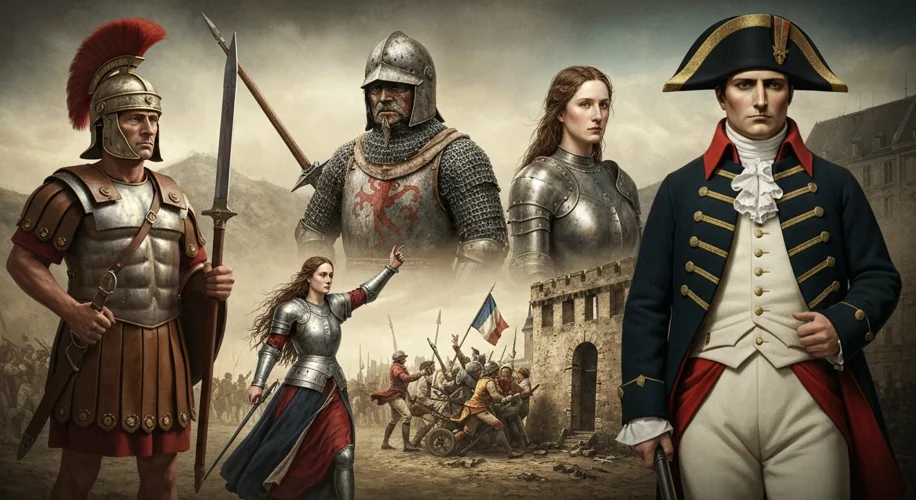
Today, France stands as a vibrant republic, a cultural powerhouse, and a key player on the global stage. Its history, a tumultuous yet inspiring journey from ancient tribes to a modern nation, continues to resonate, shaping not only its own destiny but also the broader narrative of Western civilization. The echoes of its past – the Gallic spirit, Roman order, Capetian ambition, revolutionary fervor, and Napoleonic might – are woven into the very fabric of its identity.