
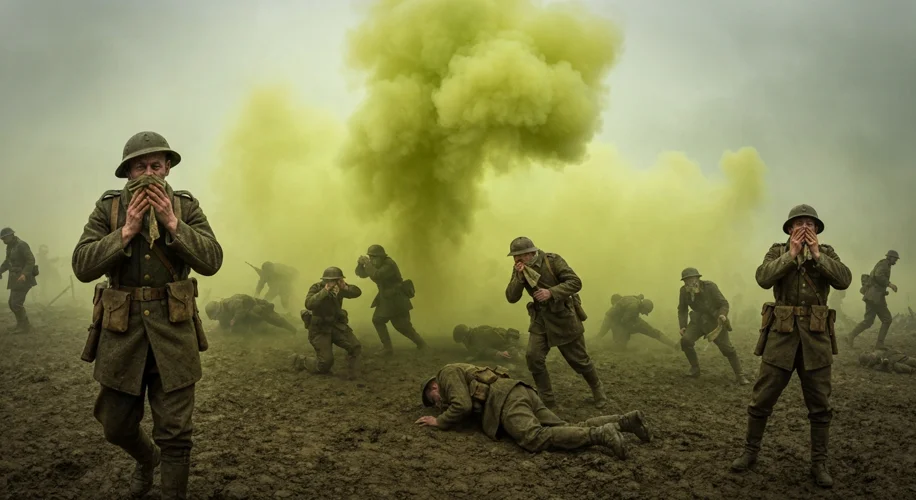
The year is 1917. The air in the trenches of the Western Front is a thick, acrid soup, not just of mud and despair, but of something far more insidious. A chilling wind whispers across the churned earth, carrying not just the stench of death, but a metallic, almond-like tang. This is the smell of poison gas, the phantom of World War I, a weapon that redefined the very meaning of suffering on the battlefield.
The world had been plunged into war in August 1914, fueled by a complex web of alliances, nationalism, and imperial ambitions. Initial battles were characterized by grand maneuvers, but the stalemate that set in along the Western Front, from the Swiss border to the North Sea, soon bred a desperate innovation. The trenches, intended as a defense, became a deathtrap, and the commanders on both sides began to seek any advantage, no matter how horrific.
The first major gas attack was unleashed by the German army on April 22, 1915, near Ypres, Belgium. It was a fearsome spectacle: a cloud of greenish-yellow chlorine gas, released from thousands of cylinders, rolled towards the Allied trenches. The effect was immediate and devastating. Soldiers, unprepared and unprotected, experienced searing pain in their eyes and throats, choking on their own breath as their lungs filled with fluid. Panic ensued, and a gaping hole was torn in the Allied line.
This horrifying debut was not the end, but the beginning of a terrifying escalation. The Allies, outraged and seeking retribution, soon retaliated. Chlorine gas, while potent, was quickly countered by simple, if crude, improvised masks – rags soaked in water or urine. The race, however, had begun.
Next came phosgene, a more insidious gas that was nearly invisible and caused delayed death, making its effects more terrifying. But it was mustard gas, first used by the Germans in 1917, that proved to be the most devastating and enduring weapon of the chemical war. Unlike earlier gases that attacked the respiratory system, mustard gas was a blistering agent. It caused horrific burns to the skin, eyes, and lungs, and could linger in the environment for days, contaminating the very ground soldiers walked upon.
The experience of gas warfare was a profound trauma. Soldiers lived in constant fear of the wind shifting, of the tell-tale smell, of the desperate scramble for their gas masks. Even if they survived an attack, the long-term effects were devastating: blindness, chronic respiratory illnesses, and psychological scars that would never fully heal.
One soldier, writing home in 1917, described the horror: “The gas… it burns your eyes and your throat. You can’t breathe. You cough and choke, and you feel like you’re drowning from the inside out. Even when you get to the dressing station, they can’t always help you. Some men just… stop breathing.”
This new form of warfare, however, was not a decisive factor in winning the war. While it caused immense suffering and disrupted offensives, armies adapted. Gas masks became standard issue, and soldiers learned to react quickly to gas alerts. The development of new, more effective gases was often met with counter-measures, turning the gas war into a grim, attritional stalemate.
The legacy of chemical warfare in World War I is a dark stain on human history. It was a stark reminder of humanity’s capacity for invention, even when that invention led to unimaginable cruelty. The use of poison gas violated the very fabric of what was considered civilized warfare and left an indelible mark on the soldiers who endured its choking embrace. The memory of those gas-filled trenches serves as a potent and enduring warning against the dehumanizing potential of modern warfare.
Ultimately, the gas attacks of World War I did not win the war for any side, but they certainly made it a far more horrific ordeal. The psychological impact on the soldiers was immense, leaving many with lifelong trauma. The lingering fear of the “gas alarm” and the sight of men struggling for breath became a defining image of the conflict. It was a grim testament to how innovation, when untethered from morality, could lead to the deepest depths of human suffering.