
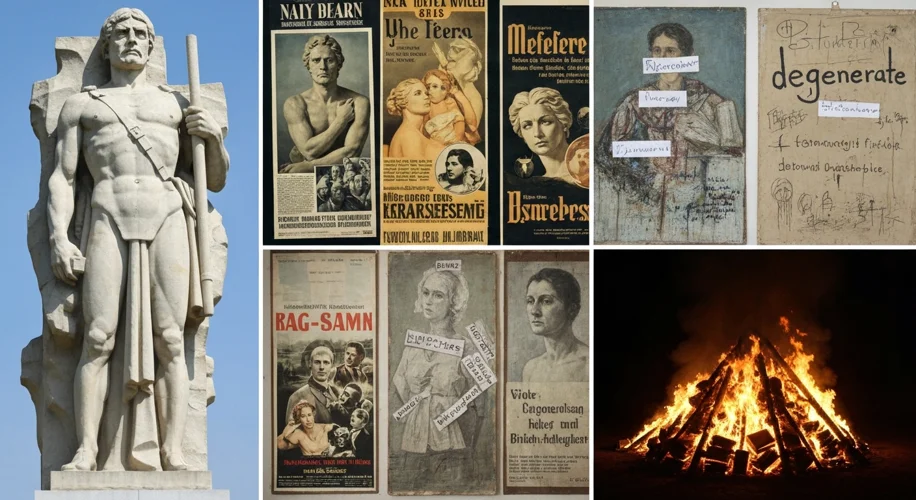
The year is 1933. The air in Germany crackles not just with political fervor, but with a chilling artistic decree. Adolf Hitler and his Nazi regime were not content with conquering land; they aimed to conquer minds, and their chosen weapon was culture itself. Art, music, literature, and theater were not mere forms of expression but powerful tools to forge a new, ideologically pure Germany, or so they believed.
Imagine a grand opera house, once a temple of diverse artistic expression. Now, under the Nazi regime, its stage is reserved for works that extolled the virtues of the Aryan race, the strength of German nationalism, and the purity of traditional values. Sculptures of muscular, idealized Aryan figures adorned public spaces, a stark contrast to the avant-garde art deemed ‘degenerate’ – art that dared to challenge norms, express individuality, or, most damningly in the Nazi lexicon, reflect Jewish influence.
This wasn’t a spontaneous artistic movement; it was a meticulously crafted policy. Joseph Goebbels, the Minister of Propaganda, was the architect of this cultural war. He understood that symbols, imagery, and sound could bypass rational thought and appeal directly to primal emotions. His ministry became the gatekeeper of German creativity, dictating what was acceptable and what was anathema.
The regime’s cultural policy was a two-pronged attack: promotion and suppression. On one hand, they championed artists who aligned with their vision. Composers like Richard Wagner, whose music was already infused with nationalist and anti-Semitic themes, were elevated to god-like status. Architects like Albert Speer were tasked with designing monumental structures that would awe and intimidate, projecting an image of eternal power. Films, too, became potent propaganda tools. Triumph of the Will (Triumph des Willens), Leni Riefenstahl’s documentary of the 1934 Nuremberg Rally, remains a chilling testament to the power of cinematic propaganda, its sweeping visuals and stirring music designed to indoctrinate and inspire.
On the other hand, the Nazis waged a brutal war against anything deemed ‘un-German.’ In 1937, they organized the infamous ‘Degenerate Art’ exhibition (Entartete Kunst) in Munich. This was not an art show in the traditional sense; it was a public humiliation. Works by artists like Picasso, Van Gogh, Matisse, and Chagall were displayed in chaotic, insulting arrangements, often defaced, with mocking captions that ridiculed their creators and their styles. The message was clear: modern art was a symptom of societal decay, a Jewish-Bolshevik conspiracy to undermine the German spirit.

Book burnings became a potent symbol of this suppression. On May 10, 1933, Nazi students, fueled by a feverish ideology, gathered in Berlin’s Opernplatz and torched thousands of books by Jewish, communist, pacifist, and liberal authors. The flames that consumed the works of Goethe, Thomas Mann, and Albert Einstein were meant to cleanse the German intellectual landscape, but they illuminated the darkness of the regime’s intentions.
The consequences of this policy were devastating. For the artists who conformed, it meant a career built on lies and coercion. For those who resisted or whose work was deemed ‘degenerate,’ it meant professional ruin, exile, or worse. Many fled Germany, taking their talents and perspectives with them. Jewish artists and intellectuals were systematically persecuted, their contributions erased from German cultural history. The vibrant, diverse cultural scene that had flourished in pre-war Germany was suffocated, replaced by a sterile, monolithic propaganda machine.
The Nazi cultural policy and propaganda serve as a stark historical lesson. They demonstrate how the control of information and the manipulation of art can be used to consolidate power, demonize enemies, and indoctrinate entire populations. The regime’s attempt to create a ‘pure’ culture ultimately led to a cultural wasteland, a testament to the fact that true art thrives on freedom, diversity, and the uninhibited expression of the human spirit, not on the chains of ideological conformity.
By weaponizing creativity, the Nazis didn’t just silence dissenting voices; they sought to rewrite reality itself, proving that the battle for the soul of a nation is often fought not on the battlefield, but on the canvas, the stage, and in the pages of a book.