
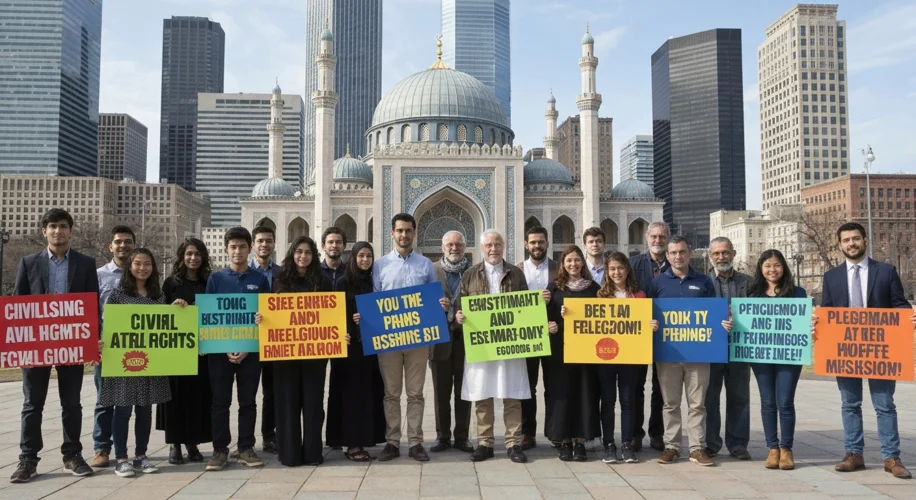
In the grand, often tumultuous, narrative of the United States, the story of civil rights is a multi-threaded epic. While the struggles of African Americans and other marginalized groups are well-documented, the journey of Muslim Americans in asserting their fundamental rights, particularly against the backdrop of shifting political climates and legal challenges, is a crucial, though less frequently told, chapter. This is a story woven with threads of faith, identity, discrimination, and the persistent, unyielding pursuit of justice.
The arrival of Muslims in America is not a recent phenomenon. Long before the current political discourse, individuals of Muslim faith, often from diverse backgrounds, began to find their way to American shores. Early Muslim immigrants, primarily from the Levant and parts of South Asia, faced challenges common to many immigrant groups: language barriers, cultural misunderstandings, and economic hardship. However, they also navigated a nascent, and often indifferent, American society that held little understanding of Islam or its adherents. Despite these hurdles, they established communities, built mosques, and began the slow process of carving out a space for themselves in the American mosaic.
The mid-20th century saw a more organized advocacy emerge. As the Muslim American population grew, so did the need for unified voices. Organizations like the Muslim Students Association (MSA) and later the Council on American-Islamic Relations (CAIR) began to form, aiming to serve as liaisons between Muslim communities and the wider American public, as well as to advocate for their rights. These groups tackled issues ranging from religious accommodation in schools and workplaces to combating nascent forms of prejudice.
However, the landscape of civil rights for Muslim Americans dramatically shifted in the wake of significant global events. The Iranian Revolution in 1979, and more acutely, the September 11, 2001 terrorist attacks, cast long shadows. Suddenly, Islam and its followers were thrust into a new, often hostile, public spotlight. The narrative began to shift from one of individual religious practice to one perceived as a monolithic threat.
This era witnessed a surge in Islamophobia, manifesting in increased surveillance, discriminatory profiling, and hate crimes. The rhetoric emanating from some political figures and media outlets often painted Muslims with a broad brush, associating an entire faith with the actions of a radical fringe. This had tangible consequences. Muslims faced increased scrutiny at airports, were often viewed with suspicion in their communities, and their places of worship became targets of vandalism and attack.
Legally, Muslim Americans found themselves at the forefront of critical civil rights battles. Cases involving religious freedom, freedom of speech, and due process became more frequent. The right to wear religious attire, such as the hijab, faced challenges in public spaces and workplaces. Accusations of religious discrimination in employment and housing became a significant concern. Furthermore, the post-9/11 era saw the rise of government surveillance programs that disproportionately targeted Muslim communities, raising profound questions about privacy and civil liberties.
The legal and political responses to these challenges were varied. While some legal avenues provided recourse and affirmed religious freedoms, others proved to be uphill battles. The narrative of