
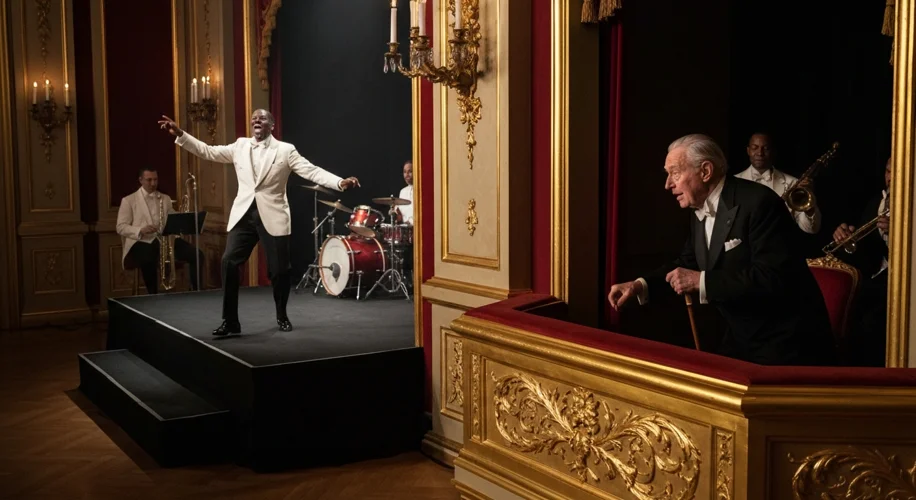
In the vibrant, swinging world of early 20th-century jazz, where music transcended social strata and borders, a captivating, though likely embellished, tale emerged. It’s the story of Cab Calloway, the charismatic bandleader whose signature tune, “Minnie the Moocher,” allegedly charmed no less than a monarch – King Gustav V of Sweden.
Imagine the scene: Stockholm, Sweden, in the 1930s. The air, perhaps crisp and cool, is suddenly electrified by the infectious rhythm and Calloway’s unmistakable scatting. Cab Calloway and his orchestra were a sensation, their performances not just concerts but theatrical events filled with energetic showmanship and a sound that was quintessentially American, yet universally appealing. “Minnie the Moocher,” released in 1931, was their magnum opus, a song that told a tale of a “pro-nasty” woman of the streets, complete with a catchy chorus and a call-and-response section that invited the audience into the performance.

The song’s narrative, a darkly humorous glimpse into a character of dubious repute, was far from royal subject matter. Yet, the story goes that during one of Calloway’s European tours, the Swedish King, Gustav V, a man known for his stoic demeanor and a keen interest in the arts, became utterly captivated by “Minnie the Moocher.” Legend has it that the King, so enthralled by the song’s rhythm and Calloway’s performance, requested an encore, and then another, much to the delight of the band and the astonishment of the court.
Some accounts even suggest that the King, in a moment of uncharacteristic exuberance, might have even attempted to join in the song’s famous “Hi-De-Ho” refrain. Whether this royal participation was a spontaneous eruption of joy or a meticulously planned diplomatic gesture, its apocryphal nature only adds to the mystique. The image of a dignified Swedish monarch tapping his foot, or perhaps even singing along, to the wild energy of Calloway’s jazz is a powerful testament to the music’s universal appeal.
This tale, regardless of its strict historical accuracy, highlights several crucial points about the era. Firstly, it underscores the immense cultural power and reach of jazz music. In a time when Europe was grappling with political upheaval and economic depression, American jazz offered an escape, a vibrant expression of freedom and innovation. Artists like Cab Calloway were cultural ambassadors, their music breaking down barriers and fostering a sense of global connection.
Secondly, it speaks to the unexpected intersections between art and power. Royalty, often perceived as being detached from the common pulse of society, could be moved and inspired by the same art that resonated with the masses. The story suggests that even figures of immense political standing could be swayed by the sheer charisma and artistry of a performer like Calloway.
Cab Calloway, often called the ‘King of Hi-De-Ho,’ was more than just a musician; he was an entertainer, a showman who understood the theatricality of performance. His music, with its call-and-response sections, his energetic stage presence, and his distinctive vocalizations, created an immersive experience for his audience. “Minnie the Moocher” became an anthem, its simple, repetitive structure allowing for improvisation and audience participation, making it a truly dynamic piece of music.
The story of the Swedish King and “Minnie the Moocher,” while possibly a fanciful embellishment, serves as a delightful anecdote. It reminds us that history is not just about grand political maneuvers and battles, but also about the moments of cultural exchange and human connection that transcend time and station. It’s a reminder that a catchy tune, delivered with passion and flair, can indeed reach the ears, and perhaps even the hearts, of kings.