
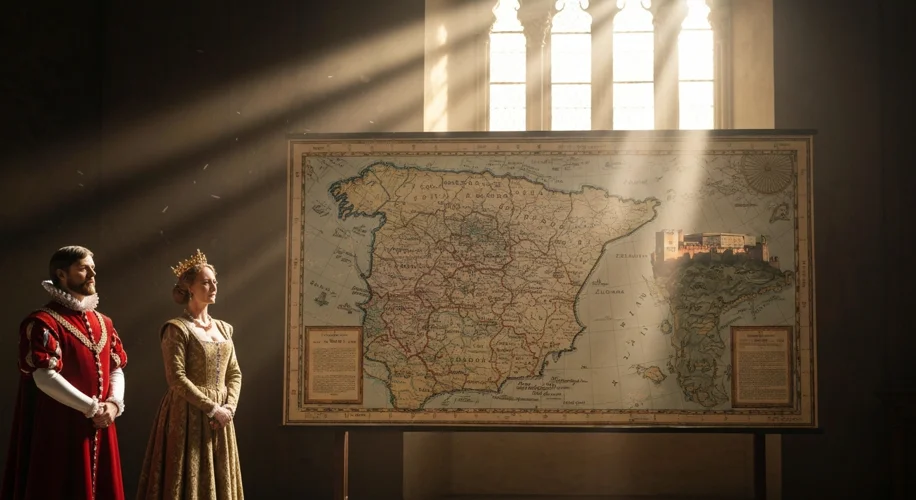
In the twilight of the 15th century, a seismic shift was underway in the Iberian Peninsula. Two kingdoms, Castile and Aragon, long rivals and distinct entities, were poised to merge under the unwavering gaze of their respective monarchs: Isabella I of Castile and Ferdinand II of Aragon. Their union, cemented by marriage in 1469, was more than a dynastic alliance; it was the genesis of a unified Spain, a nation that would soon cast a long shadow across the globe.
Born into a world fragmented by petty kingdoms and the lingering presence of Islamic rule in the south, Isabella and Ferdinand were thrust into the tumultuous currents of power from a young age. Isabella, known for her piety and iron will, ascended to the throne of Castile in 1474 after a bitter succession struggle. Ferdinand, the shrewd and ambitious king of Aragon, had already proven his mettle in the complex political landscape of his kingdom. Their marriage was a strategic masterstroke, designed to combine their vast territories and formidable armies.
The air in Iberia was thick with a potent blend of religious fervor and the yearning for stability. For centuries, Christian kingdoms had been engaged in the Reconquista, a long and arduous campaign to reclaim territories from the Moors. By the time Ferdinand and Isabella took the reins, only the Kingdom of Granada, a jewel of Moorish civilization, remained under Islamic rule. It became the ultimate prize in their shared ambition.

The year 1492, etched forever in the annals of history, marked a turning point. On January 2nd, Granada fell to the Catholic Monarchs, finally bringing an end to nearly 800 years of the Reconquista. The surrender of Boabdil, the last Moorish king, at the Alhambra palace was a moment charged with profound significance – the culmination of a centuries-old dream and the dawn of a new era for Spain. This victory was not merely territorial; it was a powerful assertion of Christian dominance and a key step towards religious and political unification.
But 1492 was a year of more than just conquest. It was also the year that saw a Genoese navigator, Christopher Columbus, secure royal patronage for his audacious westward voyage. Driven by a vision of reaching the East Indies by sailing west, Columbus’s plea was met with skepticism by many, but Isabella, perhaps sensing the potential for immense glory and riches, gambled her faith and resources on his endeavor. The subsequent discovery of the Americas on October 12th would irrevocably alter the course of world history, ushering in the Age of Exploration and forever linking the names of Ferdinand and Isabella to the New World.
Their reign was not without its darker chapters. The pursuit of religious uniformity led to the establishment of the Spanish Inquisition in 1478, a feared institution designed to root out heresy and enforce Catholic orthodoxy. This period also saw the expulsion of all Jews from Spain in 1492, a tragic event that displaced a vibrant community and cast a long shadow of intolerance. While the monarchs were driven by a deep-seated faith and a desire for a unified, religiously pure nation, the consequences of these actions were devastating for those targeted.
Ferdinand and Isabella, however, were more than just conquerors and patrons. They were astute administrators who laid the groundwork for a powerful, centralized monarchy. They reformed the legal system, strengthened the royal treasury, and established a standing army. Their influence extended to foreign policy, where they skillfully navigated alliances and rivalries, shaping Spain into a major European power.
The legacy of Ferdinand and Isabella is complex and multifaceted. They were the architects of a unified Spain, a nation that would become a global empire. They were the patrons of voyages that would change the world map forever. Yet, their reign also witnessed the brutal enforcement of religious uniformity and the expulsion of entire communities. Their story is a compelling testament to the ambition, faith, and often harsh realities that forged the modern world, a tale that continues to echo through the corridors of history.