The year is 1494. The air in Tordesillas, a small town in Spain, hums with a tension thicker than the sea salt carried on the Atlantic breeze. Two of the world’s most powerful seafaring nations, Spain and Portugal, stand on the precipice of a global scramble, a race for dominion over lands glimpsed only in the wildest of sailors’ tales.
For years, these Iberian kingdoms had been locked in a fervent competition, spurred on by the insatiable European appetite for spices, gold, and new trade routes. Spain, recently invigorated by Columbus’s daring westward voyage that had ‘discovered’ the Americas, and Portugal, with its seasoned explorers like Vasco da Gama pushing eastward around Africa, found themselves on a collision course. The very ground beneath their feet, and the vast oceans stretching before them, were becoming a source of bitter dispute.
Imagine the scene: King John II of Portugal, a shrewd monarch known as ‘the Perfect Prince,’ and the young, ambitious Ferdinand and Isabella of Spain, fresh from expelling the Moors and unified by a shared vision of Catholic expansion, sending their emissaries. The stakes were astronomical. Not just wealth and prestige, but the very souls of the people inhabiting these unknown territories were on the negotiating table. The Pope, Alexander VI, initially attempted to arbitrate, issuing bulls that largely favored Spain, but Portugal, fearing it would be shut out of the race, pushed for a direct agreement.
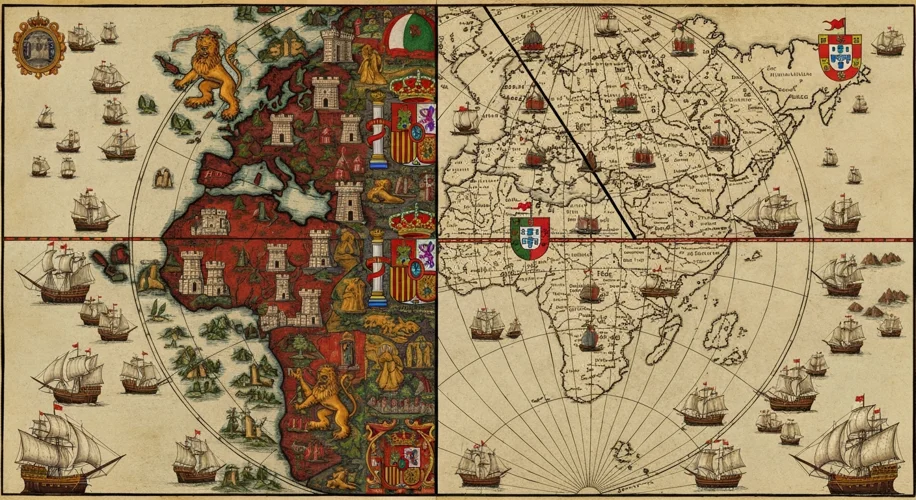
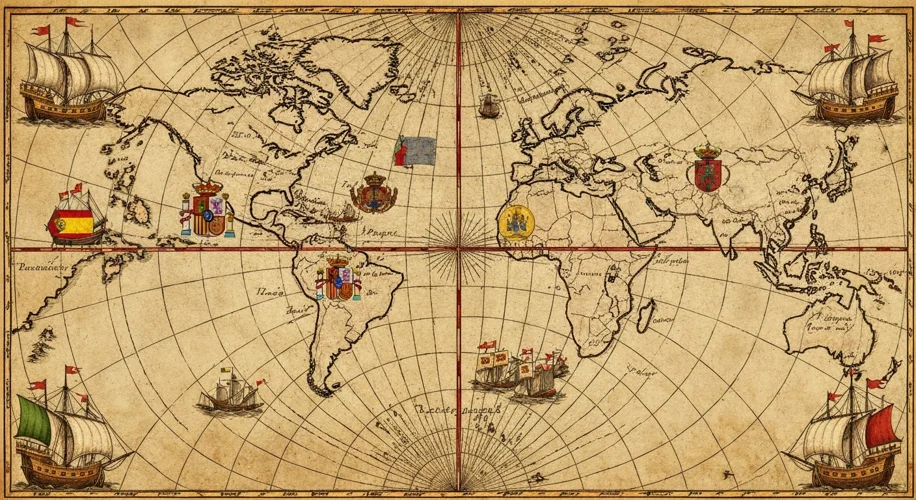
Thus, the Treaty of Tordesillas was born. Signed on June 7, 1494, it was an audacious attempt to carve up the entire non-European world between these two Iberian powers. The core of the agreement was a north-south meridian line drawn 370 leagues west of the Cape Verde Islands (off the coast of modern-day Senegal). Spain was granted dominion over all lands to the west of this line, while Portugal received rights to all lands to the east.
This was more than just a geographical division; it was a bold assertion of geopolitical power, legitimized by papal authority. Spain’s claim now encompassed the vast majority of the Americas, including the rich empires of the Aztecs and Incas that would soon be conquered by explorers like Cortés and Pizarro. Portugal, meanwhile, secured its existing routes to Africa and Asia, and crucially, its claim to the easternmost bulge of South America, which would, through sheer luck and this treaty, become Brazil. It’s a fascinating twist of fate that the treaty designed to prevent conflict inadvertently awarded Portugal its most prized possession in the New World.
The treaty, however, was far from universally accepted. Other European powers, particularly England, France, and the Netherlands, scoffed at this bilateral division of the globe. They largely ignored it, pursuing their own explorations and colonial ambitions with little regard for Iberian diktats. The treaty’s practical enforcement relied heavily on naval power and the ability to physically claim and defend territories, a challenge that only grew as more nations entered the fray.
The consequences of Tordesillas were profound and far-reaching. It shaped the linguistic and cultural map of the Americas, explaining why Portuguese is spoken in Brazil and Spanish elsewhere. It laid the groundwork for vast colonial empires, fueling the transatlantic slave trade and the exploitation of indigenous populations. For Portugal, it cemented its position as a leading maritime power for centuries, connecting its vast trading network from Brazil to Goa and beyond.
Yet, the treaty was also a testament to the limits of European imagination at the time. The world was still largely unknown, and the lines drawn in Tordesillas were based on incomplete and often inaccurate geographical knowledge. The treaty represented a particular worldview, one where European powers believed they had the divine right to claim and rule any land they encountered, regardless of the existing inhabitants. It was a stark manifestation of the Eurocentric biases that would define the Age of Discovery and its subsequent colonial legacies.
The Treaty of Tordesillas stands as a pivotal, albeit controversial, moment in global history. It was an agreement born of ambition, rivalry, and a burgeoning sense of European dominance, forever altering the course of continents and the destinies of millions. Its echoes continue to resonate, reminding us of how lines on a map, drawn in a small Spanish town centuries ago, could so profoundly shape the world we inhabit today.