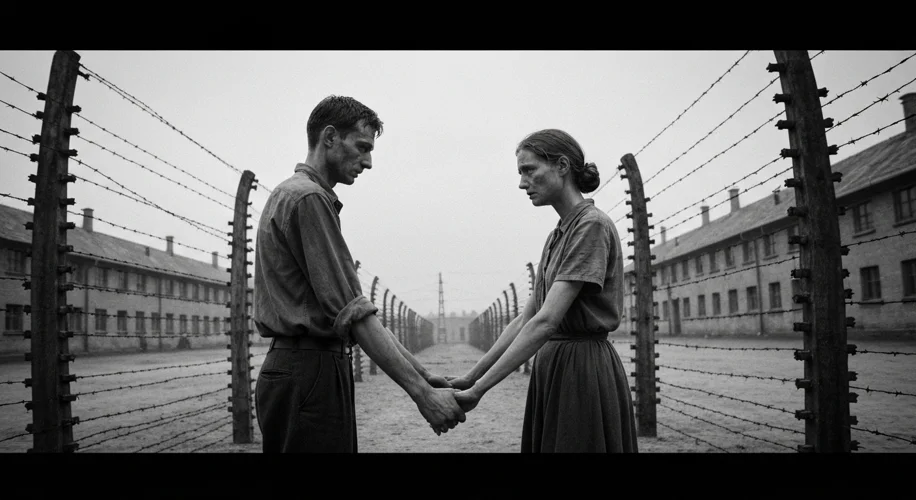
The air in Auschwitz-Birkenau hung heavy, not just with the acrid smell of burning flesh, but with the silent, suffocating despair that clung to every soul. Amidst this landscape of unimaginable horror, a different kind of resilience flickered – the unwavering bond of love between those who faced the abyss together, hand in hand.
These were not stories of grand pronouncements or heroic battles, but of quiet defiance, of shared glances that spoke volumes, of stolen moments of humanity in a place designed to strip it all away. Imagine Lena, her frail frame shivering in the meager labor camp uniform, her eyes scanning the sea of gaunt faces for a glimpse of her husband, David. They had been married for only three years when the SS arrived, their wedding rings confiscated, their dreams shattered, and their lives thrown into the inferno.
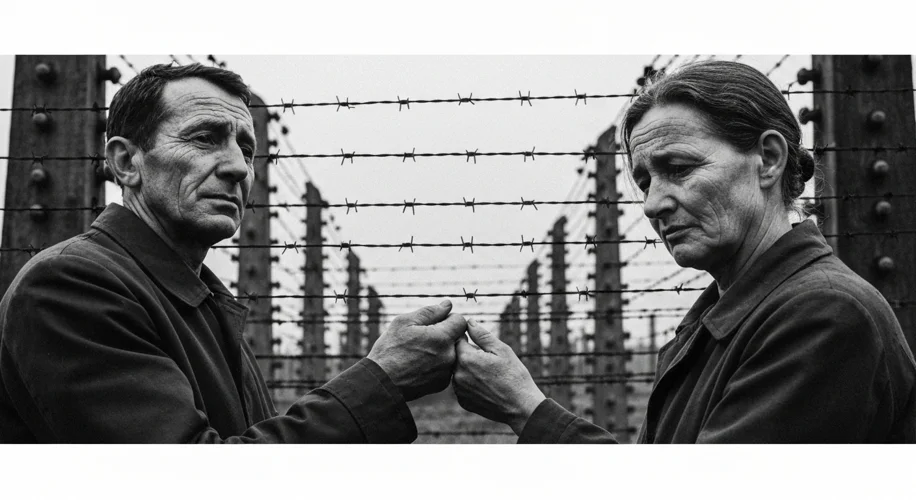
David, a carpenter by trade, used his skills to survive, a fact he attributed to Lena’s quiet encouragement. “She was my strength,” he would later recall, his voice raspy with age and memory. “When I saw her, even from a distance, I knew I had to keep going. For her.”
Their story is not unique. Countless married couples endured the camps, their relationships tested in ways that defy comprehension. They were separated, reunited, and separated again by the capricious cruelty of their captors. The shared purpose of survival often became intertwined with the instinct to protect one’s spouse, to share the last crust of bread, to offer a word of comfort in the darkest hours.
Consider the story of Esther and Samuel. Separated upon arrival at Dachau, their reunion months later was a miracle. Esther, having been forced into grueling factory work, had never given up hope. Samuel, who had been subjected to brutal medical experiments, had clung to the memory of her smile. When they found each other again, gaunt and broken, they were strangers in their own bodies, yet their eyes met, and the recognition was instantaneous. Their love, forged in the fires of shared humanity, proved more potent than the dehumanizing forces that sought to annihilate them.
But survival came at a cost. The physical and psychological scars ran deep, forever altering the landscape of their relationships. The constant fear, the hunger, the loss of children and family members – these traumas cast long shadows. For some, the return to normalcy was a daunting, often insurmountable, task. The intimacy they once shared was now complicated by the ghosts of their past.
Many survivors grappled with the question of how to rebuild a life, a family, a future, when so much had been irrevocably broken. The simple act of holding a child, once a cherished dream, could now be fraught with anxiety, a constant fear of history repeating itself. Some couples found solace in each other, their shared experience creating an unbreakable bond that transcended words. Others, however, found the chasm of trauma too wide to bridge, their love stories ending not with a tragic separation by the Nazis, but by the silent, internal erosion of their shared past.
Yet, in the face of such devastation, the survival of these relationships is a testament to the indomitable human spirit. Their stories, often whispered and rarely told, are crucial echoes from a past that must never be forgotten. They remind us that even in the deepest darkness, love can find a way to endure, to adapt, and to persevere, offering a flicker of light against the encroaching shadows of history.
These survivors, with their love and their losses, embody a profound resilience that continues to inspire. Their journeys, from the infernos of the camps to the quietude of post-war life, are a stark reminder of the human cost of hatred and the enduring power of connection. They are the living proof that even after the unimaginable, the will to love and to live can triumph.