
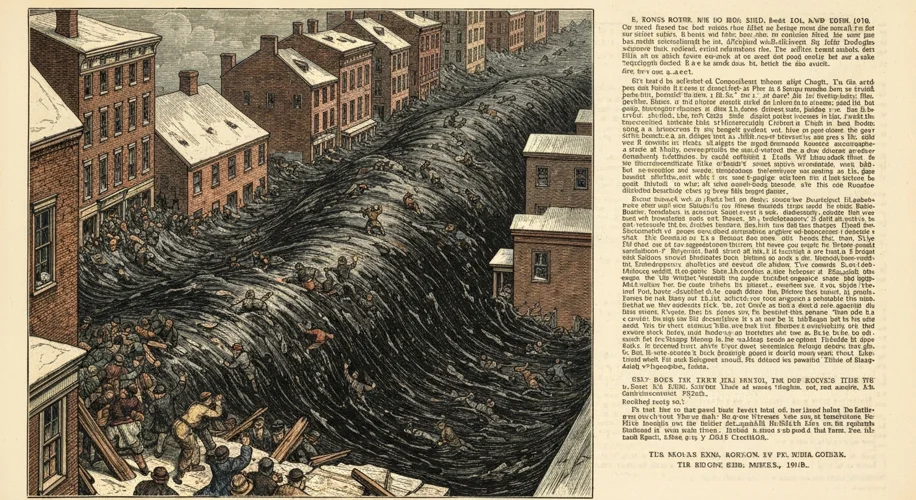
The air in Boston’s North End on January 15, 1919, was thick with the usual chill of a New England winter. But beneath the frost-laden sky, an unseen force was building, a dark, viscous tide of industrial ambition poised to erupt. It was a day that would forever be etched in the city’s memory, not for any heroic deed or political triumph, but for a bizarre and utterly devastating disaster: the Great Molasses Flood.
To understand the sheer scale of the catastrophe, one must first grasp the role of molasses in early 20th-century America. Far from being a mere sweetener, molasses was a crucial ingredient in the burgeoning industrial landscape. It was a key component in the production of rum, a highly sought-after commodity, and also found its way into industrial alcohol, used in everything from munitions manufacturing to cleaning agents. The Purity Distilling Company, a subsidiary of the United States Industrial Alcohol Company, operated a massive fermentation plant in Boston’s North End, a densely populated immigrant neighborhood.
At the heart of this operation stood a colossal steel tank, towering 50 feet high and 40 feet in diameter, capable of holding an astonishing 2.3 million gallons of molasses. This behemoth, constructed with alarming haste and questionable integrity, was a monument to industrial progress, but also a ticking time bomb. Reports from the time suggest that the tank leaked from the moment it was filled, its riveted seams weeping dark, sticky goo. Locals, including children, would often collect the dripping molasses in pails, a seemingly innocuous act that belied the structural weakness of the colossal vessel.
The day began like any other. Workers at the Purity Distilling plant were busy. The ambient temperature, while cold, was not extreme. Then, at approximately 12:30 PM, a sound like a machine gun ripped through the air, followed by a deafening roar. The immense molasses tank, unable to withstand the immense pressure of its dark cargo, ruptured. It wasn’t a slow leak or a gentle overflow; it was an explosive cataclysm.
A wave of molasses, estimated to be 15 to 25 feet high and moving at a speed of approximately 35 miles per hour, surged through the streets. Imagine a tsunami, but instead of water, it was a thick, sticky, unyielding liquid. The sheer force of the wave was terrifying. It ripped buildings from their foundations, buckled railway tracks, and swept away everything in its path. Horses were drowned, wagons were crushed, and people were engulfed. The sticky tide was so powerful that it knocked people off their feet, suffocating them as it rushed over them, trapping them in its viscous embrace.
The scene that followed was one of unimaginable horror. Rescuers, many of whom were also residents of the North End, waded through waist-deep molasses, desperately trying to pull survivors from the sticky morass. The sweetness of the molasses, normally associated with pleasant treats, became a sickening, cloying scent, a macabre perfume of death. The rescue efforts were hampered by the very substance that caused the disaster; the molasses clung to everything, making movement difficult and the extraction of victims a Herculean task. It took days for the sticky tide to recede, leaving a thick, dark residue that coated the entire neighborhood.

The aftermath of the Great Molasses Flood was a sobering lesson in the perils of unchecked industrial ambition. Investigations quickly followed, and lawsuits were filed. It became clear that the tank had been poorly constructed and inadequately tested. The speed with which it was built, likely to meet production demands, had overridden safety concerns. The company, United States Industrial Alcohol, initially tried to blame anarchists for sabotaging the tank, a desperate attempt to deflect responsibility. However, the evidence of structural failure was overwhelming.
Ultimately, the company was found liable and ordered to pay substantial damages to the victims and their families. This marked a significant moment in the history of corporate accountability in the United States. The disaster spurred a greater emphasis on building codes, industrial safety regulations, and more rigorous oversight of large-scale construction projects.
The Great Molasses Flood serves as a stark reminder that progress, if unchecked by caution and responsibility, can carry a devastating cost. It was a bizarre, tragic event, a sticky footnote in history that underscores the vital importance of safety in the relentless march of industry. Even today, on warm days, some Bostonians claim to catch the faint, sweet scent of molasses lingering in the North End air, a spectral reminder of the day the city was nearly drowned in a tide of its own making.