
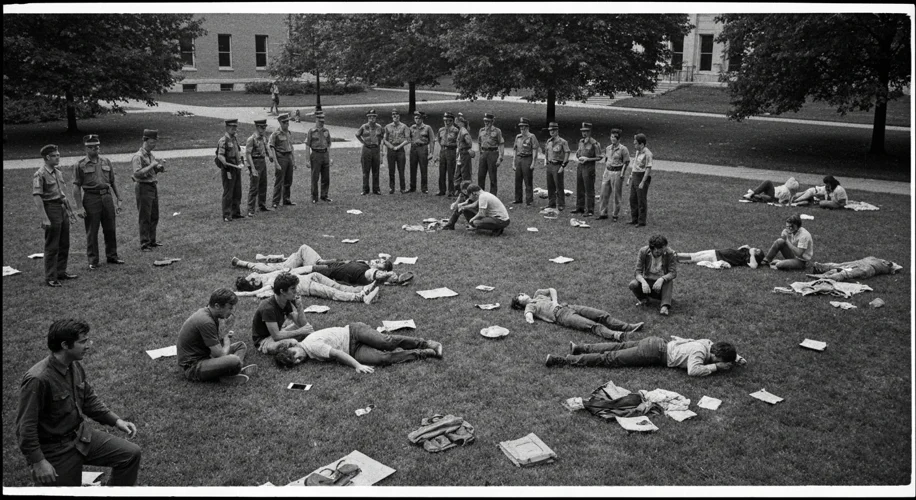
The oath is solemn, a pledge to protect and serve, to uphold the Constitution and defend the nation. For many, the National Guard represents a noble calling, a bridge between civilian life and military service, a force ready to respond to both foreign threats and domestic emergencies. Yet, history, in its unforgiving scrutiny, reveals instances where this dual role has tragically intersected, leaving indelible scars on the lives of ordinary citizens and raising profound questions about order, justice, and accountability.
The National Guard, with its roots tracing back to the colonial militias of the 17th century, has always occupied a unique space in American society. It is a citizen-soldier force, composed of individuals who live and work in their communities, drawn into federal service during times of national crisis or deployed by their state governors to handle local emergencies. This inherent connection to the civilian populace is often seen as a strength, fostering trust and understanding. However, it is precisely this proximity, this blurred line between protector and participant, that has, on occasion, led to devastating consequences.
One of the most searing examples etched into the American consciousness is the Kent State shootings of May 4, 1970. Amidst widespread protests against the Vietnam War, Ohio Governor James Rhodes called in the Ohio National Guard to quell the unrest at Kent State University. What ensued was a scene of chaos and tragedy. Under orders that remain debated to this day, Guardsmen opened fire on unarmed students, killing four and wounding nine. The victims—Allison Krause, Jeffrey Miller, Sandra Scheuer, and William Schroeder—were not soldiers, not enemies, but students caught in the crossfire of a deeply divided nation.

The Kent State incident was not an isolated event, though its stark brutality made it a national trauma. Decades earlier, during the Civil Rights Movement, the National Guard was sometimes deployed not to protect protesters but to enforce segregation. In 1957, Arkansas Governor Orval Faubus, defying federal orders to integrate Little Rock Central High School, deployed the Arkansas National Guard to block nine Black students from entering the school. President Eisenhower, in response, federalized the Arkansas National Guard and sent the 101st Airborne Division to escort the students, a stark illustration of the complex and often conflicting mandates the Guard could face.
The societal impact of such events is profound and far-reaching. At Kent State, the shootings ignited further protests and deepened the anti-war sentiment. It shattered the illusion of the Guard as an exclusively protective force and exposed the raw potential for state-sanctioned violence against its own citizens. The incident spurred countless investigations, legal battles, and a deep societal reckoning with the use of military force against civilian populations. The trauma also left lasting psychological scars on the survivors, the witnesses, and the Guardsmen themselves.
In the aftermath of Kent State, questions lingered: Who was truly responsible? Were the Guardsmen acting under unlawful orders, or were they reacting to perceived threats? The legal outcomes were complex, with a civil suit eventually resulting in a settlement for the victims’ families, though no criminal charges were ever brought against the Guardsmen involved. This ambiguity often fuels public distrust and the perception of a lack of accountability.
The challenges are multifaceted. The National Guard operates under a dual command structure, answerable to both state governors and the federal government, which can create conflicting loyalties and operational directives. The training and equipment, while robust, are designed for both domestic peacekeeping and combat, creating a constant tension in how they are deployed. Furthermore, the pressure on Guardsmen in volatile situations, often facing intense civilian anger and civil disobedience, can be immense. These individuals are often neighbors, friends, and family members to the very people they are tasked with managing.
Examining these difficult moments in history is not about demonizing the National Guard or the individuals who serve within it. Instead, it is a crucial exercise in understanding the delicate balance of power, the complexities of maintaining order, and the enduring need for robust civilian oversight and accountability when state power is deployed. The unseen scars left by these tragic encounters serve as a potent reminder that the line between protector and perpetrator is a fragile one, and that upholding justice for all citizens must remain the paramount concern, even in the most tumultuous of times.
As we reflect on these historical instances, we must continue to ask difficult questions. How can we ensure that the forces sworn to protect us do not become instruments of oppression? How can we foster greater transparency and accountability when the line between civilian and military authority is crossed? The echoes of Kent State, Little Rock, and other such events resonate through our present, urging us to learn from the past and to strive for a future where the National Guard’s service is unequivocally a force for peace and justice for every member of society.