
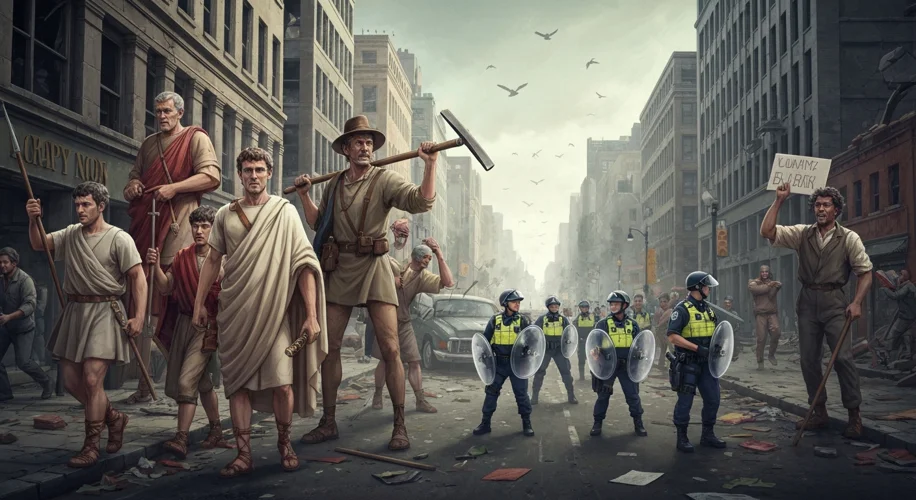
The cobblestone streets of history are not always paved with peace and quietude. Beneath the veneer of order, a recurring human drama has unfolded: the eruption of public disturbances, often fueled by aggressive individuals whose actions have tested the very fabric of society. From the hushed whispers of dissent to the thunderous roar of riots, these moments reveal much about our collective fears, our systems of control, and our evolving understanding of public safety.
Imagine, for a moment, the year is 1768. London is a city on edge. The air crackles with discontent, not just over political grievances, but over the very tangible presence of aggression in its public spaces. It wasn’t uncommon for drunken brawls to spill out of taverns, for disgruntled mobs to form around perceived injustices, or for solitary, disturbed individuals to unleash their fury on unsuspecting passersby. The city watch, a rudimentary and often overwhelmed force, struggled to maintain order. Their methods were blunt, their resources scarce, and their understanding of mental distress was, by modern standards, virtually non-existent.
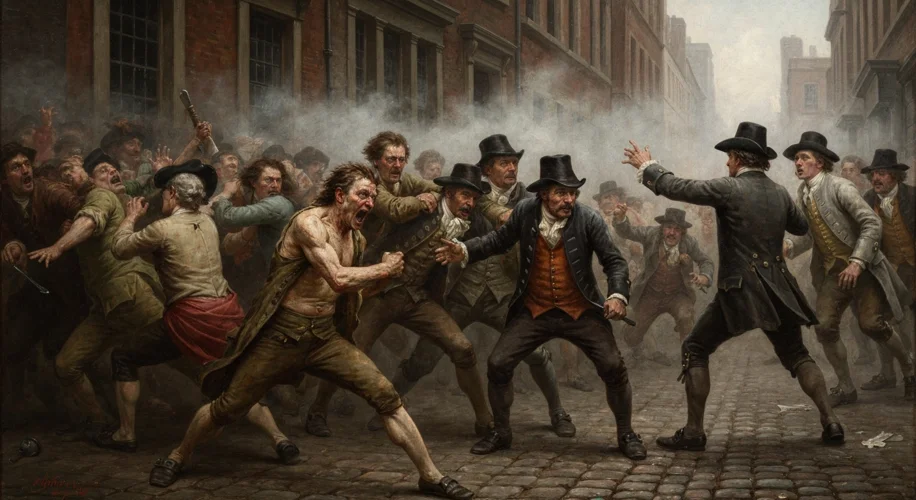
These were not isolated incidents. Throughout history, societies have grappled with what we might now term ‘belligerent behavior’ and ‘public disturbances.’ In ancient Rome, the Forum could quickly transform from a hub of civic discourse into a volatile arena, especially during times of political upheaval or economic hardship. Emperors and magistrates alike relied on legions and a rudimentary police force to quell disturbances, often with swift and brutal efficiency. The concept of ‘public order’ was less about protecting individual rights and more about preserving the stability of the state and the emperor’s authority.
Fast forward to the 19th century, a period of immense social and industrial change. As cities swelled and poverty deepened, so too did the potential for unrest. The Luddite movement, while primarily a protest against new machinery, often involved acts of vandalism and intimidation that spilled into public view. These were not just acts of economic protest; they were expressions of desperation and frustration, fueled by individuals who felt their livelihoods and way of life were under direct assault. Law enforcement, now evolving into more organized police forces, began to develop strategies for crowd control, though their responses were often reactive and sometimes heavy-handed.
Consider the infamous ‘Bread and Roses’ strike in Lawrence, Massachusetts, in 1912. While the core of the protest was about fair wages, the sheer scale of the mobilization, the passionate oratory, and the confrontations with police and company guards painted a vivid picture of collective agitation. Amidst the peaceful marches and the powerful speeches, there were moments of heightened tension, of individuals driven by deep-seated anger and a sense of injustice. The presence of agitators, or simply individuals overwhelmed by emotion, could easily tip the balance towards disruption.
Even in the 20th century, with the rise of more sophisticated policing and a burgeoning understanding of psychology, public disturbances remained a persistent challenge. The civil rights movement, while fundamentally a quest for justice and equality, saw periods of intense confrontation. While the leadership often advocated for non-violent resistance, the sheer passion and anger of participants, coupled with the often brutal responses from authorities, led to moments that could be characterized as public disturbances. These were not acts of random aggression, but rather a desperate outcry against systemic oppression.
The modern era has seen a further evolution in how we understand and respond to public disturbances. We now have a more nuanced appreciation for mental health, for the socio-economic factors that can contribute to aggression, and for the importance of de-escalation techniques. Law enforcement agencies employ specialized units, and legal frameworks have developed to address everything from petty vandalism to large-scale riots. Yet, the fundamental human element remains. The individuals who act out in public, whether driven by malice, desperation, or psychological distress, continue to pose a complex challenge.
The history of belligerent behavior and public disturbances is not merely a catalog of lawless acts. It is a mirror reflecting our societal anxieties, our attempts to create order, and our ongoing struggle to balance individual freedoms with the collective need for safety and peace. As we look back, we see not just the chaos, but the complex human stories behind it, reminding us that the quest for public order is a continuous, evolving journey.
Tags:
Public Order, Social Unrest, Aggression, History of Policing
Categories:
Social History, History of Law Enforcement, Cultural History
Image Prompt:
A stylized depiction of historical public disturbances, showing figures from different eras (e.g., a Roman citizen, a Luddite, a civil rights marcher) amidst scenes of unrest, with a subtle thread of modern policing intervention weaving through the imagery.